


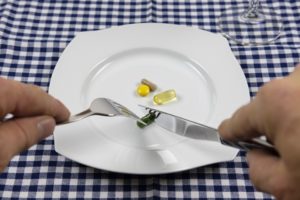
Medicines in old age: Video analysis shows application errors
14.03.2023 12:23
The older people get, the more medication they usually have to take - if possible according to the prescription and the package leaflet. Unfortunately, this doesn't always work as well as it should: tablets are cut into unequal halves with a fruit knife and drops are counted onto the spoon without reading glasses. Such application errors also affect patients who are mentally fit, live in their own home without outside help and visit their family doctor independently.
“If medication is not taken correctly, the therapy goals often cannot be achieved,” explains Dr. Janine Gronewold, scientist at the UDE Chair of Vascular Neurology. Most of the time, those affected do not notice if they are taking their medication incorrectly. There is often a large gap between their self-assessment and their actual abilities, which even the treating doctors rarely notice.
In their ABLYMED study*, scientists from the medical faculties of the University of Duisburg-Essen (UDE) and the Heinrich Heine University Düsseldorf (HHU) are investigating what these medication self-management skills are like and whether they can be used independently and can be objectively assessed by medical staff. 67 people over 70 who regularly take more than five medications took part in this study during an inpatient stay at the University Hospital Düsseldorf. They have been filmed using various medications. A novel evaluation scheme was used.
“For the assessment, up to 19 people watched the video recordings and assessed the seniors’ self-medication skills,” explains Anneke Lügering, doctoral student at the Institute of General Medicine at the HHU and first author of the recently published study. In fact, after a short training course, medical students from the clinical semesters were already able to safely use the assessment scheme and thus objectively and reliably assess their self-medication skills. “If errors in the use of medication remain undetected, this can lead to health problems,” say the authors of the study.
On the one hand, the researchers' results should encourage doctors to talk to their older patients more often about the correct use of prescribed medication and to point out possible sources of error. The topic should also be taken into account when prescribing. “Ideally, for example, a lower-dose preparation could be prescribed, which then doesn’t have to be laboriously halved at the kitchen table at home,” says Gronewold. On the other hand, the researchers would like their new evaluation scheme to support the development of patient training. “If you get a feel for potential sources of error, you can avoid them more easily,” explains Lügering. “And if the prescribed medication is carefully dosed and used correctly, this enables many seniors to grow old more safely and remain independent for longer.”
The ABLYMED study research team is currently also evaluating a survey in which patients report on their self-perceived problems with medication use. It will also be analyzed to what extent the subjective assessment corresponds to the actual skills in the video and which factors influence medication self-management skills.
*ABLYMED stands for: ability to self-administer medication in non-demented in-hospital patients