


Mergers and use of new technologies: Germany's hospitals are using rapid structural change to reposition themselves
19.07.2023 09:44
"Hospital Study 2023" shows pressure to act primarily due to market consolidation, increasing outpatient care, a shortage of staff and a backlog of investments. In order to survive in the long term, hospitals are redefining their role and setting the course for a suitable positioning in the market. Those responsible see mergers and acquisitions as well as artificial intelligence and Telemedicine has the most potential.
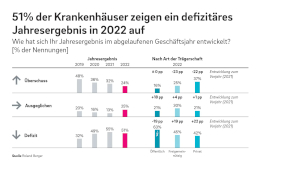
German hospitals are still under high economic pressure. As the new “Hospital Study 2023” by Roland Berger shows, more than half (51 percent) made losses in 2022, while 24 percent reported positive annual results. At the same time, the hospital landscape is undergoing profound structural change. According to the study, many hospital managers have understood that they need to reorganize their facilities to make them fit for the future. At the top of the list of possible solutions for problem areas such as a lack of personnel, financing difficulties, investment backlogs or rising prices due to inflation are topics such as mergers, the use of artificial intelligence and outpatient care.
“The transformation of the German hospital sector is inevitable,” says Peter Magunia, partner at Roland Berger. “It is no longer a question of whether and how the hospital landscape will change in the coming years, but rather a question of how the change can best be managed. Those responsible in the clinics have also recognized this. Maintaining economic stability in the short term is a basic requirement. For long-term success, managers must primarily address issues that are increasingly having an impact on hospitals. These include the trend towards outpatient healthcare services, artificial intelligence, digitalization and the shortage of skilled workers. The clinics must now set the right course for all of these challenges, because only if they position themselves accordingly can they position themselves strategically for the future in the market.
Mergers accelerate consolidation
For the 2023 hospital study, the Roland Berger experts interviewed managing directors and medical directors of the 600 largest German hospitals in May this year about their financial situation, but also about trends and their outlook. Most expect a further deterioration in their economic situation, especially in the short and medium term. Only three percent of those surveyed expect the situation in their facility to improve as a result of the hospital reform by 2024. Regardless of reforms to the framework conditions, those surveyed see a need for action due to the current structural change.
The assessments of the development of hospital numbers in Germany show how great the pressure to act is: While there were just under 1,900 hospitals in 2021, 51 percent of the participating hospital managers expect a number of at most 1,250 by 2033. 38 percent of those surveyed expect a reduction to a maximum of 1,500 houses and 11 percent expect up to 1,750 clinics in ten years. The greatest decline is expected between 2028 and 2033. The main reason for this is the shift from services that were previously provided in inpatient care to increasingly outpatient care.
Given the ongoing and accelerating consolidation in the hospital market, mergers are becoming increasingly important. “Hospital operators have recently entered into increased collaborations with other service providers in order to leverage synergies and operate more profitably,” says Janes Grotelüschen, partner at Roland Berger. “But the potential of pure collaboration appears to have been largely exhausted. Mergers and acquisitions are now increasingly important strategic options for those surveyed in order to position themselves optimally. This particularly includes activities to expand outpatient care, such as the establishment and expansion of medical care or integrated health centers.”#
Innovative technical solutions for more efficiency
Another top topic on the agenda of those responsible is artificial intelligence (AI): part of the survey for the first time, the topic landed in second place among the most important technologies of the future. The study participants expect that AI will play a decisive role in everyday hospital life in the next ten years, for example in image recognition and decision support, in analyses, but also in process optimization in the administrative area, and thus fundamentally change patient care. According to those surveyed, AI is only surpassed by telemedicine. Especially in the course of the expansion of outpatient care offerings to compensate for declining revenues from the inpatient sector, they attach great and growing importance to telemedicine offerings.
“Our study shows that hospital managers have recognized the signs of the times. Structural change is in full swing and only those who rethink their own role in the system, develop concepts at an early stage and set the right strategic course will be able to survive in the long term in an overall shrinking market,” sums up Magunia.