


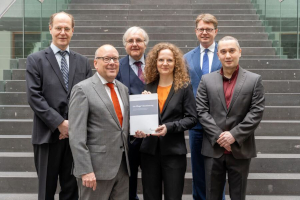
Expert council “Nursing Finances” presents a concept for intergenerational and parity in care cost insurance
17.04.2023 16:28
In the coalition agreement, the traffic light promised financial relief for those in need of care. An independent and interdisciplinary committee set up by the PKV has developed a proposal for this. The performance attracted a lot of attention.
Several hundred participants attended the presentation of the "Long-Term Care Plus Insurance" either in person or online. One reason for the enormous interest is certainly that the problems of financing long-term care are becoming increasingly apparent and have recently moved more into the public spotlight – be it through recent press reports or studies such as those conducted by the Scientific Institute of Private Health Insurance (PKV) or the Scientific Advisory Board of the Federal Ministry for Economic Affairs and Energy.
The expert council on long-term care has now addressed an area where, according to its chairman – Prof. Dr. Jürgen Wasem from the University of Duisburg-Essen – "the shoe pinches the most." He is referring to the high out-of-pocket costs for inpatient care. This facility-specific out-of-pocket contribution (EEE) now averages over €1,200 nationwide. Those requiring care currently have to pay this portion of the costs themselves. The governing coalition intends to address this issue: In its coalition agreement, it has agreed to examine how the social long-term care insurance system can be supplemented with a "fully financed, equal-share insurance" that "comprehensively covers the full cost of long-term care.".
Capital funding as an answer to the challenges of demographic change
Professor Christine Arentz of the Cologne University of Applied Sciences explained the decision in favor of a fully funded system by stating that strengthening the pay-as-you-go system would lead to "unsystematic redistribution effects between generations." This is because today's younger generation would also be paying for people who have already made provisions for their care and could financially manage the risk of needing care themselves – this applies to roughly two-thirds of all those requiring care. The expert council's proposal for a fully funded system thus avoids a redistribution of funds in favor of those who are financially better off.
Key points of the reform proposal
- Introduction of a mandatory, capital-funded supplementary insurance ("Care Plus") linked to a mandatory acceptance requirement for insurance companies (without individual health checks and without sales commissions). The calculation includes automatic adjustments for inflation protection; children are insured free of charge, and pensioners pay only half the premium.
- The insurance covers the care-related out-of-pocket expenses remaining with the person requiring care in the nursing home – except for a deductible of 10 percent.
- The contribution is calculated to be around 39 euros per month for those starting at age 20, and around 48 euros for 40-year-olds (for employees, half is paid equally by the employer).
Experts consider mandatory insurance necessary to cover the risk of long-term care.
Furthermore, Professor Dr. Thiess Büttner from the University of Erlangen-Nuremberg emphasized that the contribution in a private insurance model is fair: "The premiums paid correspond to the expected benefits." However, with only 4.3 million contracts currently in place, existing voluntary supplemental long-term care insurance policies are underutilized. This is due to an underestimation of the long-term risk of needing care, according to Büttner. He argued that policymakers share responsibility for this, as the mere existence of statutory long-term care insurance suggests adequate risk coverage. Therefore, the insurance model proposed by the expert council is mandatory for everyone.
Constantin Papaspyratos of the Federation of Insured Persons also shared the view that a comprehensive solution via voluntary supplementary insurance would be difficult, not least because the need for it is not adequately communicated. Furthermore, he argued that when taking out insurance as a 20-year-old, one has to insure against a risk that typically only materializes around 65 years later. This uncertainty often leads to people postponing taking out insurance.
Professor Dr. Christian Rolfs cited another advantage of an insurance solution: Here, the insured's savings are protected from unauthorized access. In contrast, a capital stock held under the umbrella of social security is not safe from misappropriation by politicians. There are numerous examples of this – such as the long-term care fund. With the expert proposal, however, the principle is: "Long-term care is secure."„
The private health insurance association sees an urgent need for action on sustainable long-term care reform.
Dr. Florian Reuther, Director of the Private Health Insurance Association, thanked the expert council for the comprehensive proposal and emphasized: „We must act quickly now. The announced nursing care reform by the Federal Minister of Health does not provide a solution for the long-term financing of nursing care and will even exacerbate the problem in the long run.“
The expert council's proposal, on the other hand, takes into account the political guidelines of the coalition agreement and can be implemented during this legislative period: "We will introduce the expert commission's proposal into the political processes, because it is high time to act. The discussion is now open."„