


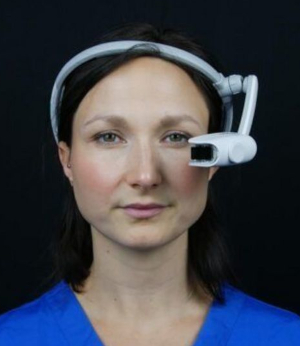
When using smartglasses in healthcare, the design of the glasses is crucial
17.08.2023 12:10
Smartglasses or intelligent glasses have been used for a long time when working in the logistics sector. Use in the healthcare system is now increasingly being discussed. Unlike logistics, healthcare professionals rely on trusting interaction with patients. Researchers at the Leibniz Institute for Work Research at TU Dortmund University (IfADo) have therefore examined how patients rate the wearing and use of smart glasses by nurses and doctors in hospitals. The study shows that eyewear design is most crucial to impression formation.
The development of smart glasses has experienced a boom with digitalization and artificial intelligence. In particular, the idea of integrating virtual and augmented realities into everyday life has gained attention. Smart glasses are also said to be helpful in the clinical area, especially in nursing, to reduce negative work results and reduce the stress of nursing staff.
However, healthcare professions differ from other professions where smartglasses are already used in that the focus is on interaction with the patient. The interaction forms the basis for a trusting relationship between the patient and the healthcare professional. It is still unclear how the presence of smart glasses may affect this interaction.
Results from over 400 participants evaluated
The IfADo study has now examined the visual effects of various smart glasses. The researchers come to the conclusion that the design of the smart glasses is crucial for interaction work. People who wear glasses with a familiar design are rated as competent and trustworthy as people without glasses. Larger glasses with larger headsets and displays have an impact on the assessment, while glasses that are designed more like reading glasses do not change perception. The participants in the study not only wanted an inconspicuous reading or sunglasses design, but also emphasized the importance of seeing facial features such as eyes or non-verbal behavior.
These results suggest that before using smart glasses, not only the user of the glasses should be taken into account, but also the context of use and the design of the glasses. For professions in which face-to-face interactions and relationships with people are the focus, such as in healthcare, it makes sense to consider the design of the smart glasses in addition to ergonomic features and functionalities. In addition, it may make sense to accompany wearing and use with explanations until a broad audience is familiar with the smart glasses.
Original publication
S. Sobieraj, S. Eimler, G. Rinkenauer: Can smart glasses change how people evaluate healthcare professionals? A mixed-method approach to using smart glasses in hospitals, International Journal of Human-Computer Studies, Volume 178, 2023, https://doi.org/10.1016/j.ijhcs.2023.103081.