


Employer study: Psychological stress at work is becoming increasingly important – absenteeism has increased significantly
23.03.2023 17:05
More and more tasks, faster processes, mobile working without being tied to time and place: the demands on employees in the digital working world are becoming increasingly complex. Added to this are the psychological burdens on people caused by fear of the future, the pandemic and the war in Europe. It is not uncommon for employees to feel exhausted and overwhelmed.
Many companies and companies are observing this trend: For the large-scale future study “#whatsnext – Working healthily in the hybrid working world”, the Techniker Krankenkasse (TK), in cooperation with the Institute for Occupational Health Consulting (IFBG) and the personnel magazine (Haufe), wanted to know what would happen From the company's point of view, the top health topics for the world of work are currently and will be in the future.
One of the most striking results: the topic of mental health is becoming significantly more relevant. 38.5 percent of the managers, health managers and HR managers surveyed stated that psychological stress in the workplace such as burnout, excessive demands and depression are already of great importance in their companies. When asked what significance burnout and the like will have in three years, around 70 percent of those surveyed say this. The study was presented today in Berlin. Karen Walkenhorst, Human Resources Director at TK: “Mental illnesses at work have overtaken physical stress in terms of urgency in many industries. This is a major challenge that employers have to face – but at the same time it is also an opportunity to firmly anchor the health of employees in work processes and corporate culture.”
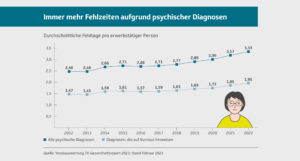
More and more sick notes due to burnout and the like.
This trend is also confirmed by the evaluations of the incapacity for work certificates of employees insured with TK. Mental illnesses have been one of the top 3 reasons for taking sick leave for years. Last year, the proportion of total sickness was around 17.5 percent, which was ahead of diseases of the musculoskeletal system (13.7 percent) and only behind diseases of the respiratory system such as flu and colds (25.3 percent). The average number of sick days per employed person due to psychological stress has also risen continuously over the last ten years. While in 2012 each TK-insured employee was on sick leave for an average of 2.46 days with a mental health diagnosis, in 2022 there were already 3.33 days absent. This corresponds to an increase of a good 35 percent.
A yoga class alone is not enough
The workplace is a major factor affecting mental health. This was already shown by the TK stress study “Switch off, Germany!” 2021. There, 47 percent of those surveyed said that work, study or school was the main trigger for stress. According to the current #whatsnext study, the biggest challenges in the workplace include the quantity and complexity of tasks, the quantity of information to be processed, constant change as well as distractions and interruptions. Around 40 percent of companies already offer their employees offers to reduce stress and strengthen resources and around 37 percent have already implemented workshops on the topic of mindfulness and resilience. But that's just combating symptoms, says TK human resources director Walkenhorst. In order to maintain employees' performance in the long term, their mental resilience must be permanently strengthened. “A yoga course alone is not enough. Both healthy work processes and an appreciative and respectful corporate culture are important factors in ensuring that employees remain physically and mentally healthy in the long term,” says Walkenhorst. Holistic company health management (BGM) can provide important support in this regard.
Managers as role models
As the first #whatsnext study showed in 2017, managers are the most important adjuster when it comes to (mental) health in the workplace. Currently, more than six out of ten respondents (63 percent) state that managers play a great or very great importance in WHM, and the trend is rising significantly. “Leaders not only have responsibility for a team, they also act as role models. A manager who is constantly available and processes chat requests and emails late in the evening does not promote the health of his or her employees,” says study leader Dr. Mark Hübers from IFBG. “Healthy leadership in the agile working world means empowerment, i.e. strengthening employees’ personal responsibility on a professional but also personal level and setting a positive role model.”
Lead with mindfulness
This is where the so-called “Mindful Leadership” comes into play. This relatively new form of leadership is based on the principle of mindfulness. The aim is for managers to actively question their thinking, feeling and behavior patterns and thus come to conscious action instead of just reacting. Around 35 percent of those surveyed already attach great or great importance to this type of leadership. For the year 2025, around 77 percent say this, more than twice as many of those surveyed. “A manager who can deal with his own resources in a reflective manner can also make employees more aware of how they work,” says Hübers.
Home office challenge
One of the biggest challenges for bosses is healthy leadership from a distance. How do I keep in touch with employees in the home office? How can a positive team and corporate culture be established and maintained even at a distance? At the shipping company OTTO, a mix of presence and home office is part of the working culture. WHM expert Cora Münz from OTTO: “We have found that face-to-face interpersonal contacts, informal exchanges or joint sporting activities are important for a healthy and successful working life and a positive corporate culture. For us at BGM this means: We plan health offers in two ways and continue to think about virtual workshops or consultation offers. This also applies to our psychosocial advice, which employees can take advantage of at any time.”