


Doctors’ Barometer: Intact environment crucial for health
29.07.2025 13:45
The climate crisis is one of the greatest public health crises of our time [1] – it is leading to an increase in diseases, including respiratory diseases, cancer, cardiovascular diseases, and infectious diseases. At the same time, the healthcare sector is responsible for approximately five percent of greenhouse gas (GHG) emissions worldwide [2]. A recent survey of practicing physicians in Germany confirms this finding.
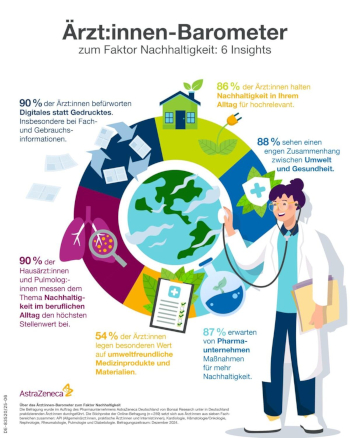
According to the survey, 88 percent of physicians see a direct connection between the environment and their patients' health. As a result, innovative and sustainable treatment options are becoming increasingly important: 54 percent of physicians already consider sustainability criteria in their treatment decisions. "The fact that sustainability is already a decision-making criterion for many physicians in treatments surprised me and is very positive," says Prof. Dr. Claudia Traidl-Hoffmann, Director of Environmental Medicine at the University Hospital in Augsburg at the Helmholtz Zentrum München. However, from Traidl-Hoffmann's perspective, the figures underscore the trend: "Sustainability is becoming a core component of responsible medicine. Not just ecologically, but also socially and economically. That's why the medical profession also expects the pharmaceutical industry to make sustainability possible in medication."
Reduce the CO₂ footprint through appropriate, adequate therapies
87 percent of the physicians surveyed expect pharmaceutical companies to actively contribute to sustainability in healthcare through measures such as CO₂ reduction, resource-efficient production processes, or sustainable supply chains. Pulmonologists, in particular, emphasize the importance of environmentally friendly product design. 60 percent of respondents consider the decarbonization of pharmaceutical companies and their supply chains to be particularly urgent. "We are aware of our role. For example, it is crucial for patients with chronic respiratory diseases to develop sustainable treatment options, as many of the more than 14 million affected patients in Germany rely on inhalers. By using an innovative propellant with up to 99.9 percent lower global warming potential, we are significantly improving the carbon footprint of these therapies," explains Dr. Michael Seewald, Vice President Medical & Regulatory at AstraZeneca Germany. "But above all, by avoiding exacerbations and hospital stays, we are reducing the CO₂ footprint."
Sustainability is only possible holistically
Doctors themselves also see themselves as having a responsibility: Over 90 percent are willing to forgo printed materials – provided digital alternatives are available. Around two-thirds prefer digital formats, especially for specialist information. They are even more reluctant when it comes to user manuals and patient information. "Sustainability can only be achieved holistically: environmentally friendly products, climate-friendly therapies, and effective disease control make healthcare greener overall. That's why, with our Zero Carbon ambition, we are working to halve the entire CO₂ footprint along the value chain by 2030," says Dr. Michael Seewald.
Joint efforts of practice, research – and industry
Doctors also believe in the pharmaceutical industry's contribution: 71 percent of respondents believe that pharmaceutical companies play a crucial role in making healthcare more sustainable, including through digital solutions. "I see a future in which we evaluate therapies not only based on efficacy and safety, but also on their lasting impact on people and the environment. This requires new structures, clear labeling, and joint efforts by practice, research, and industry," adds Prof. Dr. Claudia Traidl-Hoffmann.
About the Doctors Barometer: Sustainability Factor
The survey was conducted by Bonsai Research among physicians practicing in Germany on behalf of the pharmaceutical company AstraZeneca Germany. The online survey sample (n = 259) consists of physicians from seven specialties: API (general practitioners, general practitioners, and internists), cardiology, hematology/oncology, nephrology, rheumatology, pulmonology, and diabetology. Survey period: December 2024.
About AstraZeneca
AstraZeneca GmbH is the German subsidiary of the British-Swedish pharmaceutical company AstraZeneca PLC. AstraZeneca (LSE/STO/Nasdaq: AZN) is a global, science-driven biopharmaceutical company focused on the discovery, development, and commercialization of prescription medicines in the areas of oncology, rare diseases, and biopharmaceuticals, including cardiovascular, renal and metabolic, respiratory, and immunology. Headquartered in Cambridge, UK, AstraZeneca operates in over 125 countries. The company's innovative medicines are used by millions of patients worldwide. Further information is available at astrazeneca.de.
Sources
1 WHO News release March 15, 2016
2 The 2022 report of the Lancet Countdown on health and climate change: health at the mercy of fossil fuels