


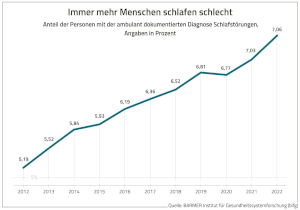
Barmer analysis – sleep disorders continue to increase
25.10.2023 18:07
The number of people in Germany with sleep disorders has been increasing for years. This emerges from a current analysis by Barmer, according to which the number of its insured people with a corresponding diagnosis grew from five to around seven percent between 2012 and 2022. This corresponds to around six million cases in 2022, an increase rate of 36 percent.
“Sleep disorders increase the risk of obesity, stroke, dementia and cardiovascular disease. Problems falling asleep or staying asleep can be triggered by professional and private stress or, in women, menopause. But sleep disorders can also be the first signs of depression. “Persistent insomnia should definitely be checked out at the doctor’s office,” says Dr. Ursula Marschall, senior physician at Barmer.
Increases in sleep disorders in all age groups from 20 years onwards
The analysis shows that in all age groups examined from the age of 20 onwards, significant increases in the diagnosis of sleep disorders were observed. In 2012, for example, doctors diagnosed around two percent of young adults between the ages of 20 and 29 with a sleep disorder. In 2022 it was already almost three percent. That corresponds to an increase of almost 50 percent in this group. There was an increase of almost 40 percent from 4.5 percent to 6.2 percent of those affected in the group of 40 to 49 year olds. From the age of 60 onwards, almost 13 percent of people will be affected by sleep disorders in 2022. “Sleepless nights are no trivial matter. Sleeping less than five hours per night increases the risk of chronic diseases and impairs performance,” says Marschall.
Time change as an additional burden
The time change next weekend could be another factor that has, at least temporarily, a negative impact on sleep. Setting the clock back by an hour further disrupts an already disturbed sleep rhythm.