


How “DEMAND” specifically strengthens dementia care
24.05.2023 18:55
The Digital Dementia Register Bavaria (digiDEM Bavaria) is introducing a new digital offer. The new online questionnaire “digiDEM Bayern DEMAND®” helps people with dementia and their carers to identify their own care needs. At the same time, the questionnaire provides a compact overview of a wide range of support offers that provide precisely tailored information.
The scientists at the Friedrich-Alexander University Erlangen-Nuremberg (FAU) developed the research instrument as part of the development of a digital dementia register and are now making the online questionnaire publicly available. The aim of the dementia register is to enable effective, regional care planning in Bavaria using scientifically proven data.
Dementia is considered one of the main triggers for the need for care in older adults, who are usually cared for at home by relatives. As dementia progresses, the need for care also increases. Caring relatives are then often faced with a major challenge: How can the increasing need for care be met? For example, do you need a household helper who cleans, washes or cooks, or someone who can help with daily dressing and undressing and dental care, among other things? Should short-term care in an inpatient facility be considered for the affected person? Or is it recommended that family caregivers attend a special nursing course?
“Different support services can help with many questions about caring for people with dementia. But not every carer knows what services are available and what help is needed in what situation,” explains Nikolas Dietzel, research assistant at digiDEM Bavaria. He is the first author of the scientific publication on the “digiDEM Bayern DEMAND®” questionnaire and is primarily responsible for its development.
Recognize your own needs within 15 minutes
With the help of the developed questionnaire “Dementia Assessment of Service Needs -DEMAND®” the individual needs for special support services of people with dementia and their caring relatives can be recorded anonymously and within 15 minutes. The questionnaire refers to a total of 16 support offers, the use and needs of which are inquired about.
These include, for example, services such as primary care, the purchase of aids such as hearing aids or visual aids, psychosocial measures such as memory training, advice (e.g. regarding the use of social benefits) and housing options such as dementia shared apartments or assisted living. “External support services effectively reduce the burden on carers and enable people with dementia to stay in their familiar home environment for as long as possible,” says Prof. Dr. Peter Kolominsky-Rabas, co-author of the publication and project manager of digiDEM Bayern.
Special feature: a range of tailor-made support services
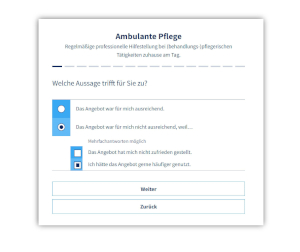
The “digiDEM Bayern DEMAND®” questionnaire has a special feature. As a result of the online survey, the questionnaire reveals a range of different support services. “We ask which services are individually and specifically used and which are needed,” explains Nikolas Dietzel. “In this way, participants receive tailored tips with detailed explanations of individual support offers as well as further information.”
In addition, unlike other instruments, the scientific assessment instrument also records the reasons for not using a service. Anyone who clicks through the questionnaire provides information about whether they need a particular service, whether it is available in their region and whether the support offer is even known.
The “digiDEM Bayern DEMAND®” questionnaire offers users another special advantage: the individual results can be downloaded and printed out as a clearly structured PDF document. With the document, relatives can then, for example, visit a “dementia and care center” in their district, a local “specialist center for family caregivers” or other counseling facilities close to their home and discuss the results with the experts there. As additional guidance, at the end of the online questionnaire there is a link to various contact points for support in everyday life as well as information on financing support offers.
Identify supply gaps
The “digiDEM Bayern DEMAND®” questionnaire was developed as part of the digiDEM Bavaria project. digiDEM Bayern is building a digital dementia register for Bavaria in order to, among other things, better understand the long-term course of the disease.
“We receive basic data that decision-makers in the healthcare system can use for effective, targeted and regional care planning. At the same time, we uncover gaps in supply,” says Prof. Dr. Peter Kolominsky-Rabas. “The research results are therefore of great importance for people with dementia and their caring relatives.”
Interview those affected in advance
The digital DEMAND questionnaire that has now been presented also has advantages for those affected. In advance of the publication, Nikolas Dietzel and his team interviewed 183 participants in detail, including dementia carers, dementia consultants, scientists and people with dementia as well as carers. Among other things, they assessed the general comprehensibility of the questionnaire, its readability and assessed the importance of different support offers.