


Fewer patients with a post-Covid diagnosis
12.07.2023 15:34
Number of patients with post-Covid diagnosis continues to decline. Almost 335,000 sick people received statutory health care in the fourth quarter of 2022. “Despite a decline in the number of treatments, post-Covid remains a serious disease with complex care requirements”
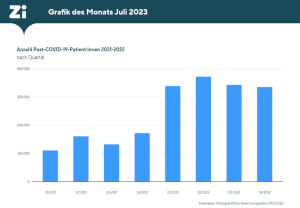
For the second time in a row, the number of patients treated per quarter with a post-Covid diagnosis has decreased. In the fourth quarter of 2022, 334,897 people with post-Covid-19 syndrome were receiving statutory health care. That is around 8,000 patients fewer than in the third quarter of 2022 (342,478) and almost 37,000 fewer than in the second quarter of 2022 (371,705), in which the peak value was documented according to the statutory health insurance billing data. At the beginning of the documented treatment diagnosis in the first quarter of 2021, the proportion of post-Covid-19 sufferers in the legally insured population in Germany was 0.15 percent (15 per 10,000 legally insured people). This value then rose almost continuously to 0.5 percent (50 per 10,000 GKV insured people) in the second quarter of 2022. Since then, the frequency of the disease has fallen again; the prevalence rate in the fourth quarter of 2022 is 0.45 percent (45 per 10,000 GKV insured people).
These are the central results of a current evaluation of the statutory health insurance billing data for the period January 2021 to December 2022, which the Central Institute for Statutory Health Insurance (Zi) published today. Since January 1, 2021, post-Covid-19 patients can use the ICD code U09.9! (Post-Covid-19 condition, unspecified) can be identified in the statutory medical billing data. According to the World Health Organization (WHO) case definition, post-Covid syndrome refers to symptoms that exist more than 12 weeks after the onset of the SARS-CoV-2 infection and cannot be explained otherwise.
Sharp increase in the number of infections with the change of the virus variant from Delta to Omicron
“The sharp increase in the number of infections observed from the fourth quarter of 2021 with the change of the virus variant from Delta to Omicron has also led to higher post-Covid disease numbers in the following quarters. However, the proportion of patients with a post-Covid diagnosis has been systematically decreasing again since the second quarter of 2022. This is a pleasing sign. Post-Covid is a serious illness with sometimes complex care needs. However, our data shows that the vast majority of post-Covid patients do not require specific medical care over a longer period of time. Anyone who wants to achieve improvements in the care of post-Covid patients must therefore ensure that research results on risk factors and the treatment of post-Covid for specific symptom combinations are available and that these are quickly implemented in care. To do this, data from care must be available to researchers. On this basis, an intensive interdisciplinary exchange of knowledge and experience can be crucial for further improving the quality of care for those affected,” said Zi CEO Dr. Dominik von Stillfried.