


Less than half of girls in Germany are vaccinated against cancer-causing human papilloma viruses
11.01.2016 12:07
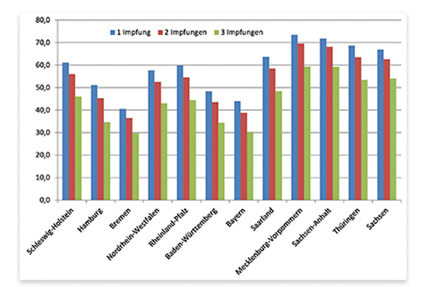
In Germany, less than half of girls are vaccinated against human papilloma viruses (HPV), which play a role in the development of cervical cancer. This is shown by a study published in the Care Atlas by the Robert Koch Institute (RKI) in cooperation with the statutory health insurance associations. What is particularly striking are the very pronounced regional differences at the state and district level.
Since May 2007, the Standing Vaccination Commission (STIKO) has recommended the HPV vaccination for girls between the ages of 12 and 17. Since there is no nationwide monitoring of HPV vaccination rates, scientists from the Robert Koch Institute, in cooperation with the associations of statutory health insurance physicians, calculated these rates from nationwide statutory health insurance billing data for the end of 2013. In the group of 12-year-old girls, less than one percent nationwide had received the three required immunizations. Of the 17-year-olds, 40 percent had received the full vaccination. The rates increase linearly across age groups.
Higher quotas in the new federal states
In a country comparison, Baden-Württemberg and Bremen are at the bottom when it comes to 12-year-olds - only 0.3 percent of girls there are fully vaccinated. The rate in this age group was highest in Saxony-Anhalt at 2.2 percent. Among 17-year-olds, the rates in Bremen are lowest at 30 percent. In Mecklenburg-Western Pomerania, however, 59 out of 100 girls are protected against HPV infection.
Bavaria is bottom at district level
In the Bavarian independent city of Kaufbeuren, the scientists were unable to identify a single girl in the data from 12-year-olds for whom the vaccination had at least begun. In 61 of the 402 nationwide districts and independent cities, none of the children had received a full vaccination. More than half of these districts are in Bavaria. In the Unstrut-Hainich district (Thuringia), the researchers recorded the highest rate of fully vaccinated 12-year-old children at 3.5 percent.
Study provides information for recommendations
“The KV vaccination surveillance provides timely information for checking and optimizing current vaccination recommendations and for targeted interventions,” the scientists write. The data from a previous study from 2014 supported the decision of the Standing Vaccination Commission to lower the recommended vaccination age to nine to 14 years. In this age segment, two instead of three vaccine doses are sufficient for complete immunization. Doctors can also use the preventive examinations (U11 and J1) to offer the HPV vaccination. “This can have a positive effect on vaccination rates,” the researchers hope.
The study
HPV vaccination rates in regional comparison: A secondary data analysis from the KV vaccination surveillance. Thorsten Rieck, Marcel Feig, Ole Wichmann. Robert Koch Institute, Department 33 – Vaccination Prevention.
For their study, the RKI team of scientists evaluated statutory health insurance billing data from 2008 to 2013 from 16 of the 17 statutory health insurance associations. The team drew a sample of 1.13 million girls, representing just under half (49%) of 12-17 year old girls in 2013. For the first time, the vaccination rates were evaluated by age group and down to the district level. The researchers calculated both the rates of started and completed immunizations.