


Suggestions for prioritizing elective procedures in inpatient settings under the conditions of the corona pandemic
10.02.2021 14:37
The current pandemic triggered a discussion early on about how to deal with the feared situation of insufficient ventilation options (or no longer) in intensive care units. In order to avoid the need for triage decisions, an attempt must first be made to make as much intensive care capacity available as possible through organizational measures. Postponing planned elective operations and other interventional measures frees up intensive care capacity and also frees up qualified personnel. It has not yet been sufficiently clarified what exactly “elective procedures” are and what criteria should be used to prioritize and the resulting postponement of operations. This working paper aims to provide a basis for discussion in this regard.
preamble
Every human life is equal; lives should not be weighed against other lives. Provided that the patient* (presumably) agrees to therapy, every therapy decision is based solely on the individual case. Only in the event of an unavoidable, critical shortage of resources must a supra-individual perspective be added.
If it is not possible to provide treatment to all patients who need treatment, it becomes essential to prioritize who receives therapy and who does not (for now).
Having to make such a decision represents an enormous emotional and ethical-moral challenge for the responsible doctors* and the entire medical team. In the event of a special care situation in which prioritization must take place, doctors should be able to rely on guidelines that are as specific as possible. These decisions should be made according to the multiple eyes principle, interprofessional support, e.g. B. through a clinical ethics committee or an ethics consultation is desirable.
It must be ensured that only medical aspects are taken into account as decision criteria, in particular the need for treatment (indication) and the prognosis. Factors such as age or gender, mental or physical disability, social status, professional position, economic aspects, level of awareness or “system relevance” must be rejected; they must not play a role in the decision.
If, after exhausting all available resources and creating additional therapy places/treatment options, it is no longer possible to achieve justice in the sense of equal treatment opportunities for everyone, it must at least be maintained at the level of strict adherence to the same allocation criteria for all patients.
Definition of “prioritization”
>> The development of socially acceptable allocation criteria and standards requires, in addition to familiarity with current problems in current medical care, clear terminology, the weighing of various ethical, legal and political options and a constant review of the current care situation. “Prioritization means the explicit determination of the priority of certain indications, patient groups or procedures over others. […] As a rule, prioritization involves determining a multi-level ranking. At the top end is what has the highest priority according to the data and public consensus and therefore appears to be absolutely indispensable. As you go down, the importance decreases; At the bottom of the list are minor or self-healing health disorders or procedures that are controversial or have no demonstrable benefit or do more harm than good, i.e. are partly unnecessary and partly inappropriate." 1
In the paper cited here by the Central Ethics Committee of the German Medical Association1, eight steps of a prioritization discussion within a limited care area are proposed:
1. Clarification of the underlying ethical, legal and political principles
2. Determination of the tasks and goals of the care area
3. Presentation and evaluation of the current care situation and its implicit/explicit priorities
4. Qualitative and quantitative characteristics of the disease burden (severity, prognosis, urgency)
5. Appropriateness of the interventions related to them (levels of evidence?)
6. Alternatives, risks and undesirable effects,
7. Direct and indirect costs, efficiency
8. Consideration of the interests, expectations and preferences of all potentially involved parties.
Definition of “elective”
An elective operation can be defined as a non-emergency procedure whose performance is indicated, but whose date can be chosen in advance without affecting the patient's health or the expected result of the procedure.2 There is currently a binding nomenclature of surgical urgency in Germany not before. The decision about the timing of the operation is based on pathophysiological relationships and clinical experience. It must be clarified how dangerous the patient's illness is, whether a worsening of the condition is to be expected and whether there are alternative treatment options. With regard to the indication and the associated time prioritization, the severity of the symptoms and the reduction in the quality of life of the affected patients should be taken into account.
Hasenberg and Shang (2006) proposed the following nomenclature for surgical urgency, which we have modified, based on the British NCEPOD classification, especially for general and visceral surgical procedures, in order to be able to distinguish between elective and non-elective operations :
• Emergency intervention: Medical conditions that are immediately life-threatening and do not allow the surgical intervention to be delayed. The time interval between indication and operation should be kept as short as possible (max. 2 hours)
• Urgent intervention: There is no acute threat to life, but there is a risk of an irreversible deterioration in the patient's condition. The procedure should therefore take place no later than 12 hours after the indication was made.
• Early elective surgery: These are surgical measures in which there is no danger to the patient's life, but surgical repair is essential and/or there is a risk of deterioration or recurrence. The surgical intervention should take place within a few days.
• Elective operations: are all interventions in which a vital threat can be ruled out. The benefit of the surgical procedure has nevertheless been proven and, when weighing up the risk and the prospect of success or benefit, is such that surgical intervention is indicated and makes sense for the individual patient. The time of operation can be freely chosen.6
A particular point of discussion is the prioritization of oncological versus non-oncological indications for surgical measures. Ultimately, most carcinomas do not constitute a medical emergency in the above-mentioned manner at the time of diagnosis. senses and are therefore classified as conditionally elective. For capacity reasons, these interventions are usually only carried out after a few weeks, even under non-pandemic conditions, without any worsening of the prognosis being expected.
Practical implementation of the temporary prioritization of operations in everyday clinical practice in the pandemic situation
Validated selection criteria for patients requiring elective/scheduled surgery in a situation in which not all patients who require surgery cannot be treated are currently only available in isolated cases.
It therefore appears necessary to set up a system of criteria that makes it possible to select patients who require elective surgery in such a way that, on the one hand, as many as possible can be helped and, on the other hand, as many as possible are spared permanent damage, lasting suffering or unnecessary pain.
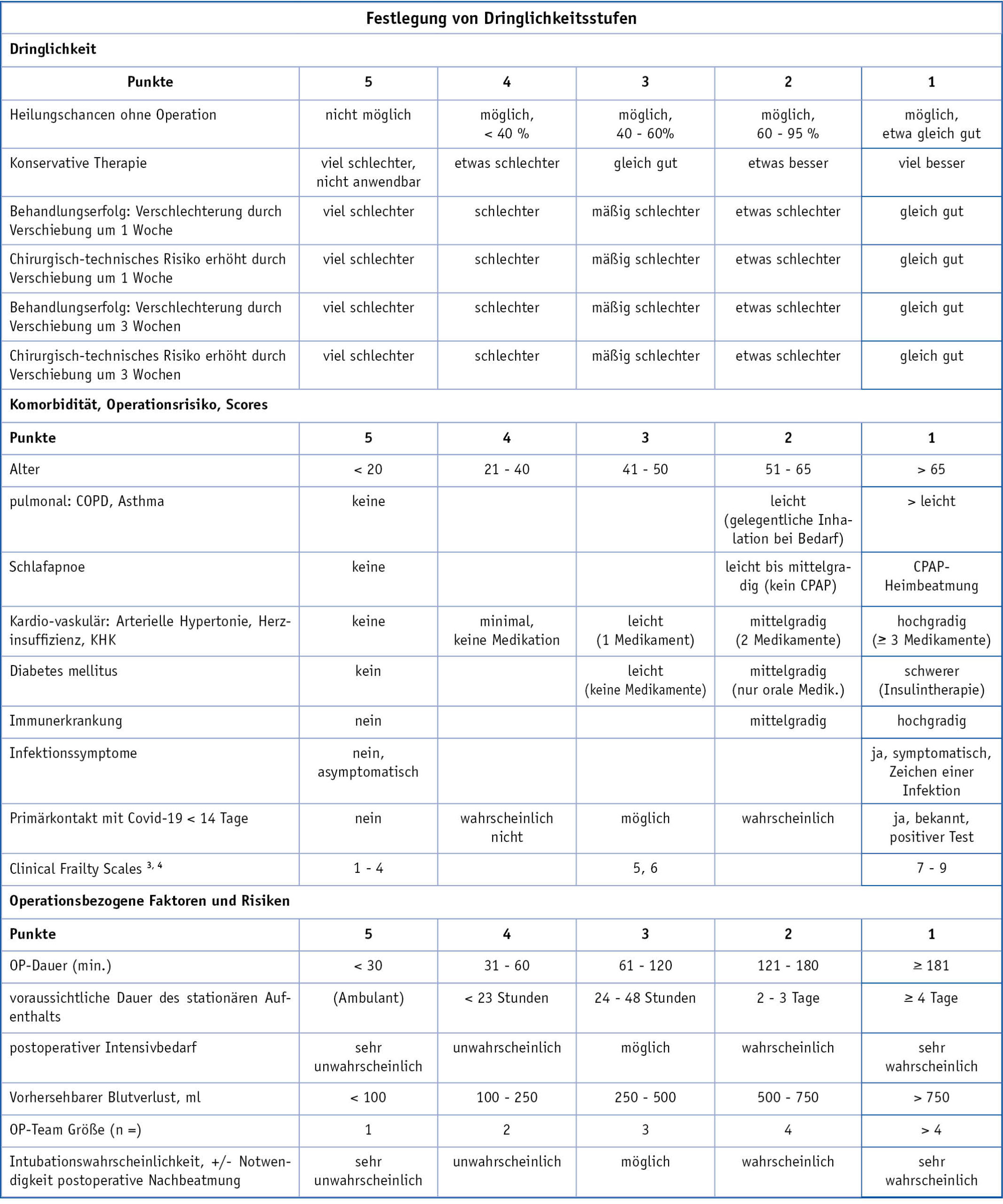
We propose, based on international publications, in particular the publications by Prachand et al. and Slidell et al. the use of Table 1. This combines a number of operation-related and patient-related factors in order to be able to find a basis for decision-making for prioritization and ranking for the individual patient. It should be expressly stated here again that it is not intended to be used as a rigid allocation scheme without a necessary interdisciplinary case-related discussion of each individual patient.5,7
Using Table 1, points can be assigned to 21 criteria based on urgency, comorbidity and change in surgical-technical difficulties. For patients who achieve the highest possible value (=105 points), it is predicted that the urgency of the operation is very high, their risk of the operation is very low and the deterioration of the surgical technical possibilities due to a postponement of the operation is very clear. Conversely, patients who achieve the lowest possible score (=21 points) have a very low urgency of the procedure, which does not become surgically and technically more difficult even if the patient waits longer, combined with a very high comorbidity and a very high probability of needing intensive care treatment postoperatively to need. In between, the situation of each individual patient is reflected in a score between 22 and 104 points with a wide variety of circumstances. This enables a transparent and comprehensible basis for decision-making in individual cases.
There should be documentation of the decision-making process.
The assignment to one of the 5 levels is not always possible and involves uncertainty. However, since the tables were created based on existing data and at least subsequently validated and the Clinical Frailty Score included here has also been well validated in clinical studies in several countries, we consider the procedure described to be practicable.
Conclusions
• Prioritization is intended to clarify which surgical procedures can be classified as “elective” and therefore temporarily postponed in order to free up intensive care capacity and qualified personnel.
• Having to make such a decision represents an enormous emotional and ethical-moral challenge for the responsible doctors and the entire medical team. In the event of a special care situation in which prioritization has to be made, doctors should be able to rely on guidelines that are as specific as possible.
• Operation-related and patient-related factors should be taken into account as a basis for the decision-making process for prioritizing each individual patient and placing them in a ranking list. Committees must be set up in the clinics to determine priorities, and the decision-making process and results should be documented.
Authors: Dr. Petra Gehle1, Prof. Dr. Matthias David2, Dr. Matthias Albrecht, Prof. Dr. Christiane Erley, Dr. Claudio Freimark, Dr. Susanne von der Heydt, Priv. Doc. Dr. Ahi Sema Issever, Prof. Dr. Jörg Oestmann, Dr. Laura Schaad, Dr. Kai Sostmann, Dr. Klaus Thierse, Prof. Dr. Jörg Weimann, Dr. Thomas Werner, Priv. Doc. Dr. Peter Bobbert
Corresponding authors:
1 Charité – University Medicine Berlin, Campus Virchow-Klinikum, Medical Clinic with S. Cardiology;
2 Charité – University Medicine Berlin, Campus Virchow Clinic, Clinic for Gynecology
literature
1. Central Commission for Upholding Ethical Principles in Medicine and its Border Areas (Central Ethics Commission). Priorities in medical care in the statutory health insurance system (GKV): Do we have to and can we decide? German Medical Journal 2000; 97, Issue 15, A1017 – A2023
2. Dox IG, Melloni BJ, Melloni JL, Melloni ML, Eisner GM. Melloni's Pocket Medical Dictionary: Illustrated. New York: Parthenon Publishing Group, 2004.
3. Abraham P, Courvoisier DS, Annweiler C, Lenoir C, Millien T, Dalmaz F, et al. Validation of the clinical frailty score (CFS) in French language. BMC Geriatrics 2019; 19(1):322.
4. Clegg A, Young J, Iliffe S, Rikkert MO, Rockwood K. Frailty in elderly people. Lancet. 2013; 381 (9868): 752-62.
5. Prachand VN, Milner R, Angelos P, Posner MC, Fung JJ, Agrawal N, et al. Medically Necessary, Time-Sensitive Procedures: Scoring System to Ethically and Efficiently Manage Resource Scarcity and Provider Risk During the COVID-19 Pandemic. J Am Coll Surg. 2020; 231 (2): 281-8
6. Hasenberg T, Shang E. How urgent is urgent? – Urgency of operations in general and visceral surgery. Perioperative Medicine 2010; 2(1): 44-48
7. Slidell MB, Kandel JJ, Prachand V, Baroody FM, Gundeti MS, Reid RR, et al. Pediatric Modification of the Medically Necessary, Time-Sensitive Scoring System for Operating Room Procedure Prioritization During the COVID-19 Pandemic. J Am Coll Surg. 2020; 231 (2): 205-15.
Citation note
Gehle et al.: “Suggestions for prioritizing elective interventions under the conditions of the corona pandemic in the inpatient area”, in: “Monitor Healthcare Research” (02/21), pp. 36-38; http://doi.org/10.24945/MVF.02.21.1866-0533.2292