


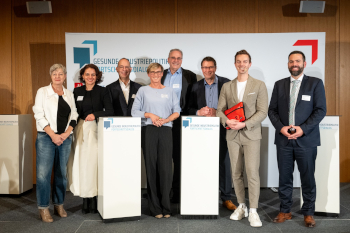
From research findings to application: The "Healthy Industrial Policy - Progress Dialogue" meeting provides strategies for successful knowledge transfer.
12.11.2025 18:29
A dialogue roundtable involving representatives from politics, research, industry, associations, and trade unions focused on collaborations and regional clusters of excellence for the successful networking of science and business. Measures for the faster transfer of innovations from the laboratory to patient care were discussed. A new position paper with concrete strategies for targeted investments and stable framework conditions was presented as a prerequisite for strengthening Germany's position as a hub for innovation.
How can scientific findings be translated into practical applications more quickly and Germany's role as a leading innovation hub be strengthened? Representatives from politics, business, science, and society discussed this question at the meeting of the "Healthy Industrial Policy – Progress Dialogue" event series in Berlin. This year's dialogue was hosted by Novartis Germany and Amgen.
The series has been held since 2023 in close cooperation with the Industrial Union for Mining, Chemicals and Energy (IGBCE) and in partnership with eight pharmaceutical companies at various locations in Germany. Until June 2025, it was under the patronage of Gabriele Katzmarek, Parliamentary Managing Director of the SPD parliamentary group, who was formally bid farewell during the event. With the transfer of patronage to Member of Parliament Matthias Mieves, the successful collaboration will now continue and be further developed.
The theme of this year's dialogue format was overcoming the translation gap – that is, the transition from research to industrial application. The focus was on developing strategies for how excellent research can be translated more quickly into therapies and healthcare.
In its coalition agreement, the German Federal Government identified the pharmaceutical industry as a key sector and set itself the goal of making Germany the world's most innovative pharmaceutical location. To this end, the pharmaceutical dialogue is to be continued, the pharmaceutical strategy further developed, and biotechnology strengthened as a key technology. The Progress Dialogue builds on these goals and brings all relevant stakeholders together to advance their implementation with concrete measures.
Representatives from successful regional innovation clusters were also invited to the most recent meeting. They network universities, non-university research institutes, university hospitals, start-ups and companies, thus promoting knowledge and technology transfer in health research.
The new patron of the Progress Dialogue, Matthias Mieves, Member of the Bundestag, member of the Health Committee and the Committee on Digitalization and State Modernization, and deputy health policy spokesperson for the SPD parliamentary group, emphasized the paramount importance of new business start-ups at the beginning of the discussion event: „The industrial healthcare sector is a crucial driver of innovation. The foundation for this is research, and this research must not remain confined to the laboratory. We need people who dare to take risks, who develop new products, find innovative solutions, and found companies. This requires courage and energy, but also a willingness to take risks. That is why I am committed to making it easier to start a business in Germany. With start-up hubs, targeted funding programs, and concrete support, we want to help young and small companies grow and succeed.“
Panel discussions addressed concrete measures to overcome the translation gap. A key approach was the exchange of best practices between different regions of Germany, in order to highlight the success factors of individual federal states and to provide impetus for similar approaches.
The plenary session unanimously agreed that academic research findings must be translated into healthcare provision in a targeted, rapid, and scalable manner. This requires clear strategies, targeted investments, and stable framework conditions. The new position paper of the Progress Dialogue, adopted at the event and available online, formulates concrete recommendations for policymakers, businesses, and researchers.
Hatice Camdere, Executive Director Value, Access & Policy at Amgen, emphasized that visions alone are not enough: „We need clear political signals for stable framework conditions. A strong research hub is characterized not only by excellence in science and development, but also by broad and rapid market access for innovative medicines. Where this access is restricted, investments are called into question. Stronger networking between public research institutions and private companies would accelerate the necessary knowledge transfer.“
„As a research-driven pharmaceutical company, translation for us means transferring scientific findings into concrete therapies – and faster than ever before,“ added Dr. Guillaume Wendt, Evidence Generation Director, Novartis Germany. „This requires research, clinical development, and industrial implementation to go hand in hand. Crucial to this are strong collaborations and partnerships with research institutions, universities, start-ups, and other stakeholders that accelerate knowledge transfer and sustainably anchor innovations. The Progress Dialogue provides the platform to further strengthen this exchange and transform excellent science into excellent care – for the benefit of patients.“
The German federal states play a special role in this context. Regional innovation clusters act as central interfaces between science and industry and make a crucial contribution to accelerating the transfer of research results into practical applications. At the meeting, successful examples from southern and western Germany were presented, demonstrating how close networking, targeted funding, and best-practice sharing can directly translate innovation into value creation.
In conclusion, Sabine Süpke, head of the Hesse-Thuringia regional branch of the IGBCE (Industrial Union of Mining, Chemicals and Energy), emphasized: „With the Progress Dialogue, we have created a long-term format that permanently connects business, politics, society, and science. Our meeting today demonstrates that closing the translation gap is a shared national task. Only if we, as an industrial location – employees, research institutions, federal states, businesses, and politicians – work together can Germany fully develop its innovative strength and competitiveness.“
About „Progress Dialogue – Healthy Industrial Policy“
The event series "Progress Dialogue – Healthy Industrial Policy" takes place at various locations in Germany as a dialogue format for representatives from politics and business on specific industry topics. The initiative is organized by the pharmaceutical and biotech companies Amgen, Bayer, Boehringer Ingelheim, Gilead, GlaxoSmithKline, Merck, Novartis, Roche, and the industrial union IGBCE, under the patronage of Matthias Mieves, Member of the Bundestag, member of the Committees on Health and Digitalization, and Deputy Spokesperson for Health Policy of the SPD parliamentary group.
More information about the opening event and all other events can be found at https://fortschrittsdialog.de/
About the IGBCE
With more than 580,000 members, the IGBCE is Germany's second-largest industrial union. It represents the interests of over 1.1 million employees in more than a dozen sectors, including chemicals/pharmaceuticals/biotechnology, energy/raw materials/mining, plastics/rubber, paper, ceramics, and glass. Michael Vassiliadis has chaired the multi-sector union since 2009. The IGBCE was formed in 1997 from the merger of the Chemical, Paper, and Ceramics Union (IG Chemie-Papier-Keramik), the Mining and Energy Union (IG Bergbau und Energie), and the Leather Workers' Union (Gewerkschaft Leder). With more than 27,000 members, the Halle-Magdeburg district, headquartered in Halle, is one of the largest in the IGBCE's Northeast region.
About Amgen
Amgen is a leading global independent biotechnology company that has been in business for over 40 years and today employs approximately 28,000 people in nearly 100 countries. In Germany, we work at two locations with around 680 employees every day to help patients. Worldwide, millions of people with serious or rare diseases benefit from our therapies each year. Our medicines are used in nephrology, cardiology, hematology, oncology, bone health, and chronic inflammatory diseases. In addition to original products, our portfolio also includes biosimilars. We have a diverse pipeline. www.amgen.de
About Novartis
Novartis is a company focused on innovative medicines. Every day, we work to reimagine medicine to improve and extend people's lives, empowering patients, healthcare professionals, and society to manage serious illnesses. Our medicines reach nearly 300 million people worldwide. In Germany, Novartis employs around 2,700 people at six locations.