


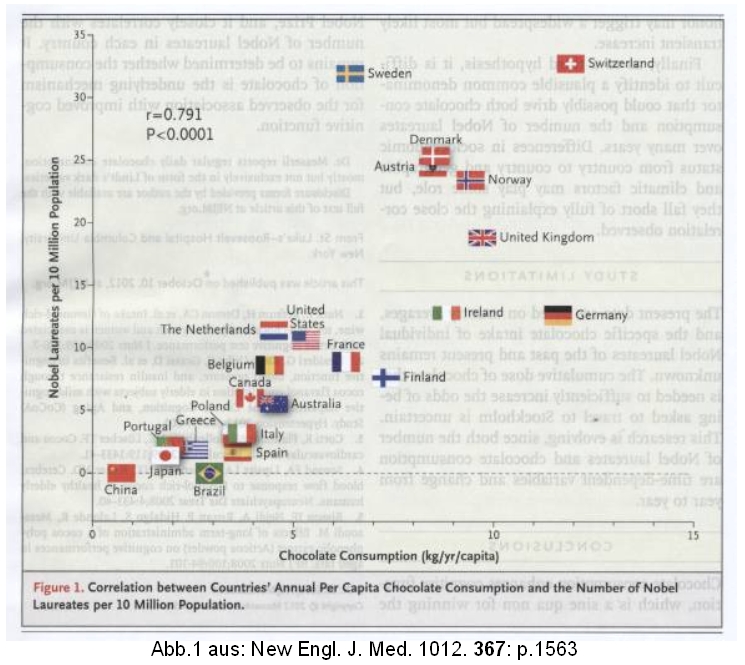
Chocolate-loving countries produce more Nobel Prize winners
19.10.2012 11:54
Yesterday in the New England Journal of Medicine online (1) under “Occasional Notes” a report by Franz Messerli from New York appeared on a significant, linear correlation between chocolate consumption per capita in a country and the number of Nobel Prize winners per 10 from that country million inhabitants (r=0.791, p<0.0001).
According to Messerli, the number of Nobel Prize winners can serve as a surrogate parameter for cognitive function in a country's population. In order to increase the number of Nobel Prize winners in a country by the number 1, an additional chocolate consumption of 0.4 kg per person per year is required. Switzerland is at the top of the list in terms of both chocolate consumption and the number of Nobel Prize winners in terms of population. The USA, France and Germany are in the middle, with China, Japan and Brazil at the bottom. Big exception: Sweden: With 6.4 kg of chocolate per capita annually, there should be 14 Nobel Prize winners, but there are 32 (see figure).
Hypothesis: Chocolate with its flavonoids increases cognitive functions, which are undoubtedly necessary for Nobel Prize-worthy achievements.
Speaker's comment:
Chocolate is apparently a jack of all trades: In two blog posts, the German Society for Endocrinology presented scientific work from this year that chocolate reduces the body mass index (2) and the risk of stroke (3). Now chocolate lovers are more likely to be awarded a Nobel Prize. Of course, Messerli was not able to examine the individual chocolate consumption of the Nobel Prize winners themselves, most of whom have already died. In the list of countries, Sweden represents an “outlier” and two explanations are discussed. The first, offered by Messerli, is genuinely “scientific”: Due to an innate peculiarity, “Swedish scientists are particularly sensitive to the brain-stimulating effects of chocolate.” The other sounds more human: The Nobel Committee that awards the prizes is based in the Swedish capital Stockholm. In the age of evidence-based medicine, the old principle must also be observed here: “Associations do not mean causality” (see: storks and birth rates). In his “disclosures” Messeli – the name sounds quite Swiss – states that he consumes chocolate every day, mostly but not exclusively dark varieties from Lindt.
(1)Franz Messerli: Occasional Note. New England Journal of Medicine online, October 10, 2012.
http://www.medscape.com/viewarticle/772411_print
(2)Klaus Doehler: Slim with chocolate. DGE blog post from March 28, 2012.
(3)Helmut Schatz: Chocolate reduces the risk of stroke. DGE blog post from September 10, 2012.