


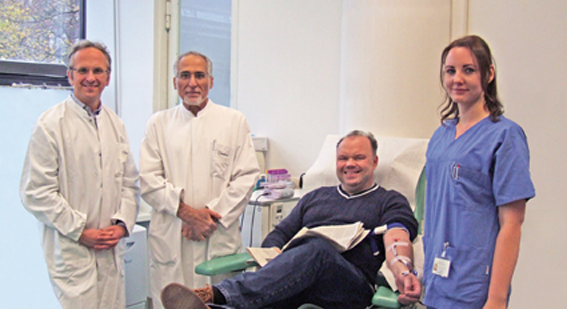
Donating blood regularly lowers blood pressure
27.01.2016 12:05
The Carstens Foundation in Essen has funded a study at the Berlin Charité with around 320,000 euros to examine whether blood donations can help combat high blood pressure, one of the most widespread diseases of modern civilization. This would mean that a classic natural healing procedure would take a new place in modern medicine, because basically a blood donation is nothing more than bloodletting. In fact, it has now been proven that regular blood donation significantly and sustainably lowers the blood pressure of hypertension patients.
About a third of adults worldwide suffer from high blood pressure. If it were possible to permanently reduce systolic blood pressure by 10 mmHg and diastolic blood pressure by 5 mmHg, the risk of death from stroke could be reduced by 40% and the risk of death from ischemic heart disease by 30%. An almost free and practically side-effect-free remedy for this could now be found and it is not a medication in the traditional sense: it is about blood donation.
Controlled observational study with 292 subjects
A research group led by Professor Abdulgabar Salama, head of the Institute for Transfusion Medicine at the Berlin Charité, and Andreas Michalsen, professor of clinical naturopathy at the Charité and chairman of the Carstens Foundation in Essen, observed a total of 292 first-time blood donors over a period of one year each. 146 of them suffered from elevated blood pressure of more than 140/90 mmHg at the start of the study, the other 146 test subjects had values in the normal range. The study participants donated 480 ml of blood to the Charité blood donation service up to four times a year, and their blood pressure and blood values were measured before and after each donation.
Therapeutic effect corresponds to number of blood donations
After the first blood donation, the hypertension patients reported a beneficial effect. The further effect built up directly with the number of donations, i.e. the more blood donations the test subjects made, the greater the reduction in blood pressure. In test subjects who donated blood four times a year, the values were reduced very significantly: the systolic value from an average of 160 ± 13 to 144 ± 15 and the diastolic value from an average of 91 ± 9 to 84 ± 9. Patients with very high blood pressure of more than 160/100 mmHg at the start of the study benefited the most. On average, their values were even reduced by 17 mmHg and 12 mmHg, respectively. There were no relevant changes in the participants with normal blood pressure, especially no blood pressure values that were too low.
High study quality
To ensure that the positive effect was actually due to the blood donations, the test subjects were asked to maintain their usual behavior and not to do more exercise or change their diet. In order to exclude these potential lifestyle effects, the parameters body weight and body mass index were taken into account in the results analysis. “The measured reduction in blood pressure actually seems to be due to the blood donations alone,” says Professor Michalsen. This conclusion is also suggested by a previously conducted randomized controlled study on phlebotomy. Here the observation period was limited to 6 weeks, but there was also a pronounced reduction in blood pressure in this study, which was ultimately greater than that caused by antihypertensive medication in drug studies.
It is only unclear how blood donation causes this effect, because the researchers' assumption that the ferritin level reduced by blood collection could be the decisive factor was not confirmed in the current study. Michalsen: “The ratio of old to young red blood cells may be crucial.”
The famous “two birds with one stone”
A blood donation is practically nothing other than bloodletting, a classic natural healing procedure. The important difference: During phlebotomy, the blood removed is disposed of, but when donating blood, the blood can then be used medically. “Our study addresses two actually independent problems of global importance: the need for low-side effect and cost-effective treatment options for hypertension and the increasing shortage of blood supplies. Patients with high blood pressure can do good for themselves and others at the same time by donating blood regularly,” explains Professor Michalsen and comes to the conclusion: “This has opened a new door for modern healthcare.”