


MLP Health Report 2022: The shortage of doctors is increasing dramatically - especially in the countryside and in the east
30.06.2022 14:52
17 billion euros - this is the amount that the financing gap for health insurance companies in Germany was estimated to be in the coming year. Despite the recently announced measures to strengthen the income base, financing is not the only problem that endangers the stability of health care: the shortage of doctors that has already started in recent years has now reached dramatic proportions - this is stated by the population and even more so by doctors. Accordingly, there are increasing complaints about long waiting times or treatments withheld for cost reasons, as well as weak points that were revealed or exacerbated by the corona pandemic. Concerns are also expressed that the experiences gained so far from the pandemic are not being used to better set up the system. Rather, both doctors and the population fear that, given the current parallel crises, the necessary reforms will not be addressed in a timely manner. The 11th MLP Health Report comes to these core results. The Allensbach Institute for Demoscopy conducted the representative population and physician survey on behalf of the financial service provider MLP.
The current healthcare system in Germany continues to be rated positively by a large majority of both the population (81 percent) and doctors (89 percent). However, from the doctors' point of view, the corona pandemic has exposed a number of political and organizational deficits: a good four out of five doctors complain that existing data cannot be brought together and used to combat the pandemic, and an almost equally large proportion complain about the technical and staffing of the health authorities is a (very) big problem. Doctors also do not expect that lessons will be learned from these obvious problems and that the health system will be better prepared for future crises (57 percent). Only one in three people assume that they will be better prepared for future health crises and pandemics in the next 10 years.
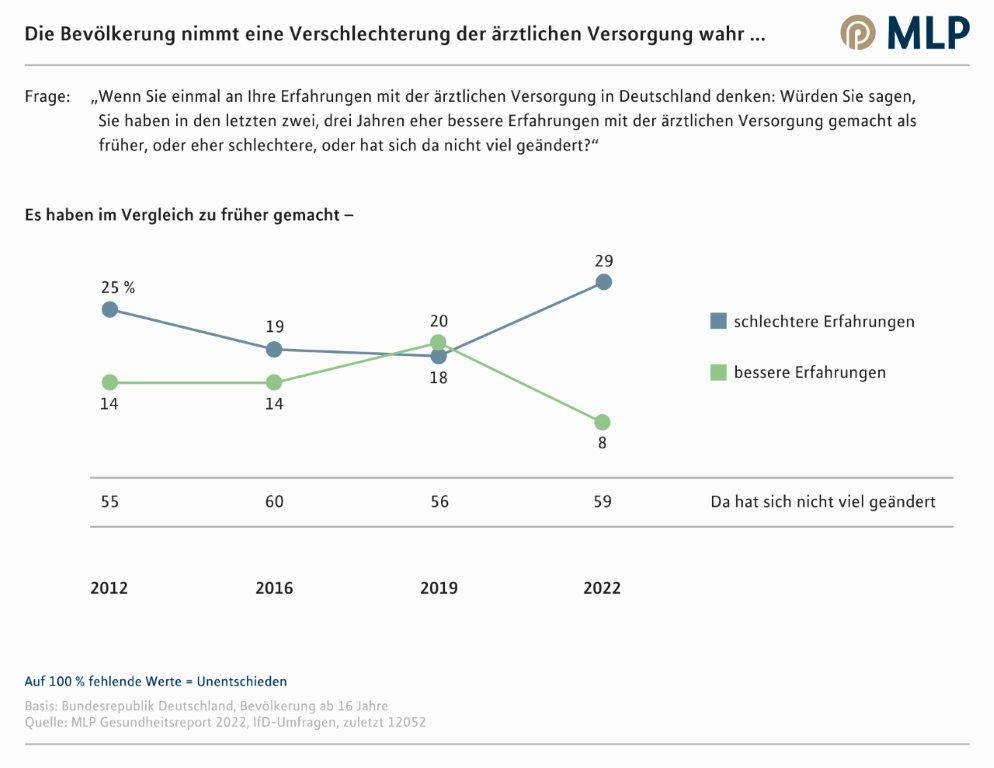
Despite the overall positive assessment of health care, the population tends to perceive a deterioration (29 percent), while only 8 percent have a more positive assessment. For 59 percent, not much has changed. Those with statutory health insurance in particular report deterioration - around one in three of this group. In contrast, those with private health insurance tended to have better experiences (11 percent) than worse ones (5 percent).
The shortage of doctors is increasing dramatically in structurally weaker regions
The population's impression that the quality of medical care is declining also comes from the fact that they are increasingly registering a shortage of doctors. Currently, a good third of people notice this in their area of residence; another 18 percent expect this to happen in the coming years. A shortage of doctors is reported much more frequently in structurally weaker regions. In the last three years alone, the proportion in cities or regions with fewer than 100,000 inhabitants has increased dramatically from 32 percent to 47 percent. Eastern Germany is also particularly hard hit: 53 percent of the population here now report a shortage of doctors (2019: 38 percent).
From the perspective of practicing doctors, the shortage of doctors is even more pronounced: the proportion of those who notice this in their own region has increased significantly from 41 percent in 2019 to currently 52 percent. At 76 percent, this proportion is above average in structurally weaker regions. Overall, 46 percent of practicing physicians have registered personal effects of the shortage of doctors, meaning they have to care for more patients. Almost three quarters of doctors in cities and regions with fewer than 100,000 inhabitants report an increasing workload as a result, with general practitioners being affected significantly more often than specialists.
The shortage of doctors is expected to worsen in the coming years. The difficulties experienced by practicing physicians in finding successors for their own practices have also increased. Currently, 68 percent of practicing physicians rate it as (very) difficult to find a successor. General practitioners are confronted with (potential) problems much more often than specialists and doctors in structurally weaker regions are much more likely than doctors in urban centers.
At the same time, the proportion of hospital doctors for whom a branch would be an option has increased again compared to before (2022: 46 percent; 2019: 37 percent). However, this would only shift the shortage of doctors, because the problem has also worsened in hospitals. Currently, 57 percent of hospital doctors say that there is a shortage of doctors in their own clinic, and a further 23 percent expect this to happen in the next few years.
Personnel shortages in the health system are not only noticeable among doctors, but also among medical specialists in doctor's practices and in the nursing sector in hospitals. More than one in five medical practices (22 percent) is understaffed; There are also problems filling vacancies (73 percent). In 2016, these problems were noticed significantly less often (59 percent). The situation in hospitals is more dramatic: four out of five doctors report that there is a lack of nursing staff in their own hospital. Here too, the situation has worsened in recent years: Currently, 89 percent of hospital doctors rate it as (very) difficult to fill vacancies (2016: 72 percent).
During the Corona pandemic, the staffing situation among nursing staff deteriorated (very) significantly due to layoffs in 32 percent of hospitals. Hospitals that provide specialized and maximum care were significantly more affected than hospitals that provide basic and standard care. Neither doctors nor hospital doctors expect the situation to improve after the end of the pandemic; on the contrary, both groups expect the situation to worsen further. As a countermeasure, from the point of view of hospital doctors, the most important thing is by far to ensure better working conditions, and nursing staff, for example. B. giving more time for each patient (79 percent). Resident doctors think it is most important to promote the nursing profession more (54 percent).
The majority of the population reports long waiting times for doctor's appointments
In their work, doctors face numerous difficulties beyond the challenges posed by the pandemic. It is still very common for doctors to report a lack of time (41 percent). On the other hand, patients complain about long waiting times for a doctor's appointment: around two thirds have had to wait a long time for an appointment with a doctor in the past one or two years, including 43 percent who had this happen several times. At 70 percent, those with statutory health insurance are particularly affected (those with private insurance: 36 percent). According to them, at least 75 percent of practicing doctors can usually make an appointment within four weeks, i.e. the period within which patients have the right to an appointment with a specialist. However, this share has decreased since 2019 (82 percent).
Finally, doctors still complain about not being able to make decisions based on purely therapeutic aspects when treating patients: Due to the cost pressure in the healthcare system, the majority of doctors see their freedom of treatment as a doctor in question. At the same time, the proportion of those in the population who have the feeling that a certain treatment or medication has been withheld from them due to cost reasons has grown - from 34 percent in 2019 to the current 38 percent. Around half of the population says that they have had to pay for treatment themselves in recent years because their health insurance company did not cover the service; This was even the case several times for 29 percent.
Widespread concerns about two-tier medicine
Despite impressive medical advances and successes in many areas - such as the rapid development of novel vaccines to combat the corona pandemic - both the population and doctors are rather pessimistic about the future: a good third of the population assumes that health care will improve in Germany will worsen somewhat or even significantly over the next 10 years. Almost two thirds of the medical profession even expect this.
Clear majorities of the population expect increasing contributions to statutory health insurance (86 percent) and that the consequences of Corona will continue to burden the health system for a long time (71 percent). In addition, the majority of the population assumes that patients will have to bear more costs themselves, e.g. B. for doctor's visits, medication or operations (57 percent) and that there will increasingly be two-tier medicine (58 percent). A similar proportion (60 percent) expects this from the medical profession. They also fear that they will no longer be able to prescribe all medically necessary services in the future (74 percent) and that health care at the current level will no longer be guaranteed for everyone (66 percent).
Doctors are critical of the entry of capital investors
A fairly new development in the healthcare sector is the entry of capital investors into e.g. B. medical care centers or larger doctor's offices. However, doctors view this trend with skepticism: 84 percent reject opening up the care structures to investors, only 10 percent support it. The main reasons for the rejection are fears that economic considerations could play too big a role in the treatment of patients (83 percent) and that care in rural areas would continue to suffer as investors focus on metropolitan areas (67 percent).
Little trust in government
Almost two thirds of doctors doubt that the government is addressing the medium and long-term challenges of the health system. In particular, there are great fears that the current parallel crises will mean that necessary reforms will not be addressed in a timely manner (doctors: 77 percent, population: 55 percent). “However, a kind of 'reform blockade' would be devastating for the long-term viability of our health system. Rather, the government must take serious precautions for the future - especially with a view to future generations. This also includes an open-ended discussion about the expenditure side, i.e. about what the state healthcare system should provide in the future and how these services can be organized and provided efficiently,” says Dr. Uwe Schroeder-Wildberg, CEO of MLP.
Overall, doctors and the public have a generally negative and rather pale impression of the federal government's health policy: 26 percent of the population have a good impression, 33 percent have a bad impression. The remaining 41 percent do not give a judgment - the highest proportion compared to previous years. This picture is even more pronounced among doctors: 28 percent who have a good impression compare to 39 percent who have a bad one. At 33 percent, a significantly larger proportion than in previous studies are undecided on this question. The government's health policy apparently lacks profile in the eyes of the medical profession.
About the MLP health report
The MLP health report is appearing for the eleventh time. For the representative survey, the Allensbach Institute for Demoscopy surveyed almost 1,100 German citizens and over 400 doctors.