


Using artificial intelligence to predict disease progression and improve patient care
28.08.2019 14:08
Artificial intelligence methods can improve healthcare in various ways. The prerequisite is suitable health data as well as expertise in the application of the models and evaluation of “big data”. Using osteoarthritis as an example, IQVIA has determined which factors are responsible for the rapid progression of the disease. The patient-relevant consequences of the results include finding the patients with the greatest medical need and making appropriately optimized treatment decisions.
Of the methods used in the context of artificial intelligence (AI), machine learning (ML) is becoming increasingly important in the healthcare sector. The core consists of learning algorithms that become more suitable as “feeding” increases1 Recognize patterns and laws in digital health data and build an ML model after an appropriate learning phase. The applications of ML are diverse and range from automated diagnostic procedures to prognosis of disease progression to therapy suggestions, whereby various characteristics such as severity or subtypes of diseases can be taken into account.
Possible advantages for patients and practitioners include a saving of time and thus earlier use of the “correct” therapy, which can lead to a slowing or prevention of an illness or even enable a chance of recovery; Corresponding findings can also be used, for example, to develop diagnostic and treatment guidelines. Doctors benefit from better support and security when making treatment decisions. Predictions as to which patient groups will benefit from a particular therapy, or what subsequent risks exist with certain constellations of characteristics, also help to improve treatments. There are lower costs for the healthcare system as a result of more targeted treatments right from the start. Pharmaceutical companies use corresponding findings, for example when conducting clinical studies, to select test centers more specifically, which is particularly relevant for increasingly smaller patient populations and individual therapies. This also saves time and costs for companies.The use of AI in the healthcare sector is currently increasing rapidly, and forecasts point to a multiplication of sales through the use of AI-based technologies in the next few years.2 This shows that the expectations of the technologies are high.
One method from the spectrum of AI-based analytics is predictive analysis, which can be used to predict the probability of future events occurring. IQVIA did this on the basis of collective data from everyday care, so-called real world data, using the example of the disease osteoarthritis, in order to gain insights into the likelihood of disease progression depending on certain constellations of characteristics. The results can, for example, help to determine the probabilities of disease progression and to better adapt therapies to a patient's individual disease progression.
Osteoarthritis is a degenerative joint disease that typically manifests itself with start-up and stress-related pain. Other characteristic symptoms include joint effusion (activated osteoarthritis), increasing deformation of the joint and joint noise due to increasing unevenness of the cartilage surface during movement. Around five million people in this country suffer from the most common joint disease worldwide and in Germany, with osteoarthritis most often localized in the knee joint; however, it can also affect other joints3.The therapy of osteoarthritis has two main goals, namely freedom from pain and endoprosthetic replacement of the joint surface.
IQVIA researchers examined how the disease progression of affected patients develops and which influencing factors play a role. In particular, the aim was to find out which patients need endoprosthetic replacement of the joint surface and what the likelihood of these patients needing it is. Furthermore, the time interval between the first diagnosis and the established need for a joint replacement was of interest in order to make a prediction about the time until surgery. This also included obtaining information about the best treatment strategy in each case, in order to determine which group of patients should receive therapy as early as possible in order to slow down the further progression of the disease, which should benefit from “watchful waiting”. (watchful waiting) benefits most, which sufferers should be examined and treated for further illnesses and which sufferers are best helped with weak or strong painkillers.
The study was based on anonymized longitudinal diagnostic and prescription information based on the retrospective database IMS® Disease Analyzer4. This includes disease histories, which form the basis for recognizing patterns. Treatment information from 2,500 general medical practices in Germany was included in the evaluation. The starting point was a pool of anonymized data from over 2 million osteoarthritis patients. After a multi-stage criteria selection, almost 48,000 patients remained with treatment information included in the analysis. After creating various patient profiles using cluster analyses, different disease progressions were calculated using machine learning tools.
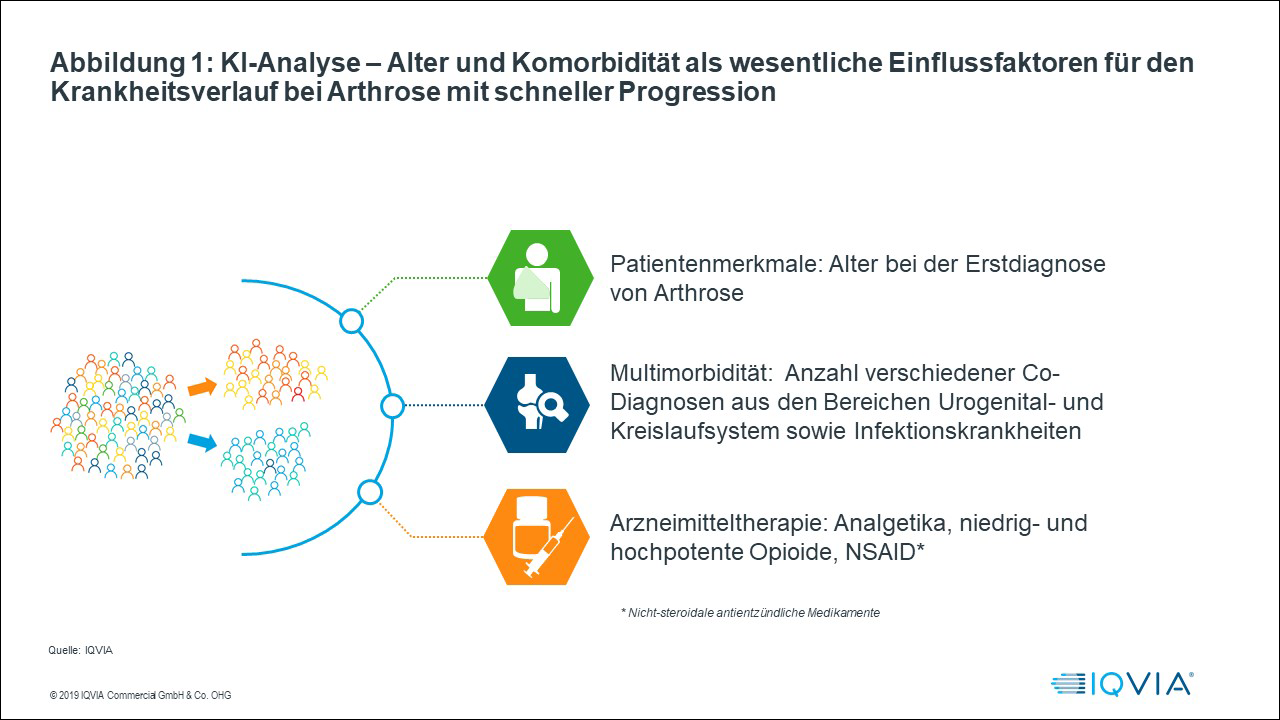
The results of the AI analysis show that the age of patients at the time of initial diagnosis and multimorbidity, including previous infections, have a major influence on the course of the disease (Figure 1). For example, older people (> 68 years of age) with more than six comorbidities need a joint replacement just three years after the first diagnosis. In younger patients with no or only a few infections, a joint replacement is only necessary after about ten years. In addition to these primary influencing factors, the extent of therapy with general painkillers as well as low- and high-potency opioids also proved to be significant.
The results allow us to find the patients with the greatest medical need and make appropriately optimized treatment decisions. They also enable clinical studies to be optimized by consciously determining the inclusion and exclusion criteria for patients.
Will AI disempower doctors in the medium to long term? No, says Dr. Matthäus Rimpler, Head of Real-World Insights & Commercial Analytics at IQVIA Germany and himself a doctor. Rather, the practitioners would be supported and relieved, provided the results are successful
AI analyzes can be easily made available in the doctor's practice software. The treating doctor will continue to make the final treatment decision. The prediction of the course of the disease only represents a small part of the spectrum of possibilities
Results: “AI analyzes can also be used, for example, to make predictions about non-adherence, which is known to be a significant component when therapies fail. Information about this can help to understand reasons for non-adherence and to take appropriate measures, to improve them. You can also find out the optimal dosage, which can also be crucial for adherence,” says Rimpler.
Artificial intelligence methods are currently not routine procedures and some legal issues, such as liability or data protection, still need to be clarified depending on the area of application. This suggests gradual rather than leap forward progress. But with the increasing The availability of adequate “big data”, new technology and analytical expertise increases the chances of significantly improving healthcare.
1 Suitability criteria include the quality and scope of the data used
2 https://bigdata-madesimple.com/artificial-intelligence-in-healthcare-worth-36-1-billion-by-2025-report/;
https://www.marketsandmarkets.com/PressReleases/artificial-intelligence-healthcare.asp
3 https://www.arthrose.de/index.php?id=89
4 IMS® Disease Analyzer is a database from IMS Health that shows anonymized therapy and treatment courses. This allows the course of the disease and therapy to be depicted over many years. IMS® Disease Analyzer is based on a representative sample of more than 2,500 practices with 3,00 practicing physicians in the Federal Republic of Germany that are equipped with IT systems.