


More is possible with the meningococcal C vaccination
12.09.2016 13:35
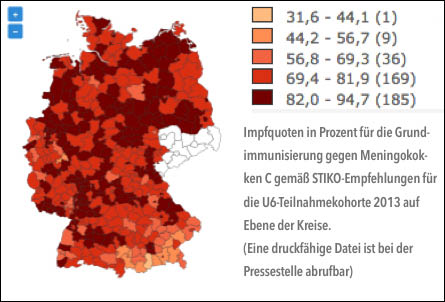
A new study by scientists from the Supply Atlas shows significant regional differences in vaccination against meningococcal C despite an 80 percent vaccination rate. Bad Tölz-Wolfratshausen in Bavaria comes last, where, according to the most recent data, only just under 32 percent of small children are vaccinated by the end of the second year of life became. The frontrunner is Dessau-Roßlau in Saxony-Anhalt with a vaccination rate of 93 percent. The study is published on the freely accessible portal www.sorgesatlas.de.
Eight years after its inclusion in the list of recommendations of the Standing Vaccination Commission (STIKO) in 2006, the scientists in the supply atlas confirm that vaccination against meningococci is generally well accepted. In the second year of life, 80.2 percent of children are vaccinated. “This is very encouraging, as an infection with meningococcal C is still fatal in almost nine percent of patients today, despite modern therapies,” explains Dr. Jörg Bätzing-Feigenbaum, head of the supply atlas. Infants and small children as well as young adults are particularly at risk.
However, the study by the researchers from the Care Atlas, which evaluated medical billing data from 2009 to 2014, shows regional differences. At the federal state level, vaccination rates for those born in 2009 fluctuated between almost 70 percent in Bavaria and 82 percent in Mecklenburg-Western Pomerania. When the 2013 vintage was examined, this gap had shrunk. In Bavaria the rate was around 75 percent, and in Mecklenburg-Western Pomerania it was ten percentage points higher. The differences between the new and old federal states are now significantly smaller. There is a tendency towards convergence here, the experts write.
Significant differences at district level
At the district level, however, vaccination rates continue to vary significantly. The vaccination rates for the 2009 cohort in the Dessau-Roßlau district (Saxony-Anhalt) were almost 95 percent, followed by Peine in Lower Saxony with almost 93 percent and Zweibrücken in Rhineland-Palatinate with 91 percent. At the other end of the quota scale, the Bavarian districts of Rosenheim were jostling with 39 percent, Miesbach with 37 percent and the bottom of the country, Bad Tölz-Wolfratshausen, with 22 percent. When the 2013 birth cohort was examined, the rates in these districts had increased - to 32 percent in Bad Tölz-Wolfratshausen, 50 percent in Rosenheim and even 55 percent in Miesbach. But with a difference of over 60 percentage points, the gap to the leaders beyond the Main line remains significant and puts the Free State at the bottom of the list at state level. Even respectable values of around or even over 90 percent in northern Bavarian districts or cities such as Wunsiedel, Schweinfurt and Erlangen can do little to change this.
Overall a positive trend
Nevertheless, the scientists emphasize that an overall positive trend can be observed: in the observation period between 2009 and 2014, the number of districts with vaccination rates below 70 percent fell from 83 to 51, while the number of districts with rates above 80 percent rose from 161 to 241 . Search for the causes. The scientists cannot determine from their data which factors are responsible for the regional differences. A variety of influencing factors probably play a role - from general health policy conditions to particular historical and regional developments to skepticism against vaccinations or their general rejection.
According to surveys, 35 percent of parents are vaccine skeptics and around one percent of parents generally do not have their children vaccinated. Even if parents have their children treated by alternative practitioners or with homeopathic medication, there is also a lower willingness to vaccinate them. In a study in Bavaria, 1.8 percent of parents generally rejected vaccinations, with a focus on southern Bavaria - where the researchers from the care atlas also found the lowest vaccination rates in this study.