


Slight decline in documented asthma frequency during the corona pandemic
27.04.2023 12:55
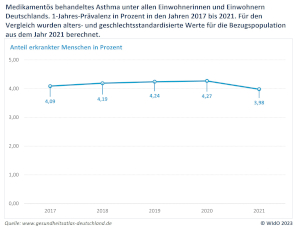
In Germany, 3.3 million people live with asthma that is treated with medication. This corresponds to a share of 3.98 percent of the population. In the run-up to World Asthma Day on May 2nd, the new WIdO website draws attention to a trend reversal in asthma frequency: Before the corona pandemic, in 2019, there were still 3.5 million asthma patients Germany.
In 2021, this number fell by around 200,000 patients – a decrease of 5.68 percent. “It is important to monitor carefully whether this declining effect may be due to the significant decline in respiratory infections during the pandemic years,” says Helmut Schröder, deputy managing director of WIdO. Asthma prevalences are particularly high in Thuringia (4.55 percent) and North Rhine-Westphalia (4.50 percent), and particularly low in Mecklenburg-Western Pomerania (3.25 percent) and Baden-Württemberg (3.52 percent). In addition to asthma will be on the new website www.gesundheitsatlas-deutschland.de The frequencies of a total of 23 diseases are systematically presented down to the level of the 400 districts in Germany and over time.
The new website presents time series for the years 2017 to 2021. There has been an increase in asthma treated with medication since 2017, reaching a maximum of 4.27 percent in 2020, followed by a trend reversal in 2021. In 2021, the proportion in the population was 3.98 percent; This corresponds to 3.3 million people in Germany who were treated with medication for asthma. In 2020, 3.6 million people were still affected, 237,000 more patients than in 2021.
Reversal of the trend in asthma is accompanied by a decline in respiratory infections
Asthma disorders can occur as a result of lower respiratory tract infections. The frequency of these infectious diseases was significantly reduced during the pandemic years of 2020 and 2021. The decline in lower respiratory tract infections during the pandemic years could have led to fewer new asthma cases. This could explain the slight decrease in prevalence in 2021. The decline is particularly noticeable among boys up to 14 years of age: While 5.25 percent of this age group were treated with medication for asthma in 2019, this proportion fell to just 2.72 percent in 2021. “It remains to be seen how further developments will develop – especially in view of the respiratory diseases that will become more common again from 2022,” says Helmut Schröder.
Significant differences according to age and gender
The current evaluation makes clear gender differences transparent: in childhood and adolescence, the frequency of asthma is significantly higher in boys than in girls, whereas in adulthood women are affected significantly more often than men. The peak prevalence is 7.16 percent of women in the 70 to 74 age group. “The greater extent to which boys are affected probably has anatomical reasons and can be explained by the narrower bronchi. This makes it easier for the airways to narrow, as occurs in bronchial asthma. In adulthood, the bronchial diameters are larger in men than in women, which explains the reversal of the gender ratio,” says Schröder. Other reasons for the gender differences could also be hormonal influences or gender-specific differences in contact with asthma-triggering substances.
Thuringia was most affected
The health atlas presents the disease frequencies for the population in 400 districts and independent cities in Germany based on a specially developed extrapolation method. According to this, Potsdam with 2.70 percent and Heidelberg with 2.77 percent are the regions with the lowest proportion of asthma patients . The frequency of the disease is approximately twice as high in the two most affected districts: the Thuringian districts of Sonneberg (6.90 percent) and Saalfeld-Rudolstadt (5.95 percent). In a “fair” comparison, the WIdO took into account the age and gender differences between the regions. In this comparison, the lowest value is recorded for Passau at 2.78 percent and the highest value for Sonneberg at 6.52 percent. “In order to prevent new cases and improve asthma symptoms, district administrators and mayors in the particularly hard-hit regions should take the various risk factors into account. These include inhaled substances that damage the lungs – especially smoking,” emphasizes Helmut Schröder. Measures to promote smoking cessation are therefore one of the most important elements of asthma prevention.
At the federal state level, Thuringia (4.55 percent), North Rhine-Westphalia (4.50 percent) and Saarland (4.36 percent) are particularly affected by asthma, according to the health atlas. In contrast, disease frequencies are particularly low in Mecklenburg-Western Pomerania (3.25 percent) and Baden-Württemberg (3.52 percent). Among large cities with more than 500,000 inhabitants, Essen has the highest proportion of asthma patients at 4.81 percent, followed by Dortmund (4.74 percent). Stuttgart is at the bottom of the list with a share of just 3.55 percent.
Association between asthma and obesity
The analyzes of the health atlas confirm a connection that is already known from other studies: in regions with a high proportion of people who are morbidly overweight (obesity), the number of asthma diseases is also increased. In the fifth of the German regions with the highest proportion of obesity, there is an asthma frequency of 4.36 percent. The fifth with the lowest obesity rate, on the other hand, has an asthma frequency of only 3.58 percent. “Various studies have shown that weight loss in severely overweight asthma patients can help improve disease control. Losing weight is also recommended for these patients in the national care guidelines so that their asthma symptoms improve,” explains Schröder.
New Health Atlas website with a systematic look at 23 diseases
The 23 diseases, the results of which are available on the new website www.gesundheitsatlas-deutschland.de, include cardiovascular diseases, mental illnesses, cancer, type 2 diabetes, dementia and respiratory diseases. The epidemiological key figures are based on routine health insurance data from the AOK and therefore represent documented treatment frequencies. All figures were extrapolated to the entire resident population in the regions using a statistical procedure. This provides local health policy actors with well-founded information about the disease situation in their region. The health atlas can thus help to identify approaches that serve to improve the health situation and thus the quality of life of citizens. The evaluations show, for example, that in 2021, depression was documented in 9.18 million residents aged ten and over (12.2 percent). 7.20 million people aged 30 and over were affected by type 2 diabetes mellitus (10.6 percent), and around 4.75 million of those aged 30 and over were affected by coronary heart disease (8.41 percent).
Heidelberg, Mainz and Freiburg perform best in the overall index
If the 400 regions of Germany are summarized in an overall index with regard to how affected they are by the 23 diseases shown in the health atlas, it becomes apparent that Heidelberg, Mainz and Freiburg im Breisgau are the least affected by these diseases. In contrast, the Thuringian districts of Suhl, Sonneberg and Hildburghausen are particularly affected. “The regional differences in disease frequencies can also be explained by demographic factors. They are caused by the different age and gender structures of the population in the regions of Germany,” said Schröder. If the differences according to age and gender are taken into account in a “fair” comparison, then the Hesse districts of Hochtaunuskreis and Main-Taunus-Kreis as well as the Bavarian Starnberg are least affected by the 23 diseases shown in the health atlas. The cities of Gelsenkirchen and Hamm in North Rhine-Westphalia, as well as Hildburghausen in Thuringia, were particularly badly affected.