


“Orient hospital reform more towards quality criteria”
02.03.2023 15:14
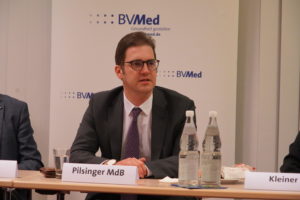
The hospital structural reform should be geared more towards quality criteria “instead of excluding specialized facilities that offer good quality due to rigid structural requirements”. If the government commission's proposals are decided 1:1, "it will be tantamount to a clear-cutting of inpatient care, especially in rural regions," said CSU member of the Bundestag Stephan Pilsinger at the health discussion group of the Federal Association of Medical Technology (BVMed).
Pilsinger is a doctor, member of the Health Committee and rapporteur for the CDU/CSU parliamentary group on hospital policy. In the discussion about hospital reform, BVMed also advocated focusing on the quality of care results at the same time as addressing structural issues. Otherwise, there is a risk that the quality of care for patients will suffer, since the focus on material costs is only on the cheapest price of the products.
Reform must come
From Pilsinger's point of view, it is undisputed that a reform must come. The pressure has increased due to rising energy prices and inflation. However, the current reform proposals were “mistaken” by the Minister of Health. Those affected such as hospitals, health insurance companies and states should actually have been involved. The CSU health politician is therefore worried “that the reform will ultimately fail due to financing”.
More flexible model for care in rural areas
According to the CSU politician, the regional states in particular have problems with the government commission's proposals. If the reform were to be implemented in this way, many wards and departments would have to be closed, especially in basic and standard care facilities. In many German districts, all that was left were “nursing homes with rudimentary emergency care”. “We need a more flexible model and other solutions for supply in rural areas. We need equal living conditions – including in the medical field,” said Pilsinger. There must be good basic care for emergencies across the board - such as heart attack care or gastroenterology. The reform with the current proposals does not ensure this.
Make the reform process more transparent and communicate better
Pilsinger would like the reform process to be made more transparent and better communicated. He also advocates further investment in digitalization and the corresponding clinic infrastructure. At the end of the reform there must be good basic care across the area, specialization and centering in highly complex procedures as well as regionally adapted opening clauses, “if a hospital has proven to provide good quality for years,” said Pilsinger at the BVMed discussion group.