


Hospital Report 2018: Centralize hospital structures
20.03.2018 13:07
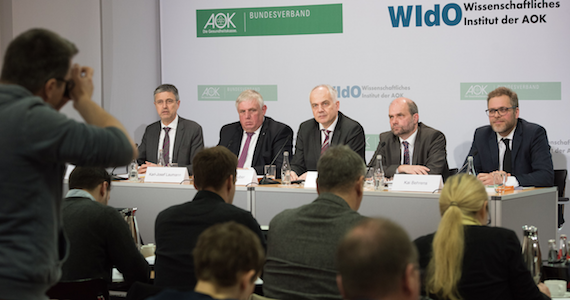
When planning hospitals in Germany, it is already possible to centralize and specialize hospital structures in a quality-oriented manner. The AOK Federal Association and the AOK Scientific Institute (WIdO) point this out when presenting the 2018 hospital report on the topic of “needs and needs justice”. The Hospital Structure Act gave the federal states extensive options for this two years ago. But countries are hesitant to use it.
That is why the AOK Federal Association is proposing a common target for the federal and state governments for 2025. “The 2025 target image should capture where we want to be with inpatient care at the end of the next legislative period,” says Martin Litsch, Chairman of the AOK Federal Association. “It’s not primarily about the question of how many clinics there will ultimately be across Germany. It would be a significant step if clinics with more than 500 beds were no longer the exception but the rule in the hospital landscape in the future.”
The change in hospital planning is already being implemented in North Rhine-Westphalia. The Health Minister of North Rhine-Westphalia, Karl-Josef Laumann, says: “So far, the planning has often focused on the number of beds. In the future, the focus must be more on quality. For patients, the quality of the results of the services is crucial. North Rhine-Westphalia also wants to make its contribution here to support this process profitably for good hospital care.”
Current analyzes by the WIdO show, using the example of colon cancer operations, among other things, that patient care could be significantly improved through centralization. In 2015, around 44,000 colon cancer operations were carried out in more than 1,000 hospitals in Germany. However, of all the clinics that offered this operation, a quarter performed the procedure a maximum of 17 times a year, and another quarter had between 18 and 33 procedures. Assuming that only certified centers or hospitals that carry out at least 50 colon cancer operations are allowed to provide this service, 385 clinics nationwide remain for surgical care. On this basis, the average journey for patients nationwide would increase from eight to just 16 kilometers. In North Rhine-Westphalia (NRW), which has a dense supply of hospitals, the average journey distance would increase from six to just ten kilometers. The highest average travel distances of 33 kilometers are in Mecklenburg-Western Pomerania. Ultimately, there would only be a few regions in Germany that would have to travel somewhat longer in this scenario. Today, 0.03 percent of the population has a journey that is longer than 50 kilometers. This share would increase to 2.5 percent.
“Stronger centralization is necessary and possible not only for cancer operations, but also for other planned interventions such as hip prosthesis operations and even in emergency care, as the WIdO analyzes show,” says Jürgen Klauber, co-editor of the hospital report and WIdO managing director. “If the quality of therapy improves and the chances of survival improve, slightly longer journeys should not be an issue. We know from surveys that people are already willing to travel longer distances to receive care in good hospitals.”
Prof. Dr. also points out the need for centralized hospital care. Reinhard Busse from the Technical University of Berlin added: “The diagnosis that the lack of concentration of inpatient cases leads to unnecessary deaths is now accepted by politicians, even if there is still a problem with therapy.” So it would be necessary to treat patients with suspicion In case of a heart attack, patients should only be admitted to hospitals with a cardiac catheterization unit and treated there. Of the nearly 1,400 hospitals that treat patients with heart attacks, fewer than 600 have such a unit. The same applies to the treatment of strokes. Only around 500 of the 1,300 clinics that currently treat strokes have appropriate stroke units. At the same time, in both cases it would have to be guaranteed that the hospital has appropriate specialists available around the clock. If the neurologists and cardiologists were distributed among the hospitals in such a way that exactly one specialist was always available, there would only be enough for around 600 hospitals. Busse: “The treatment cannot now be to equip the other 800 hospitals with stroke and cardiac catheter units.”
This situation also affects nursing staff, as the AOK Federal Association emphasizes. “We do not have enough staff to equip all existing clinic locations so that sensible staffing figures or minimum staffing levels can be easily implemented. These personnel will not be available on the labor market in the short term, regardless of whether there are 8,000 or 80,000,” says Martin Litsch. This is also why the centralization of hospital structures makes sense. In the discussion about better pay for nursing staff, the AOK is pushing for more transparency about which hospital financing funds are intended for nursing staff and whether these funds go to the right places. In order to achieve this greater transparency, the tried and tested flat-rate system should not be questioned as a whole.
Health Minister Laumann also points out the great relevance of medical staff: “We need sufficiently well-trained healthcare staff for both inpatient and outpatient care, both in the medical and nursing sectors. There is still a lot to be done, especially in the nursing sector.”