


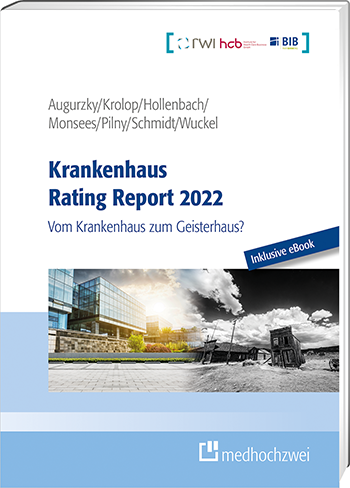
Hospital Rating Report 2022: Improvement in the economic situation of hospitals in 2020 through pandemic aid
23.06.2022 10:50
The economic situation of German hospitals improved significantly in 2020. Only 7 percent were in the “red zone” with an increased risk of insolvency. Their earnings situation has also improved, with only 28 percent of the clinics posting an annual loss at group level. However, the decisive factor for the better economic situation of the clinics was not long-term structural changes, but rather the compensation payments and other aid from the federal and state governments in the context of the COVID-19 pandemic. The German healthcare system continues to face enormous challenges for which it is currently not equipped. These and many other results come from the eighteenth edition of the “Hospital Rating Report”, which was presented to the public as part of the “Capital Congress 2022 – Medicine and Health”. It was created jointly by the RWI - Leibniz Institute for Economic Research and the Institute for Healthcare Business GmbH (hcb) in cooperation with the Bank in the Diocese of Essen (BIB).
An overview:
Status quo
- The economic situation of German hospitals improved significantly in 2020. Only 7 percent of hospitals were in the “red zone” of increased risk of insolvency, 25 percent were in the “yellow” zone and 68 percent were in the “green zone”. The year before, only 60 percent were in the "green" and 14 percent in the "red zone". The earnings situation also improved in 2020: 28 percent of hospitals posted an annual loss at group level, compared to 34 percent in 2019. In 2020, the average annual result was 1.2 percent of revenue, compared to 0.6 percent in the previous year.
- However, the decisive factor for the better economic situation of the clinics was not long-term structural changes, but rather the compensation payments and other aid from the federal and state governments in the context of the COVID-19 pandemic. Smaller hospitals, facilities with below-average case severity (case mix index) and non-private hospitals were particularly able to improve.
- Due to the COVID-19 pandemic, the number of inpatient cases fell exceptionally sharply by 13.5 percent in 2020. In the second year of the pandemic, 2021, it largely remained at this low level.
- The investment subsidies of the federal states amounted to 3.27 billion euros in 2020, which was 3 percent more than in the previous year. In relation to total hospital revenues, this corresponds to 3.4 percent. In order to maintain the substance of the company, 7 to 8 percent of the proceeds should flow into investments every year. Hospitals only partially close this investment gap on their own, so there is a depletion of assets that is clearly visible in their balance sheets. This depletion of assets was particularly strong in the East German hospitals, which - coming from very good corporate assets - are increasingly approaching the low level of the West German hospitals.
- An evaluation of existing annual financial statements from 2007 to 2020 shows patterns that are stable over time: the rating is significantly better in East Germany, and worst in Baden-Württemberg and Hesse. Non-profit and privately owned clinics perform significantly better in terms of rating and profitability than public clinics. Nevertheless, the earnings situation of private hospitals deteriorated in 2020 compared to 2019, while it increased for public hospitals and especially for non-profit hospitals. Hospitals with a medium and high level of specialization and facilities with a higher case mix index also had a significantly better rating and better profitability.
- The number of people in the healthcare sector who are subject to social security contributions rose by 15 percent between 2015 and 2021, and by 12 percent in hospitals. In addition, the proportion of people working part-time increased. In the medical service in hospitals, it more than doubled between 2004 and 2020 from 12 percent to 29 percent. In addition, significantly more foreign employees work in hospitals.
- In 2019 and 2020 there was a significant increase in the number of full-time nursing staff (+4.2% and +5.0% respectively) and at the same time a reduction in functional service, which suggests that there are shifts between service types due to The cost coverage for nursing staff costs introduced in 2020 came.
- Due to the sharp decline in the number of cases and the simultaneous increase in the number of full-time employees, labor productivity - measured as a case mix per full-time employee - fell by 16% in 2020. The decline can be partly explained by additional work due to the pandemic.
- Wage costs in the nursing service have risen significantly more in recent years than at the beginning of the 2010s. In 2019, the costs per full-time employee increased by 4.8% and in 2020 by 3.5%.
- In March 2021, the number of vacancies reported by hospitals was four and a half times higher than in January 2007. Fortunately, the number of trainees in hospitals increased by 41 percent between 2005 and 2021, meaning that the proportion of those under 25 in the workforce in 2021 has increased by over 11 percent. But that will not be enough to completely replace the workers who will retire in the coming years.
projection
- For the projection, the annual financial statements for 2020 were updated until 2030, taking into account the findings during the COVID-19 pandemic in 2021 and 2022 as well as demographic developments and legal changes that have already been adopted. The pandemic, which is still ongoing in 2021, meant that the volume of services provided by hospitals remained below the 2019 level.
- The “Return to 2019” scenario assumes a return to pre-crisis levels in 2023 and expects the number of cases to increase by 18 percent by 2030 compared to 2020. With a moderate annual increase in the base case values and rising wages, in this scenario the The proportion of hospitals in the red rating area will increase to 25 percent by 2030. The proportion with an annual loss would grow to 44 percent and the average annual result would fall to -2.5 percent.
- In the “restart” scenario, it is assumed that the volume of services will no longer reach the pre-crisis level. It will only increase very slightly compared to 2022, so that the number of inpatient cases in 2030 will only be around 7 percent above the 2020 level. In this situation there would be a dramatic deterioration in the economic situation of hospitals. Around three quarters would then post losses in 2023 and in 2030 the average annual result would be -8 percent. However, with continuous structural and process optimization and an adjustment of hospital capacities to the new lower performance level, the situation could stabilize by 2030.
outlook
- The German healthcare system continues to face enormous challenges for which it is currently not equipped. In 2021, the statutory health insurance companies ran into the highest deficit in their history and there is a lack of suitable staff to continue to provide the necessary services in good quality. At the same time, material costs rise due to inflation. The pressure to act is therefore increasing.
- In order to avoid rationing of health care services, efficiency in the health care system must increase. It is helpful for further steps to derive a target image of health care, to which the compensation systems and thus the compensation incentives are aligned.
- The introduction of the DRG ("diagnosis-related groups") system with flat rates per case in 2004 has noticeably improved hospital financing compared to the period before. However, the DRG system also creates an incentive to provide a large number of inpatient services, and as a purely inpatient remuneration system, hinders cross-sector care and slows down outpatient care. As a result, it leads to high operational efficiency, but not necessarily high system efficiency. In order to increase system efficiency, remuneration instruments should start at the system level.
- So-called hybrid DRGs or complex outpatient DRGs could form a bridge between the outpatient and inpatient sectors. You pay for services that were previously provided on an inpatient basis for remuneration reasons, but which could have been performed on an outpatient basis. It is important that a complex outpatient DRG is linked to infrastructure and staff requirements.
- Regional reserve budgets for medical service groups could significantly advance the establishment of priorities. They could also better absorb fluctuations in demand that exceed the usual level, for example as a result of a pandemic. It seems plausible to divide the nationwide DRG revenue volume (including nursing staff costs) into one third for volume-independent regional reserve budgets and two thirds for the residual DRG. In order to support the goal of establishing priorities, the regional reserve budgets should be made available for all performance groups.
- The coalition agreement puts many issues on the agenda that are important for overcoming the challenges ahead. He avoids overly specific statements and thus leaves scope to implement the plans. In this respect, the contract has great potential to address the enormous challenges. However, it also carries the risk of only touching on many of the topics superficially. In order to exploit the potential for healthcare, decisive political leadership and appropriate prioritization of issues are required.
- Important topics in the coalition agreement are the expansion of multi-professional, integrated health and emergency centers and the strengthening of “carer” functions, such as low-threshold advice services in the form of health kiosks and, especially in rural areas, the expansion of the services provided by community nurses and health guides.
- In addition, freedom of design at regional level should be increased by making population-related care contracts more attractive and expanding scope for contracts between health insurance companies and service providers.
- In order to make care more attractive, working conditions should be improved. This includes strengthening academic nursing training and the professional profile of community health nurses, as well as teaching digital skills during training. In addition, foreign skilled workers should be recruited and professional qualifications acquired abroad should be recognized more easily.
- In addition, digitalization in the healthcare system should be promoted. This includes regularly enabling telemedical services, video consultations, teleconsultations, telemonitoring and teleemergency medical care.
“The economic situation of German hospitals improved significantly in 2020,” says RWI health expert Boris Augurzky. “However, that is no reason to rest. The German healthcare system can and must become significantly more efficient, for example through cross-sector care,” said Augurzky. “Digitalization, especially telemedical services, must also be advanced,” adds Sebastian Krolop (HIMSS, Healthcare Information and Management Systems Society).
The data basis for the “Hospital Rating Report 2022” is 540 annual financial statements from hospitals from 2019 and 544 from 2020. They include a total of 957 hospitals. There were not yet a sufficient number of annual financial statements available for 2021. The report is prepared jointly by the RWI - Leibniz Institute for Economic Research and the Institute for Healthcare Business GmbH (hcb) in cooperation with the Bank in the Diocese of Essen (BIB).