


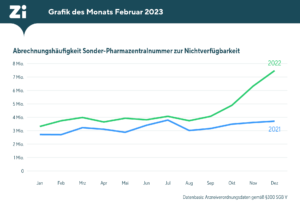
In the 4th quarter of 2022, pharmacies were unable to dispense the prescribed medication to 26 percent of patients
01.03.2023 11:48
In 10 percent of cases, the generic prescriptions were not available during this period. “In order to curb drug shortages, politicians must now create more transparency about delivery routes”
Delivery bottlenecks have been a well-known phenomenon in the supply of pharmaceuticals in Germany for a long time. What is new, however, is the scope of active ingredients that are difficult to deliver and the number of patients affected. The pharmacy billing data provides an overview of the medication supply. However, this makes supply bottlenecks for prescription drugs difficult to measure. The reason for this is that what could not be handed in is not documented.
An indicator for the unavailability of a drug is the special pharmaceutical central number (PZN) 02567024. Pharmaceutical central numbers (PZN) are a nationwide identification key in Germany for drugs, medical devices and other products commonly available in pharmacies. The special PZN 02567024 is used if a drug from another manufacturer with the same active ingredient was supplied instead of the discounted or cheapest product. It only comes into play in the generic and import-relevant market. However, looking at their frequency as a time series indicates that the situation is currently getting worse.
Commonly prescribed active ingredients are also affected
While the number of special PZNs billed for unavailable prescribed medicines was relatively stable in 2021 and the first nine months of 2022, it increased significantly in the fourth quarter of 2022. In 10 percent of the prescriptions, pharmacies were unable to access the product that was actually being dispensed (e.g. discount medicines). This affected 26 percent of patients with a prescription. This also affected frequently prescribed active ingredients. Around 75 percent of all prescribing practices had at least one affected patient. Cases in which the pharmacy had to request a new prescription from the doctor's office because the prescribed active ingredient was not available at all are not included here. These are the central results of a current evaluation of the statutory medical prescription data for the years 2021 and 2022, which the Central Institute for Statutory Health Insurance (Zi) published on February 28th.
Delivery bottlenecks have complex reasons
“The reasons for delivery bottlenecks are complex. In addition to insufficient production capacities or the withdrawal of individual manufacturers, short-term changes in disease patterns can also lead to problems. In December 2022, supply difficulties for antibiotics with the active ingredients amoxicillin, amoxicillin/clavulanic acid and penicillin V were reported. This was a particular challenge because many people, especially children and adolescents, became ill with bacterial infections during this period. However, the market was unable to react quickly enough to the increased demand. While the three active ingredients were prescribed almost two million times in the fourth quarter of 2021, there were more than 3.1 million prescriptions (+57 percent) in the fourth quarter of 2022. In addition to stable supply chains, a reserve should also be maintained, especially for such important active ingredients such as antibiotics,” said Zi CEO Dr. Dominik von Stillfried.
In order to really reduce or even prevent delivery bottlenecks, politicians must address the actual causes and create more transparency about delivery routes. Von Stillfried continued that these are often only known in detail to the respective pharmaceutical companies. “In concrete terms, this means reducing dependencies on contract manufacturers in Asia and strengthening remaining locations in Europe, as well as monitoring delivery bottlenecks more consistently so that preventive measures can be taken at an early stage.”