


High potential for improvement for the M-RSA
19.10.2017 15:52
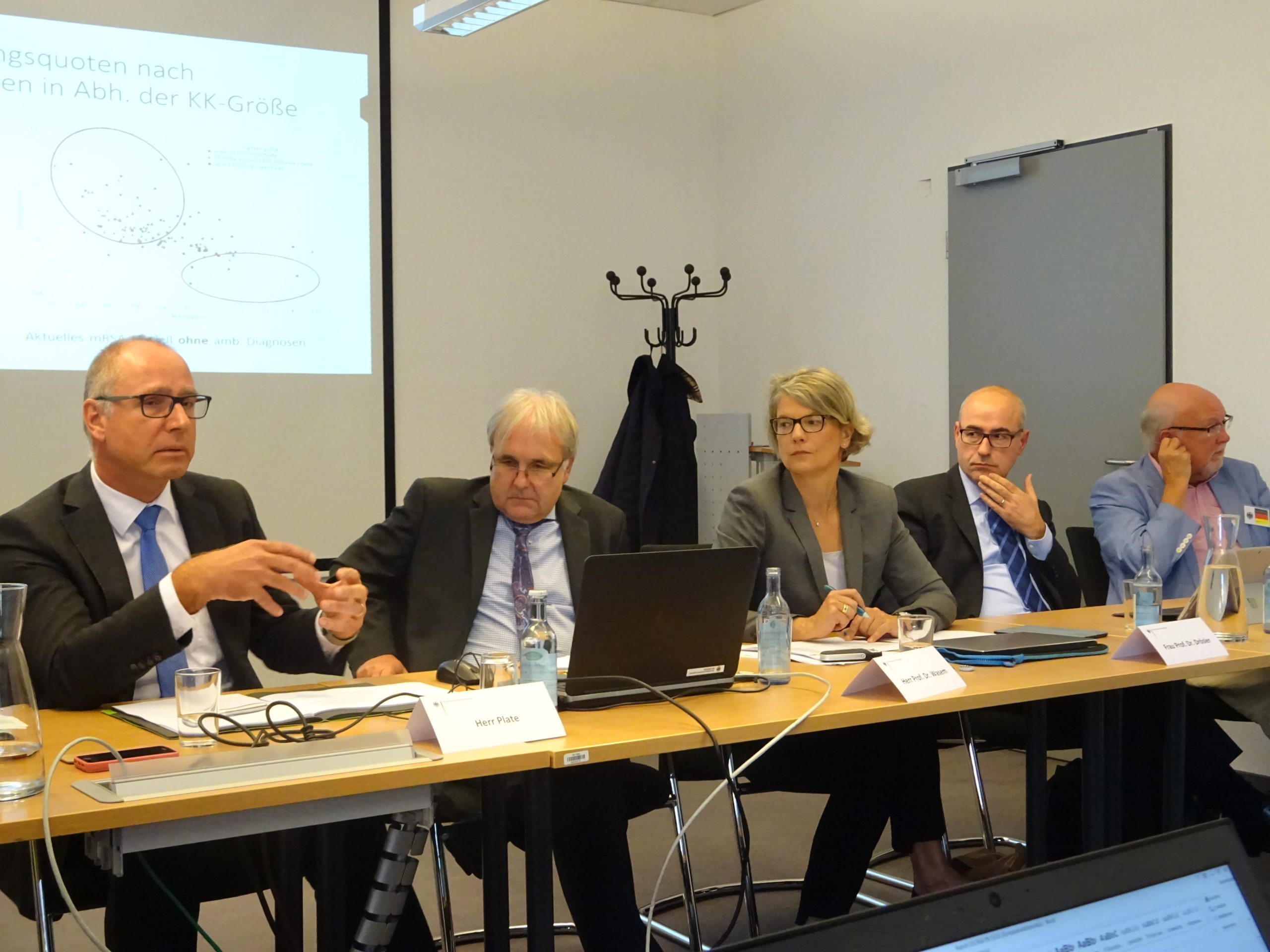
The first of two special reports prepared by the voluntary Scientific Advisory Board of the Federal Insurance Office (BVA) as the basis for a possible further development of the morbidity-oriented risk structure adjustment (M-RSA) was presented at a press conference at the BVA in Bonn.
The first special report with its more than 700 pages including appendices and literature will now be finalized in the next three weeks. On the occasion of the presentation of the results, the President of the BVA, Frank Plate, thanked the members of the Scientific Advisory Board and stated: “I am grateful that the Scientific Advisory Board, as an expert and independent body, is dealing so intensively with the evaluation of the RSA and the consequences of possible changes in the RSA. Based on the results of the special report, it is now important to further develop the RSA, which was designed as a learning system, carefully and sensibly. However, it must be taken into account that most adjustments to the distribution mechanism can only be made on the basis of legal changes." But the BVA employees and the scientists working on the advisory board are already working on the second report, which will be available by April 30, 2018 which has to examine the regional distributional effects of risk structure equalization.
Only when this report is available will an overall picture emerge of what a possible further development of the M-RSA could look like. In the opinion of Prof. Dr . Jürgen Wasem, the chairman of the BVA advisory board (see video), may well be in a position to influence some of the recommendations included in the first report - such as a changed consideration of the EMG characteristic (incapacity groups). But not the core statements of the report, which have high potential for improvement for the M-RSA, which was already “high-performing” (Wasem).
On the one hand, this is the basic recommendation that the previous limitation of 80 selected diseases (diseases) should be switched to a full model, because then there is clear potential for improving the accuracy on all three levels that are important in M-RSA (individuals, insured groups, health insurance companies). ) would be possible. However, a full model would also make sense because the use of pharmaceutical cost groups (similar to the Dutch RSA) would then also make sense. Furthermore, outpatient diagnoses should be retained because their elimination would not only lead to a significant deterioration in the statistical quality measures of the regression model, but would also increase undesirable incentives for risk selection (overcoverage of healthy people, undercoverage of sick people). The Council also suggests uniform supervisory action at the federal and state levels; In addition, the M-RSA should no longer favor or disadvantage any form of treatment in the future. For this reason, the Council is proposing the deletion of the DMP flat rate, as this would be an unsystematic promotion of a special format.
You can read a detailed report in the upcoming “Monitor health services research“ (06/17)
Video: Prof. Dr. Jürgen Wasem, Chairman of the BVA Scientific Advisory Board, at the presentation of the M-RSA special report on October 19, 2017 in Bonn: link
You can find further documents on the appointment/news portal Healthreminder: link