


Across the OECD, healthcare costs are rising faster than gross domestic product
07.11.2023 17:09
Health is becoming more expensive across the OECD: By 2030, OECD countries are expected to spend an average of around 10.2 percent of their gross domestic product (GDP) on health costs, 1.4 percentage points more than before. This means that health spending is growing faster than economic performance in almost all OECD countries. The cost drivers include, among other things, the increasing number of chronic diseases, which can also be attributed to the aging population. The use of modern technology will make the systems more powerful, but also more expensive. As incomes rise, the expectation of high-quality treatment also increases, which will also lead to higher costs. This is the result of a new OECD study.
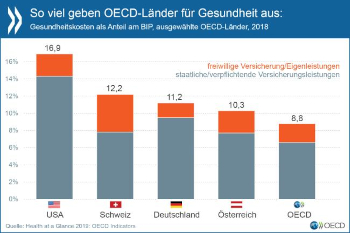
The study Health at a glance 2019 examines the health status of people and the performance of health systems in all 36 OECD countries and eight other countries. Among them, the USA spends by far the most on health: 16.9 percent of GDP in 2018. Switzerland comes in second with 12.2 percent, Germany in third place with 11.2 percent and Austria in tenth place with 10.3 percent . A particularly sharp increase in costs is expected for Switzerland. By 2030, the share of expenditure in GDP is expected to increase by around 2.6 percentage points (reference year 2015). For Germany and Austria by around 1.2 and 1.4 percentage points, respectively.
Germany: Good access, high demands
Access to healthcare services is above average in Germany. The contribution-financed benefit package is extensive; there are more doctors and more nursing staff per capita than the OECD average. When it comes to available hospital beds, Germany is in the top group (eight beds per 1,000 inhabitants compared to the OECD average of 4.7). The high availability of personnel and infrastructure goes hand in hand with high use of health services. Apart from Austria, no other OECD country registers so many hospital admissions per capita. On the one hand, this is due to the comparatively old population - around one in five people is over 65 years old. On the other hand, chronic diseases that could be treated on an outpatient basis are also treated in an inpatient setting more often than in many other countries. This is e.g. This is often the case, for example, in asthma/COPD and heart failure and could be avoided through improved primary care.
Despite the very good range of care available, Germans are only in the OECD midfield when it comes to certain health indicators such as life expectancy (81.1 years compared to 80.7 on the OECD average) and preventable mortality. The background to this is, among other things, that lifestyles that are harmful to health are widespread: 18.8 percent of Germans smoke and 60 percent are overweight. On average, every German drinks almost eleven liters of pure alcohol a year. For all of these factors, Germany is above the OECD average.
Austria: Many doctors, but also many avoidable risks
Findings and challenges are similar to those in Germany: The relatively high health expenditure in Austria also ensures a very good overall medical care offering with a far above-average number of doctors, many hospital beds (7.4 per 1,000 inhabitants) and a high number of inpatient treatments. Here too, consideration should be given to reducing the number of inpatient treatments through a greater focus on primary care. The Austrian population is younger than the German population (18.7 percent are over 65), but is also aging quickly. When it comes to life expectancy (81.7 years) and preventable mortality, Austria is also only in the middle of the OECD, which is partly due to the high prevalence of certain risk factors: almost 47 percent of Austrians are overweight and almost one in four smokes. This means that Austria has proportionately more smokers than most OECD countries. A lot of alcohol is also consumed, almost twelve liters per year.
Switzerland: Expensive system with some outstanding results
Switzerland spends the most on health among European OECD countries in terms of GDP. At the same time, a particularly high proportion of the costs (29 percent) are borne by private households. Switzerland has many doctors and nursing staff with a high proportion of specialists trained abroad. Compared to Germany and Austria, fewer inpatient services are used in Switzerland, but the general price level for health services is much higher.
Switzerland performs well above average when it comes to important health indicators. Switzerland has one of the lowest rates for preventable causes of death and at 83.6 years, life expectancy in Switzerland is higher than in any other OECD country, apart from Japan. At 42 percent, far fewer Swiss are overweight than the OECD average. However, Switzerland's tobacco consumption (19.1 percent are smokers) and alcohol consumption (9.2 liters per year) are slightly above the average of the OECD countries.
More efficiency and evaluation
The spending forecast shows how important it is to use money efficiently. At the same time, preventative measures and health education are of great importance in avoiding chronic diseases. More emphasis should also be placed on evaluations: patient surveys can help measure and improve the quality of care.