


Eunuchs live 15 years longer than uncastrated males
19.10.2012 12:20
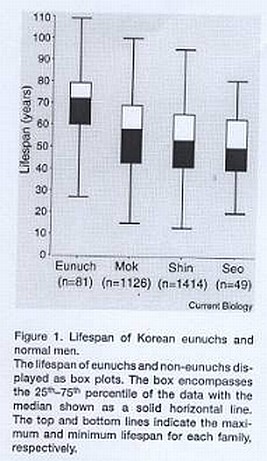
A study of eunuchs from the Korean imperial court of the Chosun Dynasty (1392-1910) found that they had an average lifespan of 70 years, while for comparable normal men from this period it was around 55 years (1).
In humans and in many mammals, females live longer than males. Among other things, it has been assumed that the male sex hormone plays an antagonistic role in the natural immune system (2). Also, testosterone might predispose to coronary artery disease (3). Conversely, it has long been known that castration increases the lifespan of animals (4). In humans, the results are inconclusive. For example, Nieschlag et al. (5) that the attained age of castrato singers did not differ significantly from that of non-castrated singers.
The special thing about the castrati of the Korean imperial court, in contrast to the Chinese Empire, was that the castrati were able to marry and adopt castrated boys and girls. The families led a largely normal life that hardly differed from that of normal families. There are family trees of castrato families spanning many generations. The authors (1) analyzed the Yang-SeGye-Bo, a 19th-century eunuch genealogy. Of the 383 eunuchs, 81 had their birth and death dates determined. Family trees of three comparable families of non-eunuchs served as comparison. Figure 1 graphically shows the data of the eunuchs and the Mok, Shin and Seo families. The difference is striking. There were also three centenarians among the 81 eunuchs (100, 101 and 109 years old), an incidence about 130 times higher than today in Japan (1:3500) or the USA (1:4400). In summary, these data suggest that the male sex hormone also shortens lifespan in humans
Speaker's comment:
The results among Korean eunuchs are consistent with the longer life expectancy of women compared to men. Prostate cancer is unlikely to have occurred in the Korean castrati and would have led to death. Even though prostate cancer is the most common form of cancer in men today, it only plays a very minor role as a cause of death compared to cardiovascular diseases. The results of previous research into the mechanisms by which testosterone shortens life appear to be inadequate.
(1) Kyung-Jin Min et al.: The lifespan of Korean eunuchs.
Current Biology 2012. 22 (No.18) R792
(2) ML Roberts et al.: Testing the immune competence handicap hypothesis: a review of the evidence.
anime behavior 2004 68: 883-889
(3) MD Schwarcz and WH Frishman: Testostserone and coronary artery disease.
Cardiol.Rev. 2010 18: 251-257
(4)D. Drori and Y. Folman: Environmental effects on longevity in the male rat: exercise, mating, castration and restricted feeding.
Exp. Gerontol. 1976 11: 25-32
(5)E. Nieschlag et al.: Lifespan and testosterone
1993. Nature 366: 215