


First sustainability index presented – sustainability in the healthcare system must be measurable and binding
21.06.2023 12:53
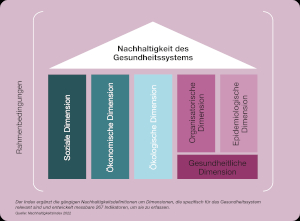
A comprehensive, scientifically based database for measurable goals: The first # sustainability index, developed by AstraZeneca and Vandage Health Economics Analytics under the scientific advice of Prof. Dr. Wolfgang Greiner from Bielefeld University creates transparency about data availability, data quality and concrete objectives in the German healthcare system. In a symposium at this year's Capital Congress, representatives of various actors in the healthcare sector discussed the need to measure sustainability and derive measures from this.
Currently, data on the health system is not uniformly available, incomplete and also extremely variable in quality: of the 267 indicators defined as part of the sustainability index, 17 percent could not be evaluated due to limited data availability. There are also deficits in deriving concrete goals: only 12 percent of the indicators have targets. “Without target values, nothing will change,” Prof. Greiner made clear at the symposium: “Only through them can we create commitment.”
Leading indicators lead to better care and comparability
The discussion at the symposium made it clear how important the topic of sustainability is in healthcare. “We need sustainability reporting. With suitable benchmarks, location determination and a development line,” Andreas Storm, CEO of DAK-Gesundheit, emphasized the importance of such an index for care: “If we succeed in developing an indicator system that aligns health policy, then we will create one cross-country measurability. Leading indicators that can also be measured at the federal state level lead to better care and comparability.”
Prof. Andrew Ullmann, health policy spokesman for the FDP parliamentary group, described the sustainability approach as a “good basis for an evidence-based policy with uniform standards and concepts that create comparability and controllability.” Only in this way can measures be promising.
The sustainability index shows that a target is missing
Tessa Wolf, Head of Health Policy and Patient Affairs at AstraZeneca Germany, used an example to illustrate how the sustainability index can specifically improve care: “We should focus on disease prevention. The sustainability index shows that we lack a target when it comes to diagnosis and early detection, for example. For example, with early diagnosis and treatment of chronic kidney failure, dialysis could be delayed by up to 13 years. In addition to the obviously positive effect for patients, this would also have a positive economic and therefore sustainable effect for the healthcare system.”
Measurable measures can be derived from data-based sustainability goals
The index complements common sustainability definitions with dimensions that are specifically relevant to the healthcare system and defines 267 indicators to capture them. This creates a data basis for the efficient use of resources. In addition, the index provides a basis for deciding in which areas of the healthcare system innovations should be developed and promoted. Measurable measures can therefore be derived from data-based sustainability goals.
AstraZeneca makes the sustainability index available to all actors in the health system and interested parties as open source. In doing so, the company wants to promote exchange and, through a broad discussion, contribute to the further development and ensuring of a sustainably efficient healthcare system. “The further development of the sustainability index will be open to all interested parties and should be shared as broadly as possible,” explains Prof. Greiner.
The annual assessment of the indicators of the sustainability index using current data and trends is intended to enable the derivation of recommendations for action by a council of experts as part of the “Partnership for Future Health”. Regular, annual reporting on new developments, special challenges and possible solutions as well as data analyzes for selected therapeutic areas are also being planned.
The complete report is available here for download.