


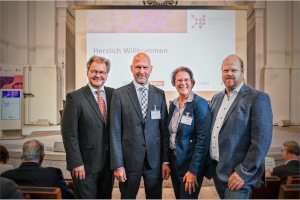
Key points of the Register Act were discussed at the 2023 Register Days
10.05.2023 16:28
More than 160 experts from the healthcare sector met from October 8th to 9th. May 2023 at the Register Days in Berlin. At the conference, Ministerial Director Markus Algermissen from the Federal Ministry of Health presented the conceptual key points of the registry law expected for autumn 2023.
“Medical registers play a major role in the digitization strategy, especially the networking of medical registers with other data,” says Algermissen. Registers are part of a networked data ecosystem of health data, which was described in the coalition agreement. The Register Act is intended in particular to increase the transparency of registers and their quality, promote standardization and contribute to better use of register data in Germany. “We assume that the Register Act will provide significant impetus for register research,” says TMF Managing Director Sebastian C. Semler, assessing the upcoming development.
Improve the framework conditions for register research
Medical-scientific registries are increasingly taking on an important, complementary role in the evaluation of medicines, medical devices and health policy measures. In order for registers to fulfill this task, certain framework conditions on the part of the legislature and a community-based discourse on the part of register operators are essential. In order to improve the quality of the registry landscape required for increased use of registry data in the evaluation process of new therapies, new financing models are needed in addition to reliable reference points. Registers must know where they are in their development and what quality measures are necessary to ensure their usability, e.g. B. for the evaluation of medicines. Despite the diversity of the register landscape, the quality and degree of development of a register must be comprehensible and transparent. Further developing the maturity model from the BMG register report is an important first step.
TMF supports and moderates registry development
A central office for medical registers was also announced for the Register Act, which is intended to support the networking of registers with each other and promote the use of existing standards. It can bundle knowledge and make it available and develop instruments to facilitate the establishment and further development of registers in dialogue with register operators.
“As a method platform for networked medical research, the TMF sees it as one of its central tasks to accompany and moderate this political process,” says Semler. TMF AG Register, founded at the beginning of 2023, will discuss the technical and content-related aspects and develop recommendations for the register community, as well as offer assistance and orientation in this complex field for everyone involved.
More networking through data exchange
The networking and collaboration of registers is an important basis for using existing human and financial resources more effectively. With cross-register evaluations, connections can be identified and important questions can be answered. Harmonization of data and orientation towards standards are essential for this and for connection to the European health data space. The Register Act therefore aims to lay the foundations to facilitate direct data linkage.
“Structures have already been developed in cancer registration that record oncological data on therapies and progression in a structured and uniform manner nationwide. In order to get even more out of this data and to be able to meaningfully link it with other medical registries, the introduction of a uniform identification number would now be the logical next step," emphasizes Tobias Harz, managing director of the Lower Saxony cancer registry and co-spokesman of the TMF-AG Register great importance of this project.
More data use through register-based randomized trials
With better exchange between registry operators and data users, the use and thus the value of registry data can also be promoted. The central demands for improving data use are strengthening registry quality in order to enable registries to carry out high-quality registry-based studies to evaluate therapeutic approaches. “Excellent healthcare research with medical registries – that should be our goal. To achieve this, we must now take the next step with the registry law and promote register-based randomized studies (RCT) on treatment comparisons,” demanded Thomas Kaiser from the Institute for Quality and Efficiency in Health Care (IQWiG).