


Third wave: Covid-19 patients are on average nine years younger
03.08.2021 10:03
The corona vaccinations of senior citizens have already significantly reduced the average age of Covid-19 patients in Berlin hospitals in the spring of this year. This is shown by a current evaluation of billing data from AOK Nordost policyholders and other AOK policyholders who were treated in Berlin hospitals. Accordingly, the AOK-insured Covid-19 patients who were treated in Berlin hospitals during the second wave (October 2020 to March 2021) were on average around 71 years old. At the beginning of the third wave, in March 2021, the average age in the Covid-19 wards fell to just under 62 years - around nine years.
“This is explained by the fact that in the third wave, more middle-aged people who had not yet received a vaccination had to be treated in intensive care,” explains Jürgen Klauber, managing director of the AOK Scientific Institute (WIdO), which prepared the evaluation . At the end of March 2021, only around 12 percent of all Berliners had received a first vaccination. At this point, the vaccination rate for first vaccinations among nursing home residents was already over 90 percent.
Mortality among hospital patients fell from 25 to 17 percent
Another number also shows the success of the vaccinations in the senior age group: In the second wave, around 40 percent of Covid-19 patients in Berlin hospitals were over 80 years old. At the beginning of the third wave, this proportion halved to 20 percent.
Not only the average age, but also the mortality rate among inpatient Covid-19 patients in Berlin fell significantly at the beginning of the third wave. In the second wave, mortality was 25 percent; in March 2021 this number was 17 percent. “This can be explained primarily by the lower average age,” says Klauber.
Even in the third wave, many were apparently afraid to go to the hospital
The evaluation of the AOK billing data also shows how many hospital treatments were carried out in total in the third wave from March to May 2021. It showed that the number of cases in Berlin hospitals fell by 19 percent compared to the same period last year. In the second wave the minus was still 25 percent. During the third wave, slightly less planned operations were postponed due to the many Covid-19 patients.
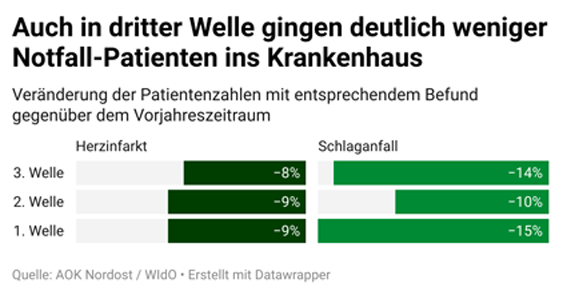
What is worrying, however, is that significantly fewer emergency patients were registered in Berlin hospitals in the third wave. The number of stroke patients fell by 14 percent compared to the same period last year, and the number of heart attack patients fell by 8 percent. Both values were similarly high in the first and second waves.
The suspicion here is that emergency patients went to hospital less often in the third wave out of fear of being infected with Covid-19 - and accepted serious consequences in doing so. In the case of both heart attacks and strokes, rapid medical help is essential in order to limit the harmful effects. “Here we can only continue to appeal that if you suspect a heart attack or stroke, you should call the emergency services without hesitation,” says WIdO expert Jürgen Klauber.