


“Politicians don’t have the courage to put the numbers used in the right context”
20.05.2020 09:34
“As constructive contributions to support the decisions of the coming weeks,” Prof. Dr. med. Matthias Schrappe and Prof. Dr. rer. nat. Gerd Glaeske the two scientific theses papers from her renowned, multi-professional group of authors*. These very detailed theses analyze the diverse effects of the Covid-19 pandemic on society, the health system and the protection of civil rights and make suggestions for how to deal with the pandemic correctly. In the cover interview of the forthcoming issue of “Monitor Health Services Research”, which describes the current status of health care research on Covid-19 on 100 pages, Schrappe and Glaeske not only explain their motives, but also the core theses of the two papers, although they do not save money either with criticism.
However, they do not want their two theses papers published together in the upcoming MVF to be seen as political or virologist bashing, but rather as an open and constructive contribution that deals scientifically and critically with previous political decisions. On the one hand, this refers to the measures taken to contain the Covid-19 pandemic in Germany, but on the other hand it also means the associated communication, which, from the point of view of the group of authors, “was hardly understandable for many people and the politically imposed consequences were not always comprehensible.” . In addition to virology, which was “certainly enormously important and correct” in the first phase of fighting the pandemic, they explicitly call for greater consideration of other scientific areas such as sociology, economics, public health and, in particular, health services research, which - according to Schrappe and Glaeske – “all of them can play an important analytical but also revealing role”. In the now necessary medium and long-term view, the laboratory perspective introduced so far is “simply too narrow”.
According to Schrappe, healthcare research in particular, as well as evidence-based medicine and organizational management, offers many “keys” for a deeper understanding of emergent phenomena – such as the corona pandemic. One of these “key elements” is that of co-author Prof. Dr. Throughput model designed by Holger Pfaff (IMVR, Cologne) and Schrappe, which was used in both thesis papers with the following question: “How is it possible with such a model to meaningfully intervene in the very complex development of an epidemic?”
One of the starting points is the question of communicating the right numbers with which politics and society can understand and also control the effects of a pandemic. According to the authors, one point of criticism is that our society has been confronted with increasing numbers of infections almost every day for a long time, but this is “almost only due to the fact that the sample size is simply increasing” (Schrappe). This was not wrong at the beginning, adds co-author Glaeske, who was a member of the Advisory Council for the Assessment of Developments in the Health Care System from 2003 to 2010. However, in his opinion, the time was unfortunately missed to “introduce more critically examined and questioned and, above all, more evident figures into the discussion”. He gives a possible reason for this in the MVF cover interview: “There was probably a fear at the political level that the pressure that had once built up on the people in our society could be reduced too quickly.”
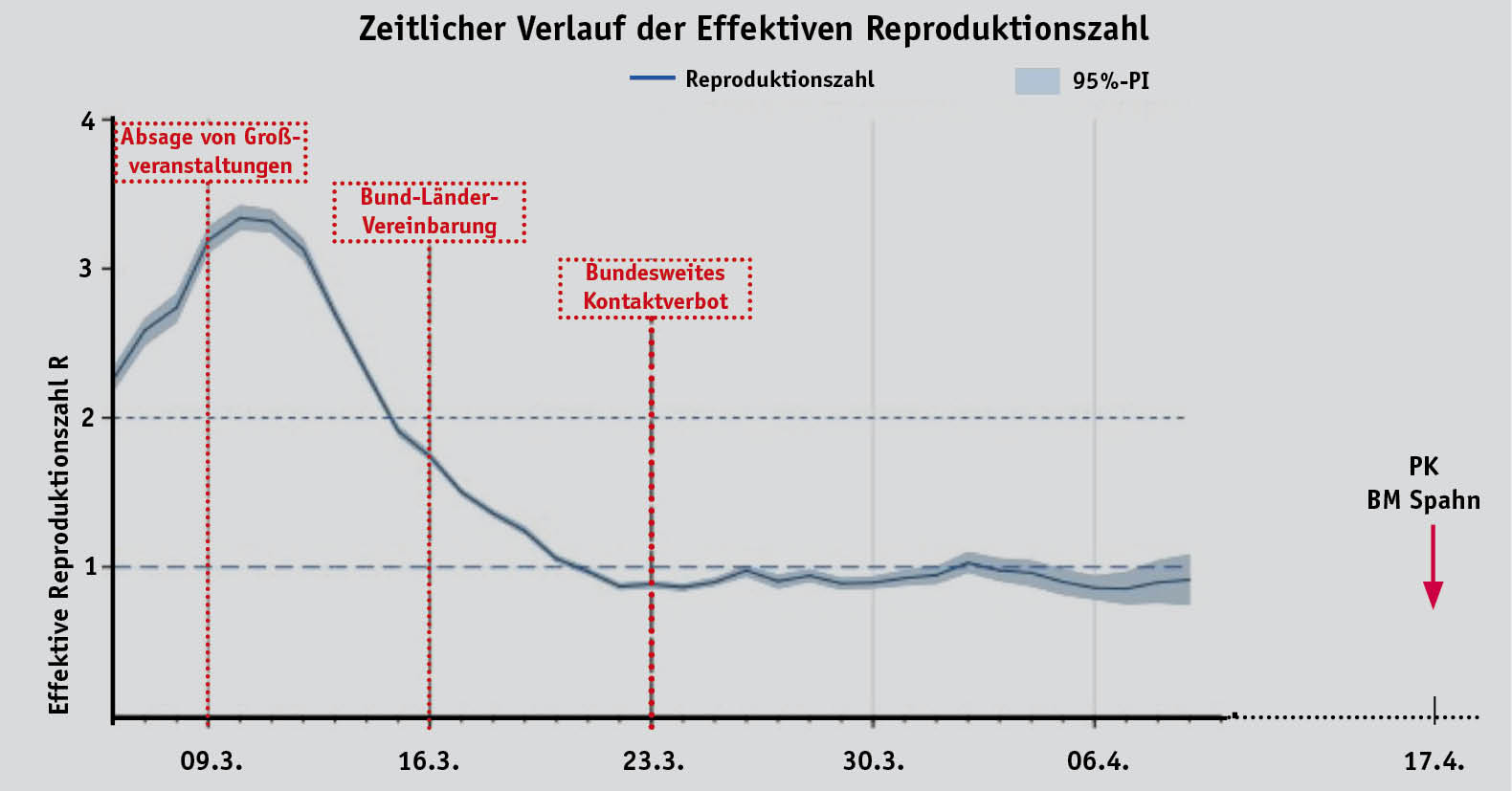
The effectiveness of the lockdown measures is also difficult to see in the figures published by the RKI. In thesis paper 2.0, the group of authors dealt very intensively with the “effective reproduction number”, which is currently in the foreground. The authors show, among other things, that after the first bans on gatherings, the reproduction number had already fallen below one before the tightening lockdown measures were taken. Which in turn raises the following question: “Were the lockdowns even necessary if you can’t really see their effect in the development of the effective reproduction number?” (see figure).
It is precisely here that the statement of the renowned group of authors differs from the narrative of many others, Schrappe interjects: “The Robert Koch Institute believes that this fact is an indication that the measures taken by politicians - on the recommendation of the advisory virologists - have already taken place "It would have had an impact very early on." It would also have been feared that the infection rates would have shot up again if the fact that the reproduction number had been below one for a long time had been used as a signal to perhaps initiate certain easing measures as early as mid-March. On the other hand, the authors clearly differentiate themselves from many other voices that negligently trivialize the Covid-19 epidemic, such as the paper from the Ministry of the Interior that was recently made public.
Nevertheless, despite all the criticism that can be made and scientifically proven, Peer Steinbrück's famous saying still applies: “Would have, would have, bicycle chain”. That means: “Unfortunately, beforehand you never know exactly what will happen later, afterward.” Schrappe, a member from 2005 to 2011 and deputy chairman of the SVR Gesundheit from 2007, said in the MVF interview: “I regret that this fact is like that little has been communicated. Basically, you have to accuse the entire political communication of this.” By this, the experienced infectiologist does not mean that politics always lags behind current developments for a variety of reasons, but “that it doesn’t explain enough and, above all, doesn’t have the courage to do so “To put the numbers used in the correct context”.
The context is described in the upcoming issue of the specialist journal “Monitor Healthcare Research”, which has been published since 2008. This issue (03/20) presents the current status of health services research on Covid-19 on 100 pages.