


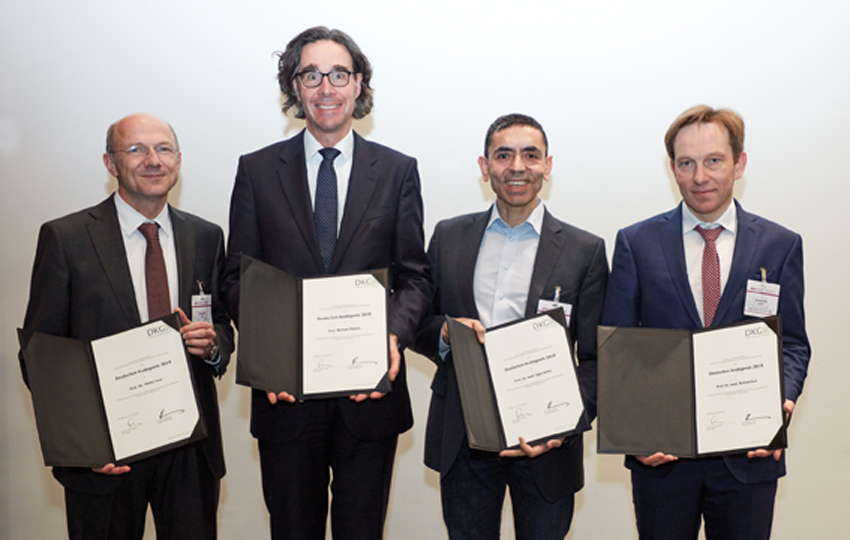
German Cancer Prize 2019 awarded at the International AEK Congress
28.02.2019 12:36
The German Cancer Prize, sponsored by the German Cancer Society and the German Cancer Foundation, is one of the highest awards in German cancer medicine. This year, the award in the “Clinical Research” category went to Prof. Dr. Michael Platten (German Cancer Research Center, Heidelberg; University Medical Center Mannheim); in the area of “Translational Research” Prof. Dr. Ugur Sahin (TRON - Translational Oncology at the University Medical Center of the Johannes Gutenberg University Mainz non-profit GmbH) was honored; in the “Experimental Research” section, Prof. Dr. Roland Rad and Prof. Dr. Dieter Saur (both from the German Cancer Consortium DKTK at the Technical University of Munich, Klinikum Rechts der Isar) received the prize. The researchers were honored at the 20th International AEK Congress in Heidelberg.
Michael Platten is one of the pioneers of innovative immunotherapeutic procedures for the treatment of gliomas. These tumors are among the most common brain tumors in adults and are therefore feared because their complete surgical removal is practically impossible and regrowth is common, even after radiation and chemotherapy. Platten and his working group have shown that a common mutation in gliomas in the gene for isocitrate dehydrogenase (IDH) is specifically recognized by the immune system and have developed a tailor-made vaccination therapy that triggers a specific inflammatory reaction in the tumor tissue in a clinical study.
Ugur Sahin works successfully at the interface between immunotherapeutic research and clinical practice. His contributions include tumor structures that are suitable targets for immunotherapy and pioneering work on the development of personalized cancer vaccines that enable the immune system to broadly attack the tumor.
Initial results from a Phase I clinical trial show that administration of the vaccine triggers strong immune responses and promising antitumor activity in high-risk patients with late-stage melanoma. Roland Rad and Dieter Saur use mouse models to investigate the molecular processes involved in the development of cancer. They developed groundbreaking genetic technologies that make it possible to systematically search the genome for tumor genes and specifically manipulate them in the mouse. As part of their work, they discovered molecular processes that are involved in the development of pancreatic cancer.