


DAK study: Media addiction has doubled during the pandemic
14.03.2023 11:53
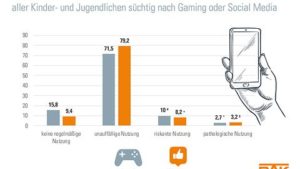
In der Pandemie hat sich die Mediensucht bei Kindern und Jugendlichen verdoppelt. Inzwischen sind mehr als sechs Prozent der Minderjährigen abhängig von Computerspielen und sozialen Medien. Damit zeigen über 600.000 Jungen und Mädchen ein pathologisches Nutzungsverhalten.
Auch die Medien-Nutzungszeiten sind seit 2019 um ein Drittel gestiegen. Das zeigt eine aktuelle gemeinsame Längsschnittstudie der DAK-Gesundheit und des Universitätsklinikums Hamburg-Eppendorf (UKE). Der Vergleich der digitalen Mediennutzung von Kindern, Jugendlichen und deren Eltern in bundesweit 1.200 Familien an fünf Messzeitpunkten der vergangenen vier Jahre gilt als weltweit einzigartig. Erstmals wurde jetzt auch das Suchtpotential beim Streaming und körperliche Probleme untersucht. DAK-Vorstandschef Andreas Storm und Mediziner sehen eine alarmierende Entwicklung und fordern mehr Prävention und Hilfsangebote für die Betroffenen.
According to the current study by DAK-Gesundheit and UKE Hamburg, the number of children and young people addicted to computer games rose from 2.7 percent in 2019 to 6.3 percent in June 2022. This means that around 330,000 boys and girls were extrapolated according to the criteria of the World Health Organization (WHO) a pathological gaming use with serious social consequences. The current results of a longitudinal study show: Around 2.2 million children and young people use gaming, social media or streaming problematically, meaning they are at risk of addiction or are already affected. In the area of social media, media addiction doubled from 3.2 to 6.7 percent, with around 350,000 people affected. According to the study, around 1.8 million children and young people have problematic use of computer games and/or social media.
DAK boss Storm: The future of many young people is threatened
“The current figures and the development of the pandemic are alarming,” says Andreas Storm, CEO of DAK-Gesundheit. “If action is not taken quickly now, children and young people will continue to slip into media addiction and the negative trend can no longer be stopped. This would destroy families and threaten the future of many young people.” In response, prevention and support services would have to be expanded and new accents set in education and family policy. “It is a new development task for politics and society that children and young people learn to be able to assess the risks of using digital media and to reflect on their usage behavior so that they can use the possibilities of the digital world constructively for their private and professional lives in the long term. “The right approach is the use of mental health coaches in schools, as planned by Federal Minister for Family Affairs Lisa Paus.
Usage times above pre-pandemic levels
According to a study by DAK-Gesundheit and UKE-Hamburg, usage times for computer games and social media have continued to increase. After a sharp increase in the first Corona lockdown in April 2020, there was initially a decline. However, this positive development did not continue: in June 2022, usage times for gaming were 115 minutes on weekdays, almost 34 percent higher than in September 2019 before the pandemic. There was an equally significant increase in social media during the same period, with 35.5 percent from 121 minutes to 164 minutes daily.
Physical complaints due to excessive media use
For the first time, the study also examined the physical effects of excessive media use. The result: A third of those surveyed complained of neck pain (32.1 percent) after using digital devices for several hours. 23.4 percent have dry or itchy eyes, and 16.9 percent said they have pain in their forearm or hand.
Decline in streaming times
Since November 2020, the study has also been examining the streaming behavior of children and young people. There was a decline here compared to the previous measurement time: In June 2022, respondents streamed 107 minutes of videos and series on an average working day. The numbers are therefore at a similar level to 2020 (104 minutes) and significantly lower than 2021 (170 minutes). In total, around 733,000 children and young people used streaming in a risky manner, and 2.4 percent showed pathological usage behavior. That corresponds to around 126,000 people affected.
Large overlaps with problematic use
The extent of the overall problem becomes particularly clear when looking at the intersections: 5.1 percent of all respondents show problematic use of gaming and social media, which corresponds to around 270,000 people affected. 1.1 percent also use streaming services problematically - 58,000 children and young people would be affected by this risky triad.
Prof. Thomasius: Using media to combat loneliness and stress
“The results of our study once again make it clear that the ongoing Covid-19 pandemic has permanently changed the way we deal with digital media and that children and young people in particular suffered from the restrictions,” says Prof. Dr. Rainer Thomasius, medical director at the German Center for Addiction Issues in Children and Adolescents (DZSKJ) in the UKE. “Despite the increasing relaxation of the Corona regulations, digital media remains an important part of maintaining contacts, combating boredom or obtaining information. For some, they can also serve to compensate for feelings of loneliness, social isolation and loss of control, as well as stress and other negative feelings. These users are particularly at risk of developing an addiction.” According to addiction expert Thomasius, excessive media use often leads to a loss of control with far-reaching consequences. “Since personal, family and school goals take a back seat, age-typical developmental tasks are not solved appropriately,” he explains. “The result is a standstill in psychosocial maturation. The results of our study once again make it clear how important prevention and therapy offers are for children and parents.”
Boys are more likely to be affected by addiction
Overall, boys are more likely to be at risk of addiction or already affected by addiction than girls - especially when it comes to gaming. 18.1 percent of children and young people show problematic use of digital games. Of these, 68.4 percent are boys. When it comes to social media, which 23.1 percent of all respondents use problematically, the distribution is somewhat more balanced at 52.1 percent (boys) and 47.9 percent (girls). With regard to the age structure, it can be seen that older young people in particular are significantly more likely to be dependent on digital media.
“Even after the corona pandemic, risky media use is part of everyday life for many children and young people,” says Dr. Thomas Fischbach, President of the Professional Association of Pediatricians and Adolescents (BVKJ). “Now it is more important than ever to strengthen prevention, especially in schools. Equally important is the early detection of media addiction, for example through media addiction screening in the pediatrician’s and adolescent doctor’s office.”
Worldwide unique investigation
The representative DAK longitudinal study on media use during the course of the corona pandemic examines the frequencies of pathological and risky use of games, social media and streaming services among children and adolescents based on the new ICD-11 criteria from the WHO. Around 1,200 families nationwide were asked about their media behavior. To this end, DAK-Gesundheit, together with the German Center for Addiction Issues in Children and Adolescents at the University Hospital Hamburg-Eppendorf, is conducting surveys in several waves by the opinion research institute Forsa. For this purpose, a representative group of children and young people between the ages of ten and 17, each with one parent, will be asked about their use of digital media at five measurement points so far. Following surveys in September 2019, April 2020, November 2020 and May 2021, the current findings reflect the results of the most recent survey in June 2022. The study, which examines the connections between usage patterns, usage motives and family usage rules over the course of the pandemic, is unique in the world.