


Corona consequence: record sickness rate in Berlin
29.03.2022 10:19
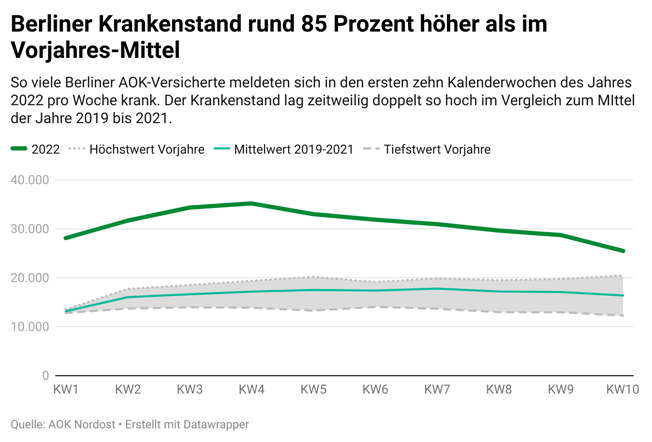
The high corona incidences have driven the number of sick people in Berlin to the highest level ever recorded. This emerges from a data analysis by AOK Nordost. According to this, Berliners with AOK insurance reported sick around 85 percent more often from January to March 2022 than on average in previous years. Working women were more affected by Covid-19 than men.
Berlin's largest health insurance company, AOK Nordost, received around 310,000 sickness reports from Berlin insured people in the first ten calendar weeks of 2022. On average over the three previous years, there were only around 167,000 sick reports during this period. “The record corona incidence that Berlin recorded in January also caused record levels of sickness. In the Berlin companies, around twice as many employees were on sick leave in January and February as in previous years,” says Dirk Becker, press spokesman for AOK Nordost. Around one in five people in Berlin is insured with AOK Nordost, so the data is almost representative.
Working women are affected more often than men
The data analysis also shows that working women in Berlin were slightly more likely to take sick leave due to a Covid-19 infection than working men. 56 percent of all Corona sick notes in 2022 came from women.
“Women work more often in social professions and health professions where employees have a higher risk of infection with Corona,” explains Dirk Becker. In Berlin, medical assistants, physiotherapists and educators were most likely to contract Covid-19, as another data analysis by AOK Nordost showed.
Comparison of federal states shows: sickness rates and incidence run parallel
The comparison of the sickness absence history in the three federal states of Berlin, Brandenburg and Mecklenburg-Western Pomerania confirms that the corona incidence was a significant driver for the high sickness absence. In Berlin the incidence was already over 2,000 at the end of January, around a third higher than in the two regional states. At the same time, sickness rates in the federal capital were significantly higher in January. From mid-February, the incidence fell in Berlin, while it rose significantly in Mecklenburg-Western Pomerania. At the same time, sickness rates fell in Berlin and rose in Mecklenburg-Western Pomerania.