


BVDW study: High acceptance of artificial intelligence and digital applications in healthcare
26.06.2019 13:23
A representative study by the Federal Association of the Digital Economy (BVDW) shows that the majority of the German population is open to digital applications in the healthcare system. More than half would prefer a doctor's office that communicates about appointments or examination results via an app.
With his draft for a digitalization law, Federal Health Minister Jens Spahn is keeping the pressure on the German healthcare system high. Among other things, it is planned that statutory health insurance companies will cover the costs of digital applications such as app diaries for high blood pressure or diabetes patients that doctors prescribe to their patients. For this purpose, approval should be simplified and shortened so that such solutions can be included more quickly in the reimbursement system of statutory health insurance companies. The BVDW praises the initiative – Vice President Achim Himmelreich (Capgemini) says: “This long overdue approach can provide an initial spark for the digitalization of healthcare. Above all, the scope of services offered by statutory health insurance companies has so far been based on a very rigid and sluggish system that simply does not do justice to the speed of development of the vast majority of digital applications.” Himmelreich also sees Spahn's approach of enabling statutory health insurance companies to invest specifically in corresponding start-ups as positive : “This should mobilize the necessary capital to make the development of digital medical applications more attractive.”
A current BVDW study (carried out by Kantar TNS; n=1012) shows that the current regulation is lagging behind patients' expectations: According to this, 58 percent of German citizens would prefer a doctor, a practice, a clinic or a health insurance company if they had one App would communicate with you more closely, send you appointment suggestions and reminders or make it easier for them to exchange X-ray images and findings via the app. While approval among 16-24 year old respondents is 62 percent, it also remains high at 54 percent among 55-64 year olds. BVDW expert Himmelreich: “The way people organize their everyday lives has changed fundamentally in recent years and this also results in a certain level of expectations. The challenge now is to further develop areas such as healthcare to meet these demands. The older target group in particular, who on average use medical services more frequently, will benefit from expanding the existing offering to include digital services.”
High acceptance of artificial intelligence in medicine
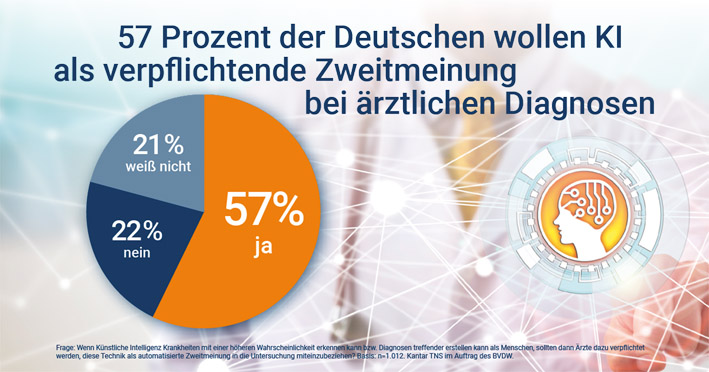
Artificial intelligence is said to have great potential, especially in the medical sector. In addition, 57 percent of the citizens surveyed in the BVDW study stated that doctors should be required to include AI as an automated second opinion in the examination if it is more likely to be able to detect diseases or make diagnoses more accurately than humans. Himmelreich says: “Examples from this area, for example from skin cancer detection, give us an impression of the potential of artificial intelligence. This is by no means about replacing doctors – the aim is to use technical tools to help them make even more precise diagnoses.”