


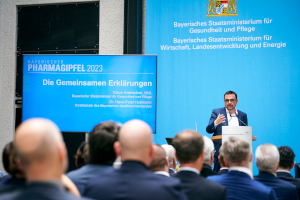
Bavarian pharmaceutical summit in Berlin: Holetschek presents measures for safe drug supply in Germany
20.04.2023 13:12
Bavaria's Health Minister Klaus Holetschek presented measures to secure the supply of medicines in Germany at the Bavarian Pharmaceutical Summit in Berlin on Wednesday, April 19th. Holetschek emphasized: “In various working groups over the past few months we have developed concrete suggestions on how, for example, Germany can be strengthened as a production location. One thing is clear: the federal government must face the immense challenges and take rapid action against the sometimes dramatic drug supply bottlenecks!”
The minister added: “In order to guarantee the supply of medicines, we need research and development as well as production in Germany and Europe! To do this, we must strengthen the attractiveness of Germany as a pharmaceutical location - which is why the price spiral for innovative medicines must not continue to decline. The increased manufacturer discount must expire on time at the end of the year and may not be extended any further. A timely adjustment for inflation is also essential.”
The Bavarian Pharmaceutical Summit takes place in close cooperation with the Bavarian State Ministry for Economic Affairs, Regional Development and Energy. Economics Minister Hubert Aiwanger said: “We have been committed to ensuring that the course is set correctly for a long time. We need the domestic pharmaceutical industry to be strengthened and no more bureaucracy and burdens for drug manufacturers in Germany.”
Holetschek emphasized: “The federal government has already taken the first important and correct steps with a recently presented draft law. But these are still not enough. Especially when there are delivery and supply bottlenecks, more pragmatism and less bureaucracy are required. In particular, procedural simplifications are needed for doctors and pharmacies, so the requirements for retaxation for pharmacies must be generally reviewed. “
The task force convened by Holetschek in view of the delivery bottlenecks has summarized the relevant demands in a joint statement.
Heinrich Moisa, CEO of Novartis Germany, said: “The pharmaceutical industry can be an important key industry for Germany. It not only ensures our health, but also strengthens Germany as a research location, creates jobs and supports our prosperity. The potential of the key pharmaceutical industry can only be used if health, economic and research policies are consistently thought through, as we know from Bavaria.”
Health Minister Holetschek emphasized: “In the past few months, we have worked intensively in various committees on how we can strengthen Germany as a pharmaceutical and biotech location. We also have the effects of GKV-Financial Stabilization Act on the future-proof supply of medicines. The law passed last autumn introduced savings and discounts for the pharmaceutical industry, which are weakening Germany as a pharmaceutical location.”
Holetschek said: “That too GKV-The Federal Government's Financial Stabilization Act has massive negative effects on the future-proof supply of medicines. With the Bavarian Pharma Summit, we are therefore particularly committed to the appropriate further development of the Medicines Market Reorganization Act (AMNOG), which creates the balancing act between financial viability on the one hand and the promotion of innovations on the other. Action must now be taken to strengthen Germany and thus also Bavaria as a pharmaceutical and research location and to put the supply of medicines in our country on a secure footing. To this end, the excessive data protection requirements in the area of clinical research must also be put to the test!”
Clinical studies are an important component for efficiently supplying the population with innovative medicines. The working group led by the Ministry of Economic Affairs, in cooperation with the Ministry of Health and the Ministry of Science, has identified measures to improve the framework conditions in a position paper. Aiwanger emphasized: “Germany has now fallen from second to sixth place in the global ranking of clinical studies carried out due to administrative hurdles and too little digitalization in the health sector and is therefore behind Spain, for example. Our joint working group has drawn up a paper on the topic of clinical research with numerous measures to make Germany a leading study location again.”
Oliver Kirst, Managing Director of Servier Deutschland GmbH, added: “After we have had uniform rules for applying for and carrying out clinical studies within the EU since last year, we now have to work quickly in Germany to remain competitive: That means more speed through tighter structures and processes, reducing bureaucracy and so on Use of digital instruments.”
Wolfgang Späth, CEO of Hexal, said: “Generics and biosimilars are indispensable pillars of drug therapy and need better and future-proof framework conditions.”
Further information about the Bavarian Pharmaceutical Summit can be found at: https://www.stmgp.bayern.de/gesundheitsversorgung/aktuelle-themen/#Pharmagipfel.