


AOK health atlas asthma presented: Major regional differences in Westphalia-Lippe
11.11.2020 10:34
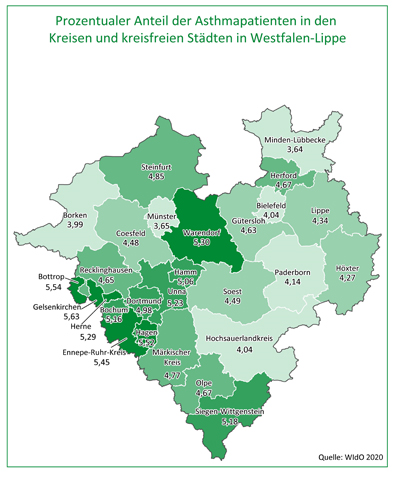
There are clear differences in the proportion of asthmatics in the population between the regions in Westphalia-Lippe. This emerges from the 'AOK Health Atlas Bronchial Asthma', which was presented on November 10th, 2020. While 3.6 percent of residents in the Minden-Lübbecke district had bronchial asthma diagnosed by a doctor, the proportion in Gelsenkirchen was 5.6 percent. In comparison with the other federal states, Westphalia-Lippe has a proportion of asthmatics of 4.7 percent, above the national average of 4.2 percent.
A total of 388,000 asthma patients who receive drug therapy live in Westphalia-Lippe. “The results show that we must not let up on convincing even more people of the special treatment offers for asthma patients in Westphalia-Lippe. We will consistently continue on our chosen path to tailor further measures with our local partners to the needs of the people,” said Tom Ackermann, CEO of AOK NORDWEST. Due to the current infection situation, it can currently be assumed that there is no increased risk for asthma patients of becoming infected with SARS-CoV-2, emphasized the AOK boss.
Using new calculation methods, the AOK Scientific Institute (WIdO), in collaboration with the University of Trier, has for the first time shown the frequency of bronchial asthma for the 18 districts and nine independent cities in Westphalia-Lippe. The AOK Health Atlas shows clear differences in disease frequency according to age and gender. The diagnosis of bronchial asthma is most often made in men aged 80 and over and women aged 70 to 79. It is striking that boys up to the age of 14 are also often diagnosed with asthma. On the other hand, as women age 25 and over, they develop asthma more often than men across all age groups.
Overweight and obesity are significant risk factors for asthma
Overweight and obesity (obesity) are considered important risk factors for the development of asthma. The AOK health atlas also determined the regional obesity frequency for the population in Westphalia-Lippe. This was divided into five equal categories. The result: Most districts and independent cities can be assigned to the categories with an above-average obesity rate. The lowest is only in Münster. The highest category includes Bottrop, the Ennepe-Ruhr district, Gelsenkirchen, Hagen, Hamm, Herne, the Märkische Kreis and Soest.
Asthma patients do not have an increased risk of corona infection
The AOK Health Atlas also examines the question of what effects the coronavirus has on asthma patients. “Even if there is currently no sufficiently reliable information about this, it can be assumed that there is no increased risk for asthma patients of becoming infected with SARS-CoV-2,” says Ackermann. However, there is evidence that specific previous illnesses can increase the risk of a serious course of the disease. “Initial study results indicate that with well-controlled asthma, an increased risk of a severe course of COVID-19 cannot be assumed,” said the AOK boss.
Causes of bronchial asthma are complex
The causes for the development of bronchial asthma are complex and, according to the current state of science, are not fully understood. Nevertheless, one thing is certain: genetic factors play an important role. The main risk factors include the presence of an allergic disease such as hay fever, neurodermatitis or an allergy to animal hair or house dust mites. But chemical irritants and tobacco consumption are also included. You can't change a genetic disposition. The situation is different with overweight, obesity and tobacco smoke. Lifestyle changes such as quitting smoking, getting enough exercise, eating a healthy diet and losing excess weight can help to significantly reduce the risk of developing asthma.
Special prevention programs help
AOK NORDWEST helps its insured persons with special offers as part of its 'Healthy Living' course program. The offers are exclusive and free of charge for AOK policyholders and are carried out on site or as live online offers on the Internet by qualified specialists. “We can only combat asthma effectively if we manage to protect people from the disease occurring and prevent the risk factors,” says Ackermann.
Tailor-made supply offers
In addition, AOK NORDWEST has been committed to better and structured medical care for asthma patients in Westphalia-Lippe for years. For example, the disease management program (DMP) 'AOK-Curaplan' has been an integral part of care for asthma patients for over ten years. Currently, over 29,000 AOK policyholders in Westphalia-Lippe have opted for this program.
In the DMP, patients are treated on the basis of scientifically proven findings. The treating doctor coordinates the entire treatment and sets therapy goals together with the patient - tailored to the patient's personal life situation and their health status. “Our insured people are actively involved in the therapy. In training courses, they learn how to deal better with their illness and how to positively influence its course. Then they know how to behave in an emergency or even how to avoid asthma attacks,” says Ackermann. In addition, they receive targeted preventative measures and regular medical information about their illness, for example in the form of patient handbooks or newsletters. “All of this helps to get asthma under control and significantly improve the quality of life,” says Ackermann. Participation is voluntary and free of charge.
Increase participation rate
However, the participation rate in the DMP asthma programs in Westphalia-Lippe could still increase significantly. Overall the rate is 21.0 percent. There are significant differences within Westphalia-Lippe. In the Warendorf districts 34.7 percent and in the Hamm district 29.3 percent of asthmatics are enrolled in a DMP, whereas in the Olpe and Minden-Lübbecke districts only 17.5 percent each are enrolled.
From Ackermann's perspective, the disease management program shows how well medical care works in Westphalia-Lippe. “Good, tailor-made care can only be achieved where there is local knowledge, a high market share and regional commitment. “That’s why the creative freedom of those involved on site must be further strengthened,” says Ackermann.
Declining mortality and fewer hospital cases
The special treatment offers and effective drug therapy contributed significantly to the fact that asthma-related mortality in North Rhine-Westphalia fell from 1,029 deaths in 1998 to 194 deaths in 2018 over the past 20 years, and the number of hospital treatments fell from 12,517 in 2000 7,678 could be reduced in 2018.