


Antibiotics for colds: prescriptions at record low
07.06.2021 10:24
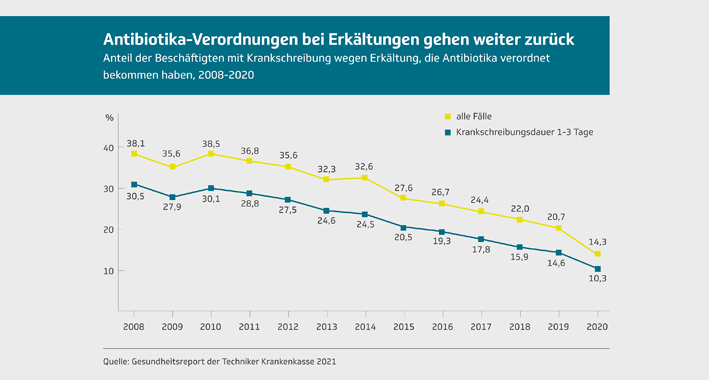
Fewer and fewer patients are prescribed an antibiotic for a cold. This is shown by a current evaluation of the medication prescriptions of employed persons insured by the Techniker Krankenkasse (TK). While in 2010 around one in three insured people (38.5 percent) who was on sick leave due to a cold was prescribed an antibiotic, in 2020 only around one in seven insured people received a corresponding prescription ( 14.3 percent) - a decline of more than 60 percent in ten years. Last year the decline was particularly significant compared to 2019, from 20.7 percent to 14.3 percent.
“Compliance with the hygiene rules has resulted in significantly fewer infections overall. The fact that fewer insured people went to the doctor at all and, for example, used the option of taking sick leave over the phone certainly played a role in the decline in prescriptions for colds. “As a result, fewer prescriptions were made,” says Tim Steimle, head of the pharmaceutical department at TK. When it comes to colds, the following applies: The vast majority of cold infections with symptoms such as a runny nose or cough are caused by viruses. But antibiotics only help against bacteria. “It is important that antibiotics are only taken when absolutely necessary. Of course, this applies to all medicines, but with antibiotics the problem of the formation of multi-resistant germs also plays a role,” says Tim Steimle.
Overall, there has been a sharp decline in antibiotic prescriptions
Overall, significantly fewer antibiotics were prescribed in the “corona year” of 2020. Prescriptions fell by almost 24 percent compared to 2019, to 2.85 daily doses per insured worker. The declines were particularly severe at the beginning of the corona pandemic in April (minus 43.8 percent) and in May (minus 41.6 percent).
The data mentioned comes from the TK's 2021 health report, which will be published on June 23rd. For the health report, among other things, the medication prescriptions of the more than five million employed people insured by TK were evaluated. In addition to those in employment, this also includes recipients of unemployment benefit I.