


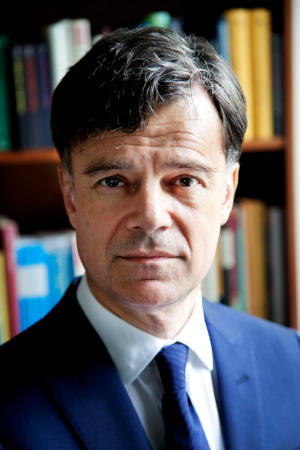
„"Geriatric medicine is relationship medicine": Keynote address by Giovanni Maio at the Geriatrics Congress in Weimar
16.09.2025 14:01
How can a humane, individual-centered geriatrics system be designed in an economized world? Professor Giovanni Maio will address this fundamental question on the first evening of the annual congress of the German Society for Geriatrics (DGG), which begins on September 18 in Weimar.
In his keynote address, designed as a celebratory lecture, the internationally renowned medical ethicist from the Albert-Ludwigs-University of Freiburg advocates for a radical rethink: away from the technocratically shortened view of the elderly, towards a medicine that takes relationships seriously – and thus also old age as a phase of life with its own dignity.
„Geriatric medicine is relational medicine,“ says Maio. „We can only help elderly people if we understand them within the context of their specific life situation and if we connect the medical findings with their well-being.“ For Maio, one thing is certain: medicine in old age must do more than simply treat illnesses. It must enable quality of life and understand the elderly person’s dependence not as a deficit, but as a fundamental condition of human life.
Dependence as a central form of life
Maio points out why the modern understanding of autonomy reaches its limits, not only when it comes to the very elderly. "We are accustomed to viewing dependence as a weakness," he explains. "Yet, dependence on others is a fundamental characteristic of all human existence." This dependence simply becomes more apparent in old age. Anyone who takes this insight seriously must also change medical practice accordingly: away from standardized procedures and towards individualized care. "Only by building a good relationship can one effectively support elderly people and help them reactivate their own resources so that they can remain as independent as possible," the medical ethicist adds.
Old age is a return to what is essential.
„Age is like a magnifying glass, enabling us to see what is essential. It thus has an important corrective function in a youth-oriented society that constantly needs such a return to basics,“ says Maio. „Older people have so much to tell us; we just need to be willing to listen to their messages. Every older person tells us something, simply through the life story they leave behind. And it is important to see in every older person the unique individual with a singular story. Only when we see this can we begin to understand how we can help them in their frailty.“
Geriatrics belongs at the heart of society
For this reason, Maio calls for a higher societal priority for geriatric medicine: „We cannot allow those who are most in need of medical support to be neglected. It is a societal responsibility to move older people from the margins to the center of society.“ He also criticizes economic perverse incentives in the healthcare system that hinder patient-centered medicine. The future of geriatrics lies not in further standardization, but in recognizing its complexity. „Geriatrics must be strengthened as an independent, caring discipline because it shows us what human medicine is all about at its core.“
To person
Professor Giovanni Maio is Director of the Institute for Ethics and History of Medicine at the University of Freiburg and is one of the leading voices in medical ethics in German-speaking countries. In numerous publications and public lectures, he advocates for a values-based medicine that respects the individual in their entirety. His research focuses on the ethics of geriatric medicine, the importance of care and relationships in the art of healing, and the critique of purely economically driven healthcare systems. Maio is a member of numerous scientific committees and ethics commissions and regularly advises professional associations and political institutions.
Save the date
Keynote address by Professor Giovanni Maio: „Personalized Geriatrics in an Economized World“
Annual Congress of the German Society for Geriatrics (DGG)
Thursday, September 18, 2025
6:30 p.m. to 7:15 p.m., Great Hall, Congress Center Weimarhalle