


During the COVID-19 pandemic, older people belong to a particularly vulnerable population group with a high risk of intensive care treatment
30.10.2020 12:48
The unbroken increase in the number of COVID-19 cases as well as the measures decided on Wednesday by the federal government and the heads of state governments to break chains of infection are further fueling the discussion about the reliable assessment of future overload of the health system.
The Central Institute for Statutory Health Insurance in Germany (Zi) has therefore developed an early indicator as a navigation aid for pandemic management. In addition to the reproduction number R and the new COVID-19 case rate, age-specific intensive care treatment rates and the free capacities in intensive care units (ICUs) are included in the calculation of the early indicator.
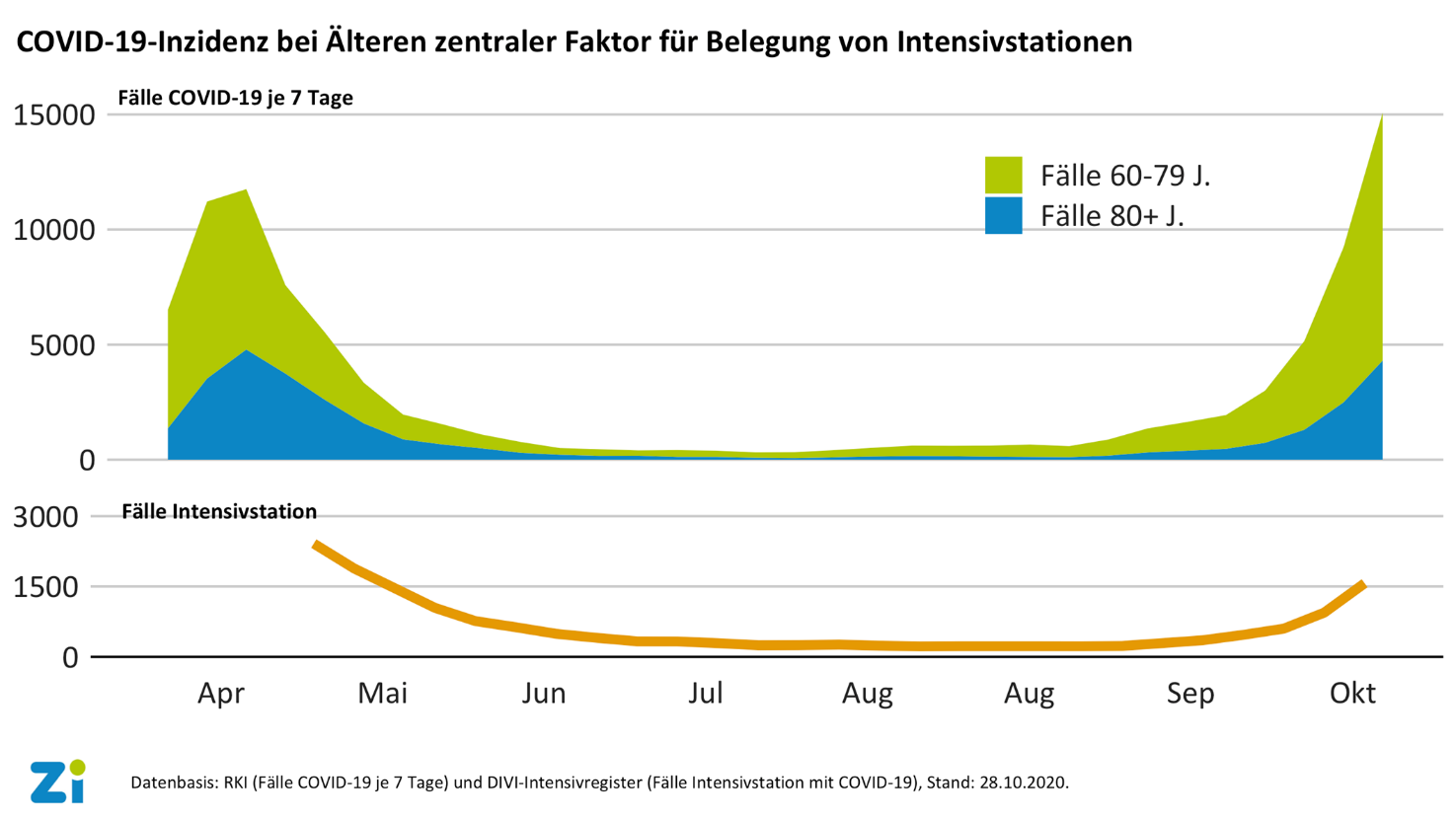
Considering the progression of COVID-19 infections since spring, the evaluation shows a clear connection between the development of the age-specific rate of new cases and the demand for intensive care treatment. In the spring, the highest number of patients over 60 years of age was almost 11,800 cases over seven days. This was accompanied by 2,415 cases in intensive care units. As the COVID-19 incidence leveled off in the upper age segment, the number of ICU cases also fell. With the beginning of the second wave, which was initially characterized by a small proportion of older patients, the same pattern as in the spring emerged again: with an increasing number of patients over 60 years of age - most recently from a few 100 to currently 15,000 cases in the last seven days – the number of ITS cases is also increasing again. This averaged around 230 in August and rose again to 1,569 by October 28th.
“It is important to look at the COVID-19 infection process in an age-differentiated manner due to the age-dependent risk of intensive care treatment. The leading indicator developed by Zi, the aim of which is to provide a realistic picture of the risk of the healthcare system being overloaded, takes this feature into account. It is intended to help focus pandemic management and medical resources on the specific protection of population groups that are at high risk of serious illness. In addition, the indicator can help make decisions on the selection of pandemic management measures while weighing up competing risks,” said Zi CEO Dr. Dominik von Stillfried.