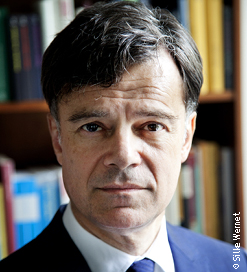
“We must not privatize the structural problems of modern medicine, but we must solve them both structurally and individually.” With these words, the medical ethicist and doctor advocates for a new understanding of what makes a good doctor and what makes good medicine. In his opinion, medical skills are primarily about “the reliable assessment of the individual case,” which requires bringing together different forms of knowledge, but which also requires “more time autonomy” and at the same time “more sensitization to the importance of communication-oriented and thus problem-solving conversations.” be. For him, the central path to good medicine is through “investing in a trusting relationship with the patient.”
>> “Without insight into the limits of what is possible and the meaning of what is given, we cannot become happy.” Do you remember when you wrote that?
Yes, that is a quote from a book published in 2014.
Hand on heart: Do you have the feeling that in medicine “the limits of what is possible and the meaning of what is given” have developed for the better in the last decade?
Some things have gotten better, but unfortunately the economicization of medicine and thus the distance from patient well-being has continued to increase.
In your presentation at the event “Diabetes care by 2030 – how much progress do we dare?”, organized by Novo Nordisk at the Royal Danish Embassy in Berlin last fall, you asked about demands and reality in the healthcare system and whether patient well-being comes first . What was your answer?
I have shown that the treatment and support of patients with diabetes requires seeing each patient in the context of their life and that the quality of the therapy depends on the quality of the relationship. I emphasized this in order to raise awareness of the fact that doctors need a combination of evidence and relationships in order to achieve patient-oriented medicine, and that the framework conditions for the latter hardly exist at the moment.
In your lecture you also addressed a discrepancy that seems to be disappearing in the age of evidence-based medicine: On the one hand, you said something like this, “medicine can only be good if it sees itself as a science”, on the other hand, medicine is not a theoretical science that deals solely with natural laws, but a practical, singular medicine that is always required to make decisions in individual cases. Accordingly, medicine must see itself as a bridging discipline that is encouraged to synthesize. Where does this thought lead us?
I wanted to make it clear that the professionalism of doctors consists in understanding the patient's particular aspects through knowledge of the general; It is the reliable assessment of the individual case that determines the skills of the doctors. But in order to be able to assess this individual case well, you have to bring together different forms of knowledge; there is the local finding that can be objectified and there is the feeling that is less objectifiable because it is subjective; there is what I can measure and map, and there is what I can only hear. There is what I can show and, above all, what I can touch. There is what the NMR image shows me and there is what the patient tells me. You have to constantly bring all of this together in medical practice, because being a doctor inevitably goes hand in hand with the need to get an overall picture of the patient. This applies to all of medicine in general, but to diabetology in particular.
In your lecture, you also pointed out a second dissonance: between the required functional-rational thinking and the equally necessary understanding-oriented, hermeneutic thinking, whereby the synthesis of both types of thinking makes medicine so demanding. But there is no corresponding number for this in the EBM (nor in the GÖA). Isn't that the biggest mismanagement in the doctor/patient system?
This is not only a mismanagement, but also a reductionism in the head that becomes normal through such structures and thus has a false impression on generations of doctors. As a doctor, you have to bring the laboratory world together with the patient's life; The laboratory world can be discounted, but the desire to understand the patient's world is considered pre-professional, and that is exactly the error in thought. Basically, the fee structure implicitly follows a mechanistic view of humanity and at the same time a positivistic understanding of science. Medicine needs scientific facts, but it does not function in them because medicine is not about repairing an organism, but rather it occurs to help people. That is why medicine cannot be absorbed in the repair paradigm, but rather it must understand interpersonal relationships as an integral part of its scientific and professionalism.
In your opinion, what is the actual performance of the doctors, even though, as you explain, they are currently paid according to the motto “The main thing is to do a lot but think little”?
The actual achievement of the doctors lies in understanding the complexity of the patient's history and using their experience with the patient to help them overcome their illness-related problems. It is the combination of complexity management skills and problem-solving skills that they have to bring to bear every day. There is no other way to practice medicine. This makes it clear that the performance of doctors cannot be reduced to mere prescription, because a successful interaction must always have taken place before the right action can be taken. Therefore, interpersonal relationships in medicine are not something super-erogatory, but rather it is the basic condition for a scientifically sound approach, because if you don't have time to listen to the patient, you will write out the wrong prescription or miss the fact that the prescription doesn't really help solve the problem .
You urge a “willingness to speak”, but in your lecture you also restrict that this willingness is tied to structures that have to be maintained. Can this be achieved in an economized system in which only individual achievements are actually rewarded, while quality and holism are, at best, products of chance?
We must not privatize the structural problems of modern medicine, but we must solve them both structurally and individually. We need more time autonomy for doctors and at the same time more awareness of the importance of communication-oriented and therefore problem-solving conversations.
“We have to recognize that, especially when it comes to chronic illnesses, we cannot start from the vision that the health we strive for can be produced, it can only be co-produced.” With this sentence, you received praise from the doctors present at the “Diabetes Care by 2030” received much applause. How can this co-production be promoted and implemented into the system even though there is (currently) no obligation to do so?
This is only possible through relationship work. No lecturing, no lecturing, no moralizing and no threatening. But rather an investment in a trusting relationship with the patient. This is the central path to good medicine.
Aren’t doctors and especially their lobbyists also partly to blame for the current remuneration system? Isn't the medical profession making it a little too easy for itself if, based on its operational logic, it wants to be paid for the (easily calculated) quantity of the individual services it provides instead of for a quality that is difficult to assign precisely?
Unfortunately, we have a very one-sided socialization of doctors. Studying succumbs to the error of a scientific bias, and practice succumbs to the error of an engineering-scientific approach to people. Both must be corrected for an integrative approach to medicine to take hold.
Many protagonists are talking about “value-based medicine”, which can only succeed if we move from the previous therapist-centeredness to a patient-centered one, said moderator Prof. Dr. Tschöpe in the conversation after your lecture. How do we get there? Wouldn't the medical profession gain much more than it would lose in monetary terms from such a paradigm shift?
My students in the lecture hall chose medicine because they didn't want to study engineering or business. They want to pursue a profession that is close to people, and that is what is actually fulfilling and meaningful about the medical profession, that you can do something good for them when you meet people. Patient orientation is therefore not a new guideline, but rather it is the actual basis, indeed the actual meaning, of medicine. We have just lost sight of this meaning and must put it back at the center of all thinking and action in medicine in the interest of patients, but also in the interest of meaningful medical practice. <<
Professor Maio, thank you for the interview.
The interview was conducted by MVF editor-in-chief Peter Stegmaier.