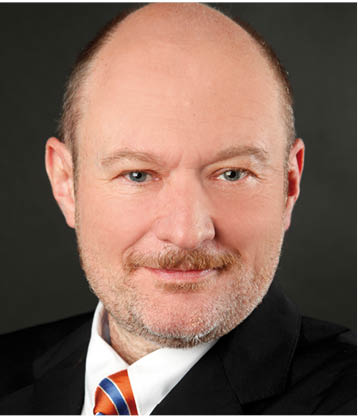
The Institute of Epidemiology and Preventive Medicine at the University of Regensburg was founded in 2008 with the appointment of Prof. Dr. Michael Leitzmann as chair and director. The institute, still headed by Leitzmann today, includes three professorships: the Chair of Medical Sociology—shared by Prof. Julika Loss and Prof. Christian Apfelbacher, which will be presented here—as well as the Chair of Genetic Epidemiology, held by Prof. Iris Heid, and the Chair of Epidemiology and Preventive Medicine, held by Leitzmann.
>> Regensburg, a city on the Danube, is the seat of the government of Upper Palatinate, one of Bavaria's seven administrative districts. The Upper Palatinate is recognized as the official center of the European continent—more precisely, in Hildweinsreuth near Flossenbürg. While the city of Regensburg, with its 150,000 inhabitants, is not quite as advanced in health services research, the professor duo Loss and Apfelbacher are working diligently on it.
Dr. Julika Loss began this work at the Institute for Medical Management and Health Sciences at the University of Bayreuth, where she worked as a senior academic councilor from 2001 to 2009. At that time, she was able to provide scientific support for a new funding program for prevention projects run by the Bavarian Ministry of Health (Healthy.Life.Bavaria) for several years. During this evaluation, it became clear to her that there were still no good approaches to quality management for preventive programs, nor any concepts or gold standards for the methodological evaluation of such programs. When she was appointed Professor of Medical Sociology at the University of Regensburg in 2009, she was able to research and work specifically in the field of clinical health services research. This is partly due to the fact that Medical Sociology is located within the Medical Faculty at Regensburg, and contacts and collaborations with medical partners from the clinic developed quickly and easily.
However, it quickly became clear that the work couldn't be accomplished alone. So Dr. Christian Apfelbacher came on board: When Julika Loss was appointed to the professorship for medical sociology in 2010, she was looking for someone to raise the profile of this field. The opportunity and the prospect of supporting the development of medical sociological research at the Institute for Epidemiology and Preventive Medicine at the University of Regensburg were both appealing to Dr. Christian Apfelbacher and, in terms of lifestyle, a very good fit for the Upper Bavarian with roots in the Upper Palatinate region. Loss: "With my colleague Apfelbacher, we have already been able to plan and implement many interesting projects in the fields of trauma and visceral surgery, rheumatology, pulmonology, dermatology, as well as ophthalmology and dentistry in collaboration with clinicians."
In the prevention research that it continues to conduct, however, the focus is currently on complex, setting-based measures to promote physical activity and healthy nutrition. In the area of cli-
In healthcare research, Loss considers the medical perspective particularly important. Among other things, data is collected from physicians on various issues to understand how they make decisions on complex clinical questions and thus influence care. This raises many questions: "How do transplant surgeons decide whether to accept or reject an offered donor organ?" "How do the increasing findings on the genetic basis of common diseases influence medical information and patient care?" Or: "How can hospital networks support medical development?"
decisions and job satisfaction?” Loss added: “I am convinced that new care concepts can only be implemented with and through doctors.” To do this, it is important to identify barriers, challenges and
to truly understand the facilitating factors in everyday clinical processes as they appear to physicians. She considers qualitative methods particularly suitable for adequately understanding the physician's perspective.
Apfelbacher comes from a somewhat different perspective. He began his scientific work in applied epidemiology in the social medicine department of Heidelberg University Hospital, focusing primarily on the incidence and risk factors of occupational skin diseases. Since those affected also receive secondary and tertiary preventive care at Heidelberg University Hospital, the evaluation of preventive measures quickly became a focus.
interventions as a research topic, which simultaneously marked his entry into health services research. "I then coordinated the establishment of the world's first therapy registry for chronic hand
eczema*, which was intended to provide information on the care and long-term course of affected patients,” is how Apfelbacher describes his entry, which culminated in intensive work with data from registers and patient cohorts on various issues.
His personal goal is to contribute to the currently dynamically developing field of health services research in Germany. Working across different
across disciplines, for example with psychologists, public health researchers and medical professionals. Apfelbacher: “Communication between the disciplines is definitely a challenge that I am willing to take on.” Another of Apfelbacher’s missions lies in strengthening what is known in Anglo-American parlance as “patient and public involvement”, i.e. the inclusion of both patients and the public in research. His thesis: “The growing scepticism towards science must also be countered in health services research, for example by involving patients from the outset in the formulation and prioritization of research questions.” And all of this not only nationally in a local context, but also internationally if possible. This is reflected, among other things, in the fact that he is both a Visiting Research Fellow at the Brighton and Sussex Medical School in Great Britain and a Visiting Professor at the Lee Kong Chian School of Medicine in Singapore.
One of Loss and Apfelbacher's greatest successes was securing funding from the Federal Ministry of Education and Research to conduct the so-called DACAPO study.** This is a Germany-wide, multicenter study to assess the role of quality of care indicators on health-related quality of life in survivors of acute respiratory failure. This study is being conducted in cooperation with the Department of Anesthesiology at Regensburg University Hospital (Prof. Dr. Thomas Bein). Results from DACAPO are, in turn, being incorporated into a project funded by the Innovation Fund to develop and pilot an intensive care follow-up outpatient clinic (PINA), which began last fall.
Another success is the Regensburg Institute's participation in two subprojects within the BMBF's research alliances on prevention ("Capital4Health," coordinated by Prof. Rütten, University of Erlangen). This project, now in its second funding phase, focuses on promoting a healthy and active lifestyle among older men and, in particular, on how to integrate community stakeholders—including the healthcare professions—into relevant programs. Furthermore, methodological work is being conducted, together with Institute Director Leitzmann, to evaluate the overall alliance. The 2015 conference "Collecting and Using Data for the Practice of Prevention and Care," held at the University of Regensburg and chaired by Julika Loss as conference president, was also a success. This joint annual conference of the German Society for Social Medicine and Prevention, the German Society for Medical Sociology, and the Bavarian State Office for Health and Food Safety attracted over 1,000 participants. Over three days, topics related to public health, social medicine, health services research, and the role of the public health service were discussed.