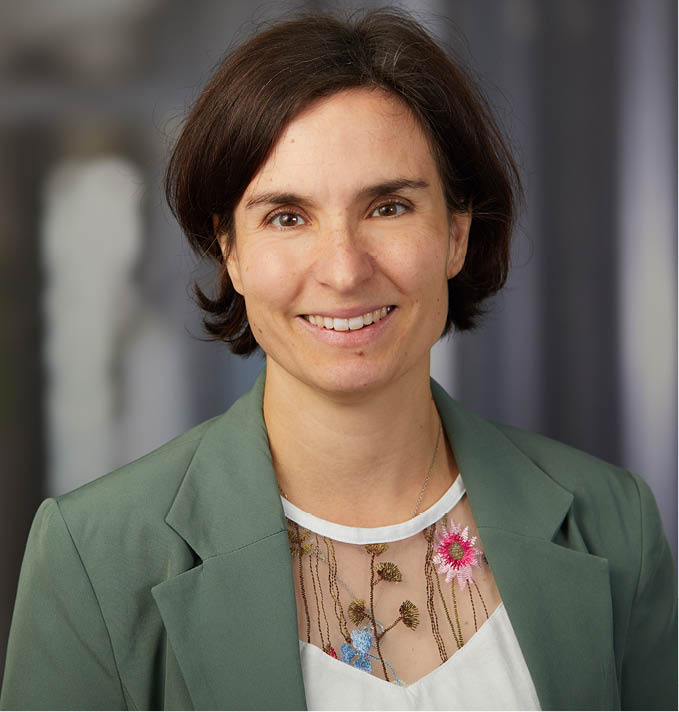
>> It is generally assumed that a career in academia, as well as its content, is planned down to the last detail. Juliane Köberlein-Neu has not entirely adhered to this ideal image of an academic career. Since her junior professorship in health economics and management at the University of Wuppertal in 2010 did not seamlessly follow on from previous academic activity, but rather followed on from a three-year stint at the Institute for Empirical Health Economics in Burscheid, her current roots in health services research are the result of an intensive orientation phase. During her time at a private contract research institute, she became aware several times that the academic freedom offered in an academic environment is priceless and a valuable asset. When the opportunity arose for her to apply for a junior professorship in health economics and management at the University of Wuppertal in 2010, she seized the opportunity. „What excited me about the advertisement for my future position in Wuppertal was that local stakeholders from the healthcare industry, together with the university and a lot of commitment, were working on a completely new research area
which the W3 professorship for health economics and management and the junior professorship, which were advertised at the same time, were now able to bring to life," Juliane Köberlein-Neu recalls her start in university teaching and research at that time.
Her vision is to bring science and practice closer together in projects and to achieve equal cooperation between both sides, not just on paper. Köberlein-Neu: "This is certainly not always easy to achieve, as cooperation on equal terms always requires accepting one's own competence limits and establishing a mutual understanding of relevance." Such a process requires time in every research network, which is rarely granted to projects. However, it is important to give practice space for its own developments and to act as a facilitator from the scientific side.
She is convinced that the opening of predominantly scientific
dominated research projects towards participatory working networks, health services research will continue to advance and health care will be sustainably strengthened in all areas.
Since this statement corresponds almost exactly to the guiding principles of the Bergisches Competence Center for Health Economics and Health Services Research, it's no wonder that since her appointment, the BKG has steadily grown and flourished both in terms of the number of employees and the range of topics covered. The composition of her working group is characterized by a high degree of interdisciplinary expertise.
In contrast to the majority of chairs and working groups in the field of health services research, the BGK is not affiliated with a medical faculty, but rather is part of the Faculty of Economics at the Schumpeter School of Business and Economics.
A key focus of the faculty-wide research activities is in the area of innovation research, which provides the working group with valuable interdisciplinary input, particularly with regard to the adaptation of methods and theories.
Research at the BKG is both quantitative and qualitative. "We conduct research and teach primarily on issues at the interface of health, healthcare, and economics," explains Juliane Köberlein-Neu. Her primary goal is to contribute to the evidence-based and needs-oriented development of regional and supra-regional healthcare.
One current focus of the work is the holistic evaluation of complex interventions. This includes the planning and evaluation of new forms of care that further develop cross-sectoral care or optimize interfaces within a sector, as well as the investigation of health technologies. In the spirit of holistic approach, evaluation is viewed as a continuous process that analyzes interventions in different stages of development or areas of their life cycle.
lysed and questions examined at different levels, e.g. organizational or patient level.
A particular focus of the work in this area is on the economic evaluation of interventions and the explanation of so-called complex causality.
Furthermore, researchers at the BKG are investigating the healthcare situation of people in different life situations (e.g., those in need of care) and in various medical fields (e.g., ophthalmology). In this context, they are also interested in surveying healthcare pathways among vulnerable population groups and the impact of health policy decisions on healthcare provision and thus on the public.
A first important milestone in the development of the working group was the funding of the project "Interprofessional Medication Management in People with Multimorbidity (WestGem Study)" as part of the Objective 2 funding series "IuK & Gender med.NRW." The project was one of the first cluster-randomized studies in Germany to examine the effectiveness of medication management supported jointly by pharmacists and general practitioners.
The BKG also gained important access to practice partners in the Bergisches Städtedreieck through the project „solimed ePflegebericht“, which was also part of the Objective 2 funding series „IuK &
Gender med.NRW“ was supported.
In the following years, important funding projects followed on other topics such as: blindness and visual impairment (Jackstädt Foundation), advance care planning (BMBF), medical-nursing cooperation in care facilities (Innovation Fund), digitally supported drug therapy (Innovation Fund) and shared decision making (Innovation Fund).
However, the working group's greatest success to date is that in 2018 the university made the research field of health services research permanent, meaning that the currently existing bachelor's degree programs in health economics and management can now be supplemented by a master's degree program.
But despite all this, Professor Dr. Juliane Köberlein-Neu also sees an important component of her research in the further development of methods in health services research and health economic evaluation.