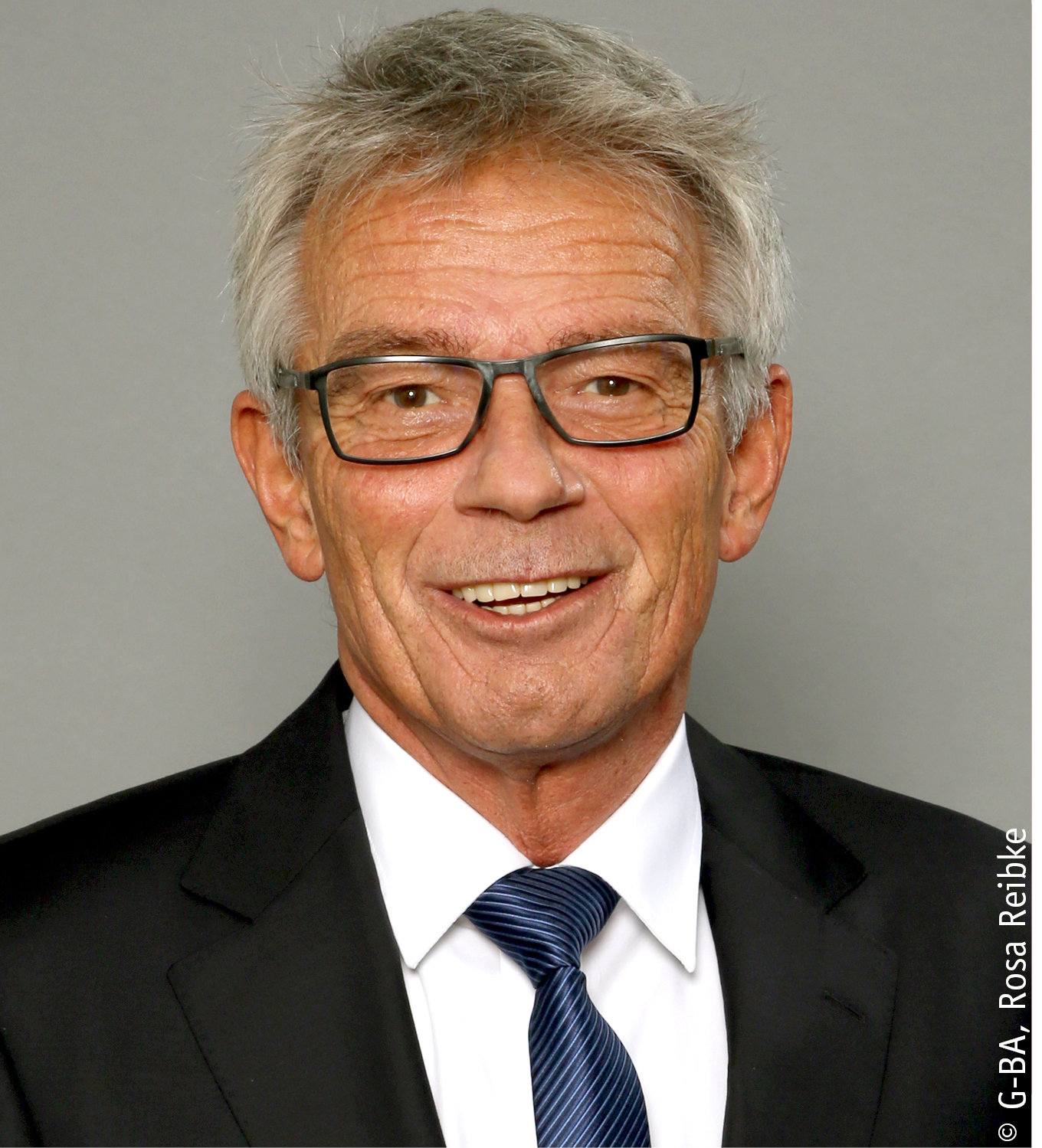
The Federal Insurance Office (BVA) currently has around 540 employees and 50 departments. A relatively small one of these presentations deals with what some health insurance representatives are currently publicly criticizing: the health fund, which for some is the devil, but for others it is a protective shield that has already proven its functionality in the current financial crisis, like Josef Hecken - President of the BVA since March 2008, previously Minister of Health of Saarland - explained in an exclusive interview with “Monitor Healthcare Research” (MVF).
>> Some representatives of health insurance companies are currently painting a very bleak picture of impending underfinancing, debt traps and insolvency, which could threaten in the next one or two years. As President of the Federal Insurance Office, which is responsible for the health fund among many other tasks, can you understand this argument?
What some box office managers claim is a bit adventurous. In public discussions, developments are usually lined up one after the other, each of which could potentially occur in isolation in a worst-case scenario, but which will not occur cumulatively.
Why?
Quite simply: If such a worst-case scenario that is being painted on the wall actually became reality, politicians would and would have to react immediately.
The worst-worst case scenario, a long-lasting economic crisis, is not that unlikely based on the current economic data.
For me, the crucial question is not how the gross domestic product will develop in the current economic crisis, but rather how employment will develop in Germany. The labor factor essentially generates the contribution income of the health insurance funds.
What alternatives do you see?
There are actually only two: either the contribution rate must be adjusted or the federal subsidy must be increased. However, this will only happen if the employment situation and thus the income situation develop so dramatically that fund coverage of 95 percent is no longer guaranteed in the coming year.
Which data set did the estimator group use to move on to the next round? And what recommendations were made?
According to the group of estimators, premium income will be around 2.9 billion euros lower this year than was estimated in October 2008. What is important, however, is that this reduced income is not at the expense of the health insurance companies and therefore not at the expense of health care. This year there are still over 167 billion euros available for the care of the sick. The health fund, which has been so heavily criticized by many, has already sustainably stabilized the income situation of the health insurance companies in the year it was introduced and has also proven to be a “protective shield” for the health insurance companies.
What would happen without a health fund?
In the “old system” the health insurance companies would have had to dramatically increase their contributions. Many board members tend to forget this. It's just more practical to hit the health fund. If the health insurance companies were to operate without the federal government's coverage, i.e. without the health fund, many health insurance fund representatives who are currently acting as prophets of disaster would have to quickly teach their insured community that higher contributions than before are necessary. The fund alone gives everyone the chance to formulate a manageable framework over a certain period of time - until the coverage ratio falls below 95 percent.
What is the current public discussion like for you?
Unfortunately, different levels are mixed in the argument. In my opinion, the fact that in the current year - i.e. the first year of the health fund - eleven billion more will be made available for medical care than in the previous year is left out too much.
Critics claim that this is not enough.
It should be noted that when this billion-dollar additional budget was determined, an increase in spending compared to the previous year of 6.4 percent was assumed, an increase that has never occurred at this level in the last ten years. That's one thing. On the other hand - and this is even more important - the available money is finally allocated to those health insurance funds that particularly care for chronically ill people through the morbidity-oriented risk structure compensation.
In the public discussion about funds and M-RSA - which, although they work together, but in principle should be seen as independently functioning instruments - the local health insurance companies and Barmer are also politely holding back.
Criticism comes primarily from representatives of those funds that, thanks to the system of the old risk structure compensation, had much more money at their disposal in the past than now, money that they did not need to care for the chronically ill. Today, 47 percent of the financial allocations for the health insurance funds are determined by direct morbidity criteria and just over 50 percent by indirect criteria such as age and gender and only 2 percent by the inability to work criterion. This shows what shifts have occurred to the detriment of the so-called competitive funds. I even understand why they don't like it.
But it probably has nothing to do with the health fund in the actual sense.
Correct. These are the effects of Morbi-RSA. It benefits the large health insurance companies, which in the past had to really struggle to finance health care for their millions of insured people in some way - often even with supplier credits. These funds in particular currently have excellent liquidity and therefore finally have the resources that they need in order to be able to really provide high-quality care to the sick people they insure. Seen this way, the money is now going where it belongs.
Isn't there still not enough money in the system?
I do not think so. If all health insurance companies really didn't have enough money to provide for their insured people, they would have to explain to me where the eleven billion had gone. What is more likely to me is that we are currently simply seeing a budget redistribution towards those funds that have the higher morbidity risks. And they therefore need the money more urgently - that was the political intention. And that is also correct.
Assuming the evidence-based case that there is not enough money in the system could actually be made, what then?
Then you will not be able to avoid making fundamental decisions about the structure of the system. However, these are decisions that, in my opinion, are only marginally influenced by the question of whether there is a health fund or not, or whether an individual health insurance company has to increase its contribution by one or two percentage points. Then it's a completely different dimension. For example, you then have to think about what the control service catalog can or should look like in the future.
Those funds that are currently dominating the public discussion are saying very clearly that the allocations will no longer be sufficient for them to be able to offer programs in the long term, especially to better care for and control chronic sufferers. On the other hand, such supply programs would be the only way those health insurance companies could manage to get by with the money available. Is the cat biting its own tail?
That is - I would like to say - a very special view of things. The fact is that for those health insurance companies that require higher budgets for the care of chronically ill people, the instrument of standardized treatment costs has finally created an opportunity to raise the DMP financing processed via the former RSA to a much higher quality level.
In the past, there were only two components to the financing of DMPs. On the one hand, this was the flat rate consultation fee of 85 euros, and on the other hand, the allocations amounted to the average costs for participating chronic patients. The new system is more qualitative?
The allocations to the health insurance companies on the basis of standardized treatment costs is a very important change that will lead to more quality in the system. A health insurance fund now receives a higher allocation than before for a rheumatism or diabetes patient through chronic surcharges. This is regardless of whether the patient is enrolled in a DMP or not. In addition, there is a significantly higher program fee compared to before if the insured person is enrolled in a DMP. This means that good care programs can be financed both on a planned and long-term basis.
If the current 180 euros are enough.
This amount consists of 55 euros for administrative costs and 125 euros for additional medical expenses. This wasn't just plucked out of thin air, but was proven by the National Association of Statutory Health Insurance Funds in what I believe to be a very transparent and open process. But of course there was criticism from many health insurance companies again.
Surely it was about the amount?
Naturally. But there was no criticism that the amount was too low. The criticism came from the cash registers, which don't have that many chroniclers. These 180 euros were far too much for them. And this despite the fact that the utility companies were able to make it credible that they were just getting by with this amount.
Which, according to Barmer's statements in the last issue of Monitor Health Care Research with a focus on diabetes, is also the case. But here the question also arose as to whether the 180 euros will continue to be a reliable basis for DMPs in the future.
That's basically what she is. However, it is also clear that the flat rate program fee will be reviewed annually.
So the money from the Morbi-RSA is just enough?
This brings into play the question of quality of care, which will become increasingly important. In the future, health insurance companies with morbid insured people will only be able to operate efficiently under the auspices of standardized treatment costs if they succeed in optimizing care. This is not possible without good programs and also not without patient control. But conversely, it is of course also true that the fund receives lower surcharges if it has fewer sick people as clients. But for me, the healthy insured person is still the best risk that a fund can have.
Or the insured person who deals with their illness responsibly.
For sure. Without the patient and his active participation it doesn't work. This is a finding from the evaluation of the DMPs. Of course, on the other hand, it has also been noted that there are significant differences in the success rates of DMPs depending on the socio-structural background of the patients. Higher care intensities are therefore necessary, especially for patients who - for whatever reason - are a little further away from active participation.
Which will ultimately result in bonuses or penalties.
In my opinion, one should think less about Mali in this context and more about bonuses. The goal must be to create a willingness to participate in some way, otherwise every health insurance fund will run after its spending spiral like a hamster in a wheel.
What about the big topic of prevention?
Primary prevention is and remains the key. The healthy insured person is clearly the best risk. If an insured person becomes ill, it is just as important to stabilize them so that the illness does not progress and cause cost problems. Therefore, secondary prevention must be strengthened. But - as with DMPs - this can only be done with the cooperation of the insured person. Without him or against him you can forget everything.
The pension funds now have those insured cohorts with high morbidities. And with Morbi-RSA we're doing quite well at the moment. But what will happen in the future if these high risks plunge into already foreseeable cost spirals simply due to age and disease progression?
Every health insurance company is well advised to set its chroniclers as precisely as possible in order to keep them in a stable state for as long as possible. But the cash registers also know this exactly.
Do you expect an increase in the public health quotient in Germany?
That is the stated goal of this system.
Will Morbi-RSA remain with the 80 diseases currently defined?
These 80 diseases represent around 3,600 diagnoses, which represent the essential part of the care system. Which doesn't mean that we mean those diseases with the highest cost structures, but rather those that mainly affect chronic care.
The number 80 is defined by politics. Will something happen?
The number 80 probably won't change. It is therefore the basis for our work, the further development and also the adaptation of the criteria or the selection of the diseases or indications that are included in the Morbi-RSA or not. The scientific advisory board, whose task lies here, has just been reappointed.
However, the advisory board needs evidence-based facts for its work, of which there are relatively few in the field of public health. You must have a veritable treasure trove of data?
That's correct. We also discussed very intensively how we would deal with this, for example as part of our first DMP evaluation report. But unfortunately there is a very relevant data protection problem here.
Certainly regarding the competitive situation of the health insurance companies.
Exactly. We evaluate the successes and failures of individual DMPs for individual diseases and health insurance companies. In this respect, certain data is of course also relevant to competition.
This will probably once again amount to anonymization, although the insured people have the right to know what is happening with their money.
The health insurance companies are not legally obliged to give us their data for health care research programs. They are only obliged to make them available for the legal technical issue of extending and financing DMPs. However, we are currently considering with the National Association of Statutory Health Insurance Funds how the data can be compressed without losing its scientific value. But sometimes the devil is in the details, for example when you think about different structures of the insured or different study approaches. That alone limits its scientific value.
What do you do with this certainly very interesting data?
Our goal is to work together with university institutes. The knowledge that is available here in a breadth and depth like nowhere else simply has to be used scientifically.
Who should finance these health services research contracts?
Probably not us. There are certainly a number of scientific institutes that have a great interest in our data. They could therefore be the starting point of a self-sustaining process for the benefit of the supply system.
Wouldn't it make sense if your institution also took part in health services research?
We would be involved. On the one hand, we would provide the data. On the other hand, we have the monopoly of initial evaluation. This evaluation in turn presupposes that we precede internal exegetical processes. In this way, I believe, we are definitely involved in any targeted healthcare research. We will also formulate questions that are of particular interest to us or our advisory boards. But we cannot and will not presume to be not only the largest risk structure adjustment authority, the largest Morbi-RSA determiner, but also the largest DMP evaluator in the world. As if we had nothing else to do.
With this bureaucratic monster, as has often been apostrophized?
In which just 22 people work for Fonds and Morbi-RSA. In principle, the whole thing is not magic. In the past there was already an RSA that was administered by the Federal Insurance Office. From the moment the new system was in place and the morbidities were entered by the health insurance companies, it was relatively easy to calculate such things. I would like to see more objectivity instead of populism when it comes to health funds. That would help everyone!
The interview was conducted by MVF editor-in-chief Peter Stegmaier