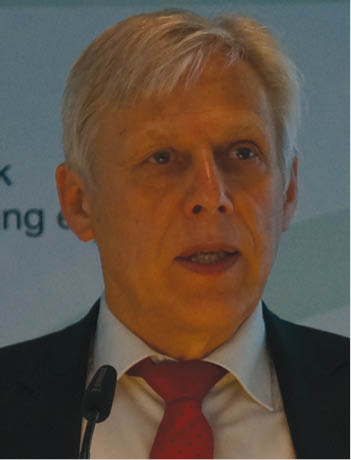
>> When Neugebauer made his “Pro” opening statement, the world of healthcare researchers was still pretty much in order. The chairman of the German Network for Health Services Research and dean of the Brandenburg Medical School spoke about what the DNVF had achieved with the memoranda, in which, among other things, a checklist on register quality was agreed upon. Only when the systematics and appropriateness, standardization, validation of sampling, data collection and statistical analyzes are consistent are we talking about good registers. But why do these registers exist? Neugebauer asked rhetorically and immediately gave the answer: “First of all, it’s about describing connections of an epidemiological nature.” He mentioned prevalence, incidence and course. However, where it becomes difficult is the evaluation of effectiveness and benefits in everyday care. Since registers can record data and facts from entry into the care facility through to convalescence, the core feature of registers is high external validity - in contrast to RCTs with high internal validity. Neugebauer: “The main difference is that we use registers to represent the so-called everyday care routine.”
This is nothing to say against RCT as such, which Neugebauer, as a self-confessed representative of the EBM scene, is also far removed from. RCTs are the gold standard, but even with this type of study there are good and bad ones. And you have to read them very carefully to see whether the information is valuable enough to be included in guidelines or a decision for action, for example. Because patient selection, low comorbidity, low comedication are Taylored, plus the care bias, the observation effect and the Hawthorn effect, which can lead to further distortions. In order to meet the criterion of everyday care in registries as opposed to clinical studies, Neugebauer considers, on the one hand, the setting - for example, normal hospital operations in registries versus artificial settings in RCTs through separate study centers or special laboratories.
As a second point, Neugebauer mentioned uncontrolled conditions in RCTs versus controlled conditions in RCTs - such as monitoring medication intake in the latter. “The main difference that distinguishes both instruments is that between efficiency and effectiveness,” said Neugebauer. An innovation as a result of a pure clinical study could change overall when it encounters the reality of health and health care. Nobody knows exactly how without a register, because the effect can be either additive or negative. His conclusion: “RCTs negate the context of a health service.” This context consists of the presentation of the health technology, the patient characteristics, the doctor characteristics, the doctor-patient interaction, which can significantly influence everything, and finally the characteristics of the setting - whether the Care is now provided in an outpatient clinic, hospital or rehabilitation facility: “The context of a health service, like the health service itself, can have significant health effects, because a complex intervention meets a complex environment.” What works and how and actually brings a benefit for the patient or In Neugebauer's opinion, only registers and health services research can represent this, even if the comparability of the data collected is certainly better with RCTs.
The ideal world of health services research suddenly clouded over when diaperer stepped up to the microphone. He announced at the beginning that he did not want to make a statement against registers because it “would be completely silly” to speak out against registers that can answer sensible questions - neither IQWiG nor he himself disputes that.
However, there is a completely different point when it comes to patient registers as part of the benefit assessment. This point, which makes the discussion relatively difficult, is - according towickeler in the original tone: "permanently repeated assertions that are simply wrong". The fact that RCTs have low external validity is simply not true, said Wascher, making a statement that he immediately repeated: “We have just read what surprised me and what I have never read before: RCTs negate the context . That's not right." That's exactly why it's relatively difficult to have a pro and con discussion when "certain statements are simply repeated over and over again that are simply not true." Now you act as if you are, because you In Germany AMNOG would have to switch to register. It wouldn't work at all, saidwickeler, "because we don't have the registers at all", at least not "registers of good quality in any halfway critical mass."
If he's not mistaken: At a kick-off workshop that took place in November at the invitation of the Technology and Methods Platform for Networked Medical Research eV
(TMF) took place in Berlin, it became clear that the critical mass had long since been reached: 51 scientists discussed concepts for setting up model registers for health services research, the concept development of which has been funded by the Federal Ministry of Education and Research (BMBF) since September 2017.
“16 different new and very different registries that use a uniform registry protocol – that is a great opportunity for health services research,” explained Prof. Dr. Jürgen Stausberg (University of Duis-
castle food). And Neugebauer, chairman of the DNVF, which supports the development of the registers in partnership with the TMF, added: “High-quality registers are of central importance for health services research and an important building block for the further development of the healthcare system.”
With funding from the BMBF, the DNVF can now contribute its expertise to the development of new register projects and thus make a concrete contribution to increasing quality. But also the TMF, which has supported and carried out various projects to set up and operate registers in recent years. Not only has there been a memorandum from the DNVF on registers, but also a guideline on the topic of “data quality in medical research” that has already appeared in the second edition (2014) in the TMF series of publications. “We are pleased that we have received the order to support the registry projects,” said Sebastian C. Semler, Managing Director of the TMF. “We bring our expertise in the development and operation of research data infrastructures to bear here.” The task of the TMS is also to network the registers with each other and with already established registers.”
In the end, that is exactly whatwickeler demands - albeit with unnecessarily harsh words. <<
from:
MVF editor-in-chief Peter Stegmaier