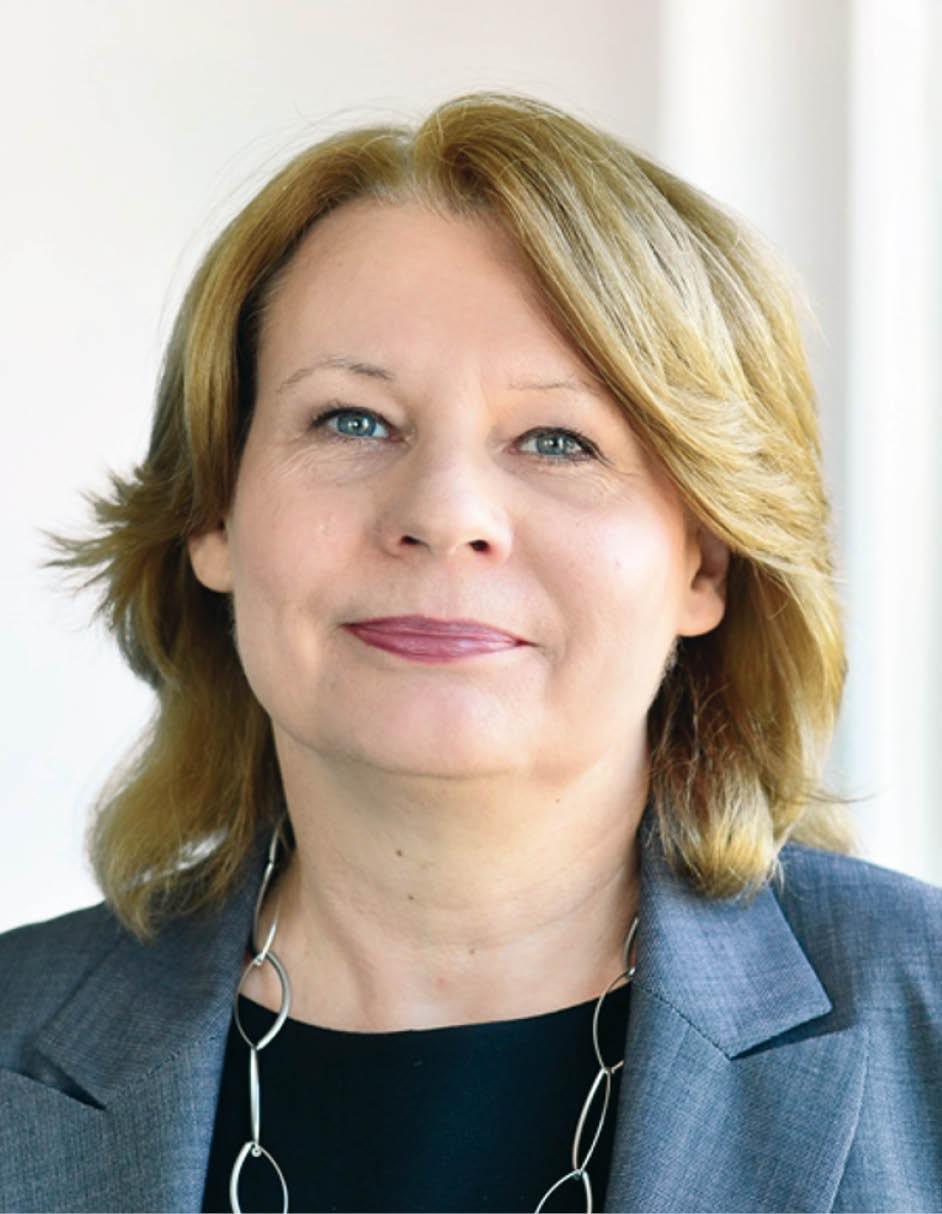
As Senator and President of the Authority for Health and Consumer Protection of the Free and Hanseatic City of Hamburg, as Deputy Member of the Federal Council for the Free and Hanseatic City of Hamburg, as a member of the Health Committee and the Federal-State Working Group, Cornelia Prufer-Storcks relies on the results of health services research. As an experienced health politician, she says in the cover interview with “Monitor Health Care Research”: “I am glad that we can rely on the results of health care research in many areas - especially on the deficits of our system.” In many, that means not in all. That's why she brought an extensive wish list with her to this year's German Congress for Health Services Research, of which she was patron.
>> Dear Senator, your federal state can definitely be seen as one of the winners of the innovation fund. According to an evaluation by the Berlin knowledge consulting firm Ordinary People, no fewer than 38 applicants for innovation fund projects currently come from Hamburg, and there are also - double entries are possible here - 75 projects in which consortium partners from Hamburg - above all TK - are involved.
On the one hand, this is the positive impression of the excellent healthcare research landscape that has developed in Hamburg, especially in the last decade. On the other hand, it shows the willingness of service providers and payers in Hamburg to take new paths together. We can be a little proud of that.
You also supported this year's 16th German Congress for Health Services Research, whose president also comes from the Hanseatic city.
When Professor Härter from UKE asked me well in advance of the congress whether the state of Hamburg wanted to support this year's DKVF, I immediately agreed. This is certainly partly due to local patriotism, but is particularly an expression of my appreciation for health care research as such. That's why, as a health politician, I was happy to take the opportunity to leave a small wish list with the healthcare researchers gathered here at the opening event.
Do you feel a bit left alone by health services research?
Not in Hamburg, but at the federal level one is sometimes surprised that there are no German studies on very relevant issues. In Hamburg we not only have a very diverse and broad landscape of health care research, but also very intensive cooperation between health services research, the payers, the service providers and of course also politics, which is of course also due to the special situation of our city state. This gives us the opportunity to discuss many of the issues that concern politics with health services research and have them researched by them. This is exactly why the Hamburg Center for Health Economics (HCHE), a joint center between the University of Hamburg and the University Hospital Hamburg-Eppendorf, was founded in 2011. Over 70 researchers work and conduct research in this, which is the largest German health economics research center, which includes eight chairs and institutes. No wonder that, in addition to research projects from the Federal Ministry of Education and Research, there are also many from the Innovation Fund. And then there is also the Hamburg Network for Health Services Research, or HAM-NET for short, which was created in 2017 as part of BMBF funding for “Structural Development in Health Care Research”. There is also a lot of research going on here that health politicians like me are particularly interested in.
What for example?
At the HCHE, essential preparatory work has been carried out on the subject of minimum staffing levels for hospital care. In addition, Professor Schreyögg, the head of the HCHE, advises the federal government on health issues in the Advisory Council. He also works on the Scientific Commission for a Modern Remuneration System (KOMV), which was appointed at the suggestion of Federal Health Minister Jens Spahn and confirmed by the Federal Cabinet in June of this year.
And yet you brought your own wish list to the DKVF.
I couldn't miss the opportunity to address the entire healthcare research landscape in Germany.
What concerns in particular?
We all know very well that the major challenges ahead in healthcare are essentially characterized by the aging society and the associated increase in chronic diseases and multimorbidity. But although we have known this for years, I personally have doubts as to whether we can really respond adequately to the challenges of the future with our current healthcare structure. My wish list is therefore linked to what we currently have as a current political discussion in healthcare. We currently have the opportunity not to have to formulate austerity laws, but rather to initiate fundamental reforms with equally fundamental decisions that can and should address exactly those areas where we have had the biggest problems in the healthcare system for many years. When I say “fundamental decisions,” that means that you also have to have the courage to reverse a decision from the past at one point or another.
On which?
Over the last 15 years, we have repeatedly tried to make our healthcare system more flexible, more adaptable and more patient-oriented, primarily through increased competition. Above all, the sector boundaries must be overcome because the strict separation of sectors in Germany contradicts pretty much all requirements for future-proof treatment, especially for chronically ill people, and thus also patient-oriented care. However, we have to be honest and take stock that overcoming sector boundaries with selective contracts has hardly been successful so far - at least not beyond certain model experiments. But we also have to see that with the competition that politicians themselves have set in motion, for example through the introduction of flat rates per case in the hospital sector, we have also promoted a movement that is leading to an extremely tense personnel situation in nursing. We – and I can definitely speak for all the health politicians I know – certainly didn’t want that.
What is to be done now?
There is a declared intention of the federal government, but also of the states, to finally initiate the transformation of our healthcare system into a cross-sector care system. To achieve this, fundamental changes must be introduced in many areas, for example in requirements planning, remuneration, quality assurance, coding, ensuring documentation of data exchange and much more. The guiding principle must be that all areas speak the same language, by which I mean not only the outpatient and inpatient areas, but also nursing. A federal-state working group was set up for exactly this purpose and began its work a few weeks ago. Here, too, as a member of this working group, I am very happy that we can rely on the results of health services research in many areas - especially on the deficits of our system.
What about the stronger quality orientation in the healthcare system that was already initiated in the last legislative period?
This is a long-term project that must be put on the agenda in this legislative period and far beyond. It should be critically noted that self-administration is very slow in implementing the political will, which could encourage the relationship between state and self-administration to be examined more closely. But I don't want to go into that here and now because it's a very separate and very complex topic. But here too, politics - like self-administration - is urgently dependent on the results of health services research.
Where else to go back to your wish list?
I would personally like to see more German studies on the influence of treatment quality on life expectancy and quality of life. Evidence of where we can achieve the maximum positive impact with certain procedures, for example second opinion procedures, allows us to set priorities better. Another topic that is particularly important to me in the healthcare metropolis of Hamburg is a current development that is almost the opposite of the desired de-hospitalization in psychiatry. We have to notice that there are an increasing number of hospital cases that are not actually due to the classic diagnoses that require hospital treatment, but are increasingly triggered by depression. I would like to see more results from health services research. The question should also be pursued as to what prevalence mental illnesses really have in Germany. And how to ensure that the patient is treated exactly where it is best for the person concerned, regardless of incentives based on offers or remuneration.
There is a lot to do in health services research.
I'm far from finished yet.
Namely?
Another very central point is that we have to put the meta-topic of competition to the test. Competition can certainly be very helpful for better care in certain places and in certain forms, but not in others, for example when I think of the undesirable development of care in hospitals that I have already mentioned. Politicians have now already ensured that payment for hospital care is separated from the flat rate per case and in the future will again be based on the cost-coverage principle, which means nothing other than that every position filled must also be paid, which is also ensured by minimum nursing staffing limits the hospital departments. Here I have to make a somewhat critical comment to health services research that, as a member of the expert commission that initiated these minimum staffing levels for hospitals, I would have liked to see German studies on the connection between staffing levels in nursing care in hospitals and treatment results, because Not every international study is so easy to apply to the German healthcare system.
Continue with the dream concert.
For example, what about the question of the relationship between insurance status and quality of care? Or between remuneration systems for medical services and the performance of services? At this point I would like to see more scientific support, which would particularly benefit the scientific commission that is supposed to develop a modern, uniform remuneration system. Anyone who is to develop a system that avoids false incentives must not only be aware of the weak points in our system - which in particular includes the lack of coordination of health services - but also have documented them in a scientifically sound manner.
A broad field for health services research.
We urgently need well-trained health care researchers who deal with relevant questions and support the upcoming and urgently needed decisions so that we as politicians do not remain in the playing field of chance.
Which is a well-known accusation.
Yes, I know that all too well, but politicians don't like to fly blind. I expressly wish for the necessary evidence. However, as a health politician, forgive me for focusing on care rather than science: what is relevant for health politicians may not automatically be a boost for a scientific career.
Some of these wishes are certainly addressed to the innovation fund.
Politicians have also tried to use this instrument to advance health services research to some extent. In both parts of the innovation fund, because the innovative forms of care that are to be incorporated into standard care if possible must be accompanied by health care research. At this point I would like to acknowledge the work of health services research in Germany, especially since this science has managed to catch up to an internationally recognized level in the last ten years. There are now regional, national and also international structures in which German health services research is very well embedded.
Your petition?
I would like to encourage healthcare researchers not only to continually make all their findings available to politicians and other, sometimes somewhat sluggish healthcare institutions, but also to impose their criticism and solutions to a certain extent. And if health services researchers need help, for example in the area of using data, then I am happy to create more opportunities, for example to use the existing routine data, because this treasure is still not exploited enough for health services research. And I am also prepared to take the results of health services research into account in my work, if necessary also to revise earlier decisions if better, more evident results are available.
A great offer for active communication.
Politics and health services research need to come into more contact. Actually, health care researchers need the ability to anticipate what politicians will be dealing with in three, four or even more years. To do this you have to stay in conversation permanently. It would be a great benefit if the good health care research structure we now have would strive to find solutions that are most urgently needed by politics, self-government, but also by patients.
Ms. Senator Examiner-Storcks, thank you very much. <<
The interview was conducted by MVF editor-in-chief Peter Stegmaier.