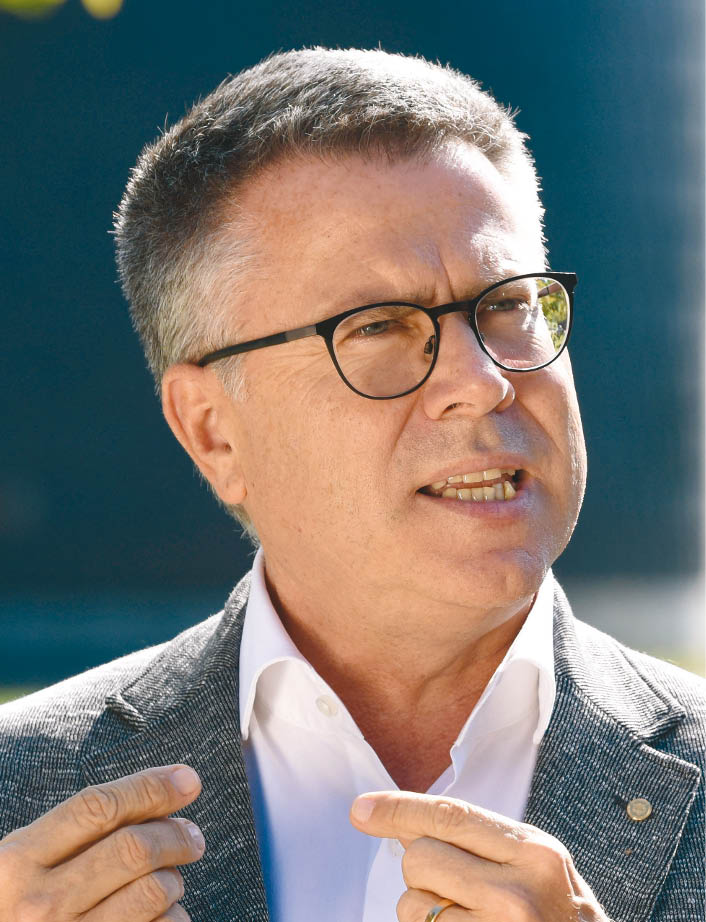
>> Mr. Pfundner, you are not only the board member of the German branch of Roche's pharmaceutical division, but also the managing director of the Roche Holding in Germany, in which the other branches in the areas of diagnostics, research & development and production are represented. You also lead the BDI “Digital Health” initiative, which was founded in January 2018. Is this broad list the route for what comes after Pharma 1.0?
That's right, the interaction between diagnostics, medication and medical treatment - i.e. the medical effect - is put into an intelligent context using data. We are already using the associated opportunities in research, clinical development and patient care. However, the prerequisite for this is that we expand our skills, our thinking and our actions beyond the classic industry boundaries. At Roche we are taking this approach aggressively. Pharma and diagnostics have been working successfully under one roof for decades. We are currently systematically expanding our competencies in the area of health IT internally and are also entering into targeted strategic alliances. Examples of this are our acquisitions of Flatiron Health and Foundation Medicine Inc. - two start-ups whose particular expertise lies in networking data and processing it so that it can be used for treatment as well as research and development.
How do you redefine what is commonly and thus very truncatedly subsumed under the term “pharmaceuticals”?
I don't think the core of what pharma ultimately is needs to be redefined. In the foreseeable future, the medical effect, i.e. what ultimately benefits the patient, will continue to be achieved with drugs. And we know how to research, develop and produce medicines. By the way, this has always had something to do with data management. What will fundamentally change, however, will be the context in which the therapeutic agent is used. This can already be observed most clearly in oncology today: the importance of molecular diagnostics for the targeted therapy of a tumor has made personalized medicine in oncology possible. Today we link the data from the anamnesis with the molecular genetic information and, for example, radiological findings, compare these with anonymized data from patients with a similar constellation and who have already received therapy, and thus provide the treating oncologist with more information in order to initiate the optimal, most personalized treatment possible .
The aim of the convergence you apostrophize is “personalized medicine”, although a documentation from the annual meeting of the German Ethics Council in 2012, at which you yourself also spoke, added critically: “Patient as beneficiary or victim?” Your opinion?
At the time, I was very pleased that the German Ethics Council had already addressed this issue in 2012. And back then I spoke out in favor of a technology offensive and advocated clearing the way for molecular diagnostics, “red biotechnology” and genetic engineering. Because these are basic requirements to make “personalized medicine” possible at all. At the time, there was also critical discussion about the fact that information technology was not yet capable of processing the necessary amounts of data. And that is exactly what has now changed fundamentally: Today we can bring together millions of patient data and thus make them usable for both individual therapy decisions and research - and the fiction that was still discussed back then has already found its way into healthcare today. Against this background, the German Ethics Council published a statement on “Big Data in Medicine” last year. Essentially, the Ethics Council summarizes its statement with the keywords “Sharing is healing”. He points to the opportunities offered by data donations, which can be used, particularly in medicine, to extend lives and enable a better quality of life.
With the networked, digitalized and therefore “personalized medicine” that you promote, which – as the quasi-promise of salvation means – enables every patient to receive the optimal therapy for them, new tasks are already arising today in the healthcare system of tomorrow. Which would those be?
The tasks are divided between politics, science and business. Politicians must ensure that we can create a comprehensive infrastructure with 5G and digital networking with the electronic patient file. Part of our reality is that data management in this country is still highly fragmented and information is often still exchanged on paper. There is still a lack of a common strategy, a collaborative approach by all those involved in the healthcare system that takes social benefits beyond special interests into account. Business can make an important contribution here. We are currently gaining experience in this context in the USA: Within just a few years, our partner Flatiron Health has established a technology platform that collects, networks and analyzes data from cancer patients. Flatiron now works with the FDA and over 280 US cancer centers and manages the data of more than two million cancer patients. The wealth of knowledge in this networked information can be used by regulatory authorities, other companies, clinics and science.
Likewise, if this new form of medicine is to be successful, significant changes to the system will likely be necessary, which can only be achieved by all healthcare partners working together. Where do you see the most important adjustment screws and who must operate them?
I agree with you completely: it can only be done together and by allowing all players to participate - because it's about the best ideas and technological implementation options. My biggest concern is that the legislature is relying too much on the “self-healing powers” of self-government. Self-government should be one of, if not the most important, beneficiaries of digitalization. But giving digitalization a mandate can only lead to a standstill - as the example of the electronic patient file shows us. It is in the nature of digitalization that it brings changes for everyone involved - especially for self-administration. This can only be done from the outside. Politics can and must set the framework here - or it will be given to us in an uncontrolled manner. And without changes to our healthcare system, we will neither be able to meet today's pace of innovation nor be able to exploit the potential of modern, digitalized medicine. An example: Today it is often no longer ethically justifiable to carry out placebo-controlled studies. We have increasing evidence that existing healthcare data, so-called real world data, can serve as a comparison arm. However, this requires a fundamental adjustment of the drug approval as well as the benefit assessment in such cases. New study concepts such as tumor-agnostic basket and umbrella studies are also part of scientific reality - here we will not get anywhere by sticking to basic methodological principles. And that's why I hope that the approval authorities and the G-BA will be open to these discussions.
Networked, digitalized and “personalized medicine” is the basic prerequisite for a vision in oncology that still seems unthinkable today to become reality, which says that in just twenty years no one should die of cancer anymore. Anyone who has visions should go to the doctor?
If we consider what has happened in oncology over the last ten or twenty years, then I am confident that this vision does not have to remain a vision. Advances in oncology are now so rapid that the vision is increasingly becoming a reality. Let's look at the most recent breakthroughs in cancer therapy: Today we are talking about drugs that intervene in tumor pathology in a highly specific way, we are talking about cancer immunotherapies that specifically activate our body's own immune defense against cancer, we are experiencing the beginnings of gene therapy and we are already working on it today Cancer vaccines – therapies that are manufactured individually for each individual patient. And drug and technological progress go hand in hand in oncology: using modern analysis methods, automated gene sequencing, an individual profile, the fingerprint of the disease, can now be created for each individual tumor within a very short time. This can support the choice of therapy for individual patients - but by networking thousands of tumor profiles, we also gain new starting points for researching further personalized therapies. I am convinced that in the foreseeable future we will enable many more cancer patients to be cured or at least to have a chronic course of the disease - if politicians and society are prepared to make the second most common cause of death in Germany a priority for action. The fact that politicians have just declared the “Decade against Cancer” is the right signal. But now it’s time to “butter the fish”.
Decades ago, Roche introduced “Herceptin,” an effective precision medicine to combat HER2-positive breast cancer. What experiences have you had with it? What were the barriers to innovation?
The introduction of Herceptin into the treatment of HER2-positive breast cancer has been described by some as the “big bang of modern personalized medicine.” And initially we – like the practitioners – underestimated the potential of this targeted approach. Neither standardized diagnostics was available nor was there a sufficient amount of the monoclonal antibody available. However, the initial treatment successes quickly corrected this picture. You have to imagine: It was known that HER2 positivity was a negative prognostic factor and that the patients had a significantly shortened life expectancy. With “Herceptin” the negative prognosis became a good one. We now have three modern antibodies available for the treatment of women with HER2-positive breast cancer - and HER2 testing has long been an established standard. If diagnosed and treated in a timely manner, these therapies offer women with advanced disease the chance of significantly extended survival - in the early stages of the disease, HER2-targeted therapies have made a decisive contribution to the fact that we can also speak of a cure. With the introduction of “Herceptin” around twenty years ago, the hurdles for further innovations in this area have also changed. Today it's about protecting women from metastasis. For example, it was shown that the combination of “Perjeta” and “Herceptin” in neoadjuvant or preoperative treatment almost doubled the proportion of patients whose tumor was no longer pathologically detectable at the time of surgery. Such a pathological complete remission can be measured after just a few months and is associated with a better long-term prognosis. This endpoint was accepted by the approval authorities - but was not included in the German benefit assessment procedure. Our system must become more flexible and progressive here.
Studies on the socio-economic footprint can prove whether innovations are worthwhile. What studies has Roche already carried out, what has been proven or not proven?
Innovations are always worthwhile – if they benefit people. For example, we recently conducted a study with the WifOR Institute on the socioeconomic benefits of lymphoma therapy with our product “Gazyvaro”. As part of this analysis, the clinical study data was linked to economic parameters. And the result of this model calculation was clear.
What came out of it?
Early use of “Gazyvaro” would result in almost 12,000 additional years of progression-free survival by 2030 compared to the current standard. This can even be quantified in economic terms: there would be an economic benefit that exceeds the therapy costs by around 200 million euros. The analysis shows us: Innovations are not only worthwhile for the individual patient, but ultimately also for our society as a whole.
In a recent statement, the Science Council complains that the potential of clinical studies in Germany is not being exhausted. Among other things, Professor Martina Brockmeier, the chairwoman of the Science Council, calls for “studies that address important questions regarding care, such as the question of which of several different therapy options is the best for the patient.” What is your opinion?
The concern is entirely justified – as are the questions associated with it. However, I do not believe that classic clinical studies do justice to the possibilities here - the duration and costs are simply prohibitive. Currently, around five percent of potentially existing patient data is collected as part of clinical studies. Conversely, this also means that the large treasure trove of data is buried in routine care. The collection and analysis of this real world data would undoubtedly be a benefit for everyone involved in the healthcare system and could answer many questions that we currently only know from clinical studies.
Prof. Dr. Michael Hallek, Chairman of the Board of the German Society for Hematology and Medical Oncology eV, recently called for “research-based care” or “care-giving research” instead of health care research at the specialist symposium “Endpoints in Oncology (MVF 06/18). Can you agree with that?
Professor Hallek speaks from my heart. This is already partly a reality today. Capturing and using real world data gives the doctor the opportunity to find similar courses as a reference; At the same time, the new data enables future comparisons. Linking molecular diagnostic methods with data from laboratory, imaging and other sources can help us make “personalized medicine” a reality today while generating usable data for future decisions. We can thus take the acceleration of knowledge growth to a new level.
What can Roche do to increase the level of evidence from real world data, which IQWiG leader Prof. Dr. Jürgen diaperer devalues, supports or even proves with the term “non-stop chatter” (MVF 06/18)?
I regret that Mr.wickeler is so apodictic here. Under certain conditions, we do not have to shy away from comparing RWD and clinical studies. Our company Flatiron Health has already developed RWD in the USA of such quality that the American FDA has recognized and accepted it as additional first-degree evidence; Reimbursement institutions in other countries also agree here. We were able to show very precisely the agreement of RWD with data from clinical studies. The same also applies to the post-approval recording of rare side effects. Here too, with RWD we were able to provide the regulatory authorities with evidence that could not be collected in post-marketing studies. That's progress!
Prof. Pfundner, thank you very much. <<
Citation note: