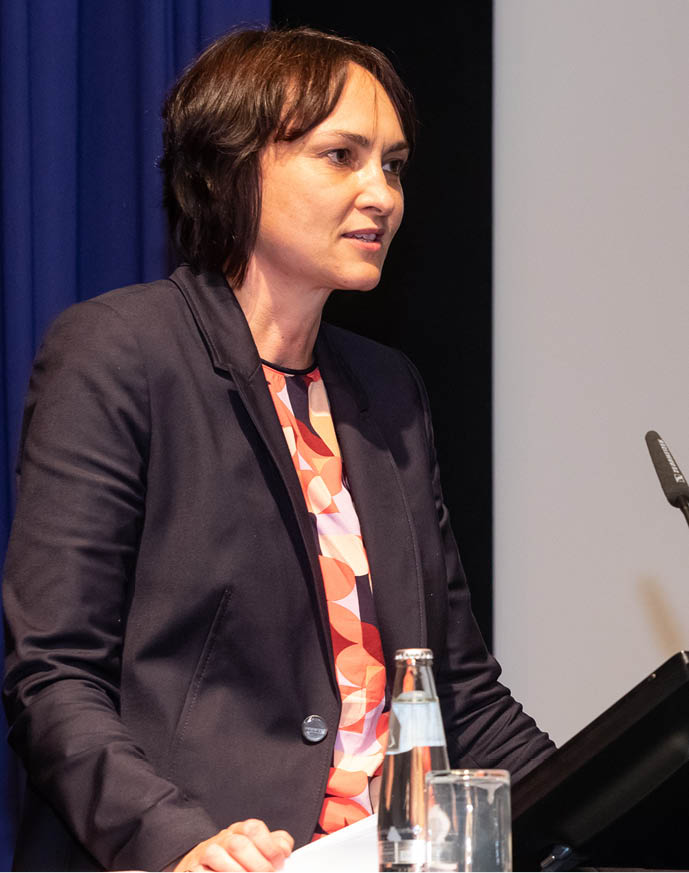
>> The DIMDI Morbi-RSA data processing center, which is “currently very thinly resourced,” is to become a “research data center with a clear, very broad area of responsibility.” Jana Holland, responsible for departmental research at the Federal Ministry of Health, explained this at the BMG satellite symposium at this year's DKVF. According to the Digital Supply Act (DVG), which was discussed in the first reading in the Bundestag on September 27th (editor's note: and has now been approved by the Bundestag on November 7th), this research data center is not just intended to provide advice and offer support for researchers, but also “significantly expand” the data available to date, which is limited to Morbi-RSA data. According to Holland, the data pool should include “the entire billing range of statutory health insurance”. At least that's how it would be set out by law now, although the pending regulation still needs to define which specific data can actually be made available. And this will no longer be done with a time delay of up to four years, as was previously the case, because, according to Holland, “direct transmission” of the data will be introduced in the future: from the individual health insurance funds to the GKV umbrella association and then directly to the research data center. Holland: “In this respect, we hope to be able to significantly reduce the time delay.”
But she had even more messages for the health services research community gathered at the DKVF. She announced that the provision of pseudonymized individual data sets (unfortunately only at postal code level, and also shortened to three digits) was no longer only regulated as an exceptional case. Her request in the subsequent panel discussion (quotes from it on the right): “As a healthcare researcher, you could provide examples from practice to show the level of detail in which the data is needed in order to be able to really generate insights. That would help everyone in the very theoretical data protection discussion.”
Another piece of good news concerned the previous practice that if, in exceptional cases, you wanted to access pseudonymized individual data sets, you had to go personally to the DIMDI in Cologne. In the future, the research data center will be required to set up so-called “controlled remote access”. These are all ideas of the BMG that can still change in the ongoing parliamentary deliberations, but - according to Holland - "we hope that the law will be passed without major changes or, above all, deterioration" (editor's note: an assessment, which was true.)
According to the plan, the law should come into force on January 1, 2020, immediately followed by an associated ordinance procedure that regulates the framework set out in the law in a data transparency regulation. In her opinion, this also includes adjustment efforts and preliminary work on the part of the National Association of Statutory Health Insurance Funds, which must be enabled to collect the data. The BMG therefore expects that the complete data offering will “perhaps be available from 2022 at the earliest”, which was a first but also difficult step, especially with regard to data protection and data security. “It is necessary to get a better deal for research,” explained Holland.
Ultimately, health services research needs good, representative data from health care and not just a small, limited range of data as before. This is the only way to generate the insights that “help us advance our care”, of course always in compliance with data protection regulations. However, Holland said that the current General Data Protection Regulation should be used to make room for maneuver, which is what the law is trying to do. Also with regard to an even larger data pool, consisting not only of the social data of the health insurance companies, but also supplemented by patient data, which should be linked “in the future” to other data bodies. However, everything is done step by step, because in Holland's opinion it wouldn't work if all possible data sets were integrated from the start.
For example, those from registers. Holland announced that the BMG wanted to take a closer look at “the potential of medical registers for care and research” to see how they could be made more usable for research. The BMG is planning to commission a report on this. <<
by: MVF editor-in-chief Peter Stegmaier
Citation note: