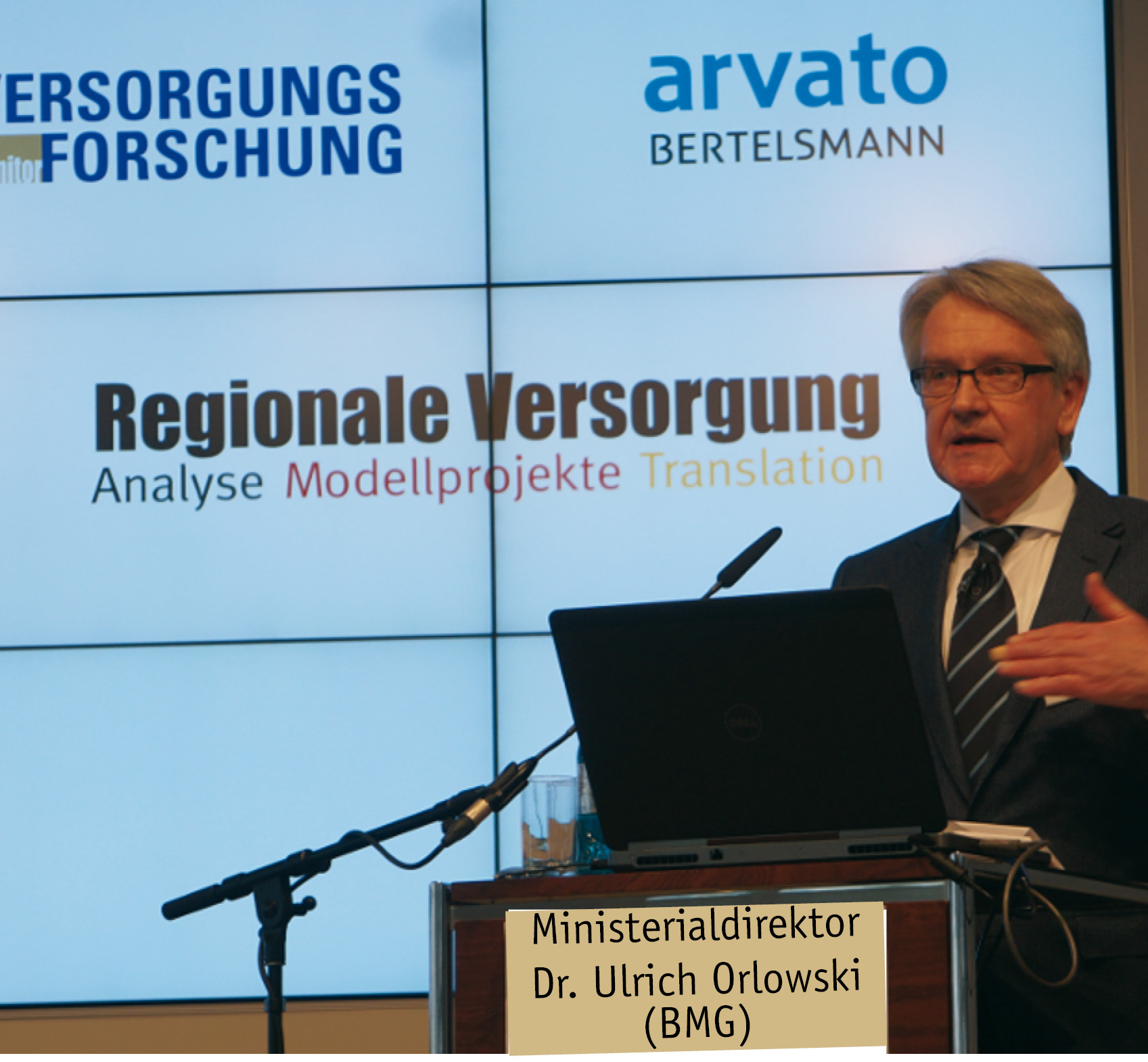
>> “We are starting with the innovation fund projects and in the meantime we are thinking about how the transfer to standard care can be successful,” Hoffmann asked the ministerial director at the BMG after his presentation, in which he explained the differences in regional care financing that is already possible today using two examples. His answer: “If you want to see it negatively, you can see it like this.” However, the innovation fund projects for innovative forms of care are not l'art pour l'art projects, but have to be started from the beginning in order to enable the transfer to standard care in, “the health insurance companies are the central players”, but the further development of the RSA in the next legislative period and the ongoing preparation of the associated discussion are also necessary in order to be able to define the financial framework conditions. Because most of these projects - at least according to his experience with integration supply projects - are not based solely on quality and efficiency reserves, that "strangely enough, that has never worked out."
That's why we will have to create framework conditions that - when it comes to the transition to standard care - will have to provide an answer, especially to the question of financing. But that will be a difficult process because, first of all, the framework conditions are financed centrally through risk structure compensation. But central also means: equal! However, since the conditions and infrastructural framework conditions are very different in all regions - both within and outside the systems - the big question arises as to the extent to which it will even be possible to organize supply projects within regions.
In order to illustrate two already established but quite different financing approaches, Orlowski chose inpatient psychiatry as an antipode, which, according to the PsychVVG, has a nationwide service description with empirically based, uniform daily flat rates (PEPP); However, the conversion of the price system into a budget system (no state base case value, but individual house fee value) had already been carried out in order to take structural and regional peculiarities into account when negotiating the total amount at house level. This means that the regional structural peculiarities in the PsychVVG are taken into account as a factor in the formation of the overall contribution, which means that the remuneration system is more regionally oriented.
In the case of somatics, however, there would be a nationwide service description with an empirically based price system (DRG) and uniform national prices. The state base case value (no price negotiations, only quantity at the house level) is now agreed at the state level, which does not allow prospective consideration of cost developments or consideration of different cost levels. Now the DKG's current demand amounts to additional (increasing) consideration of different regional effects at the house level, which leads to the question: How do we deal with regional level effects at the house or state level in somatics?
As a third antipode, Orlowski brought up outpatient contract medical care, which has a nationwide service description with a nationwide evaluation system as a rating ratio (EBM), but a regional euro fee schedule (based on the nationwide orientation value) and a morbidity-oriented total remuneration. Here, the negotiating partners could agree on surcharges and discounts for regional peculiarities in the cost and supply structure as well as for service providers particularly eligible for funding, especially in underserved areas.
However, taking regional characteristics into account is only optional here. “Is this a traffic accident or a paradigm shift?” Orlowski asked, adding that the discussion is pending but doesn’t belong here. However, the fact is that since the Care Structure Act was activated, the contractual partners have been able to agree on the above-mentioned surcharges and deductions at regional level to the total remuneration for special costs and care structures as well as for special service providers who are eligible for a salary, especially in underserved areas. Orlowski: “You can agree on that,” but this act is neither capable of arbitration nor can it be enforced. This means that the budget that flows into care through “this skill” would only amount to 200 million euros, with a total amount of around 35 billion euros in the area of contract medical care; which should be seen in addition to the money that flows into regional financing via the structural funds.
Nevertheless, a uniform answer to the question of the relevance of regionality in competition, which represents the “connectivity between allocations and service provision”, is necessary. But how this should happen is unclear. “What does regionalization mean on the delivery and financing side,” asked Orlowski and gave the honest answer: “I don’t know either. “The same price for the same service or regional compensation components based on the same prices? Or: Uniform federal allocation with or without a regional component? Or also: regional contribution calculation in addition to national average contribution calculation with regional and federal direct supervision?
However, it is clear to him that all projects that are started as part of the integration provision or with the help of the innovation fund will only work if the question of financing has been clarified, because the contractual design option alone does not lead to this. Orlowski: “You can make models as you want. If the successful projects of the innovation fund are to be transferred to standard care, the financing questions have to be answered.” Therefore, you have to decide whether you want to stick to the mantra “same price for same service “I want to hold on to it or want to expand or continue on the path to regional compensation components.
That was a balancing act, said congress co-chairman Prof. Dr. Dr. Alfred Holzgreve (Vivantes), namely between regionally functioning projects on the one hand and the need to forcefully roll out these projects that only work in a certain setting. It would be better if there were different structures for this because the supply is not the same everywhere. “I would see it differently,” Orlowski replied. Of course, it is clear that the supply needs and general conditions in the regions are quite different.
The point is that the service provider framework must make it possible for different structures to be created for the people to be cared for - which also includes the appropriate financing system. Orlowski: “You need a framework that allows the differences to develop, but is linked to a financing structure that allows for this.” The exciting question is how this should happen: with a uniform price as the basic principle or without?
But for which concept of region, asked Dr. Andreas Meusch (WINEG). He expressed concern that regions are quickly being equated with federal states in the political discussion. Meusch: “Regional diversity must not become regional arbitrariness.” It is the task of health services research to analyze where regional differences make medical sense and can be justified, and where they only serve as an excuse for arbitrariness. “I agree with the latter,” said Orlowski. So far, the regional discussion at the financing level has failed because the national border is not a suitable parameter for regional demarcation. However, he had the impression that on the basis of the report* presented by Wille and Ulrich one had come a step further because it reduced the factors to the municipal boundaries, which made it possible to bring reality and its differences to a greater extent. <<
Link to *Report
“Need for further development of the insured person classification process in the application context of statutory health care” by Prof. Dr. med. Saskia Drösler, Prof. Dr. med. Benno Neukirch, Prof. Dr. rer. pole. Volker Ulrich and Prof. Dr. rer. pole. Eberhard Wille on behalf of the National Association of Statutory Health Insurance Physicians (KBV) and the Central Institute for Statutory Health Insurance Medical Care (Zi).
Link:
www.zi.de/cms/ events/zi-forum/18-november-2016/