


More than every fourth child in Lower Saxony is chronically ill
29.08.2023 12:15
Neurodermatitis, asthma, hay fever – in Lower Saxony more than one in four children are chronically physically ill (29 percent). There are big differences between city and country children. This is shown by the new children and youth report from DAK-Gesundheit, for which the health insurance company evaluated insured data from around 64,000 children in Lower Saxony.
According to the study, almost 90 percent of all boys and girls go to the doctor or hospital at least once a year. And it turns out that school children are already increasingly suffering from obesity and back pain. The fund spends 61.7 million euros each year on the care of all minors in Lower Saxony.
On behalf of DAK-Gesundheit, Bielefeld University comprehensively examined the health and care situation of boys and girls in Lower Saxony. The representative study with billing data from 2016 provides systematic analyzes of the incidence of illness in children for the first time. “We are doing pioneering work with the report and are campaigning for children’s health,” says Dirk Vennekold, head of the DAK state representation in Lower Saxony. “We want to better understand the health situation of children and bring them more into the political discussion.”
Chronic suffering puts a strain on children
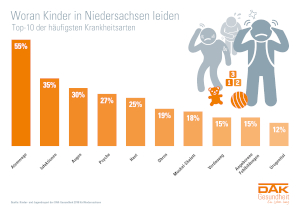
In Lower Saxony, more than one in four children is chronically physically ill. Boys are affected slightly more often than girls. The children and youth report evaluates 14 different illnesses that can potentially take a chronic course. The most common are asthma and neurodermatitis, followed by hay fever and other allergies. “These are illnesses that can have a significant impact on everyday life for children and parents,” emphasizes Dirk Vennekold. They are more common in Lower Saxony than the national average. This is mainly due to asthma (plus 27 percent) and allergies (plus 14 percent). In bronchial asthma, narrowed bronchi lead to rattling breathing. The patients suffer from attacks of coughing and shortness of breath. Asthma sprays are the fifth most common drug group among children.
Even children have back pain
Overall, respiratory diseases are the number one most common type of illness in children. More than half (54.8 percent) of all boys and girls in Lower Saxony suffer from a flu-like infection or acute bronchitis at least once a year. This is followed in frequency by infectious diseases, eye diseases, mental illnesses and skin diseases. Musculoskeletal problems such as back pain are also quite common. Almost one in six children has a corresponding diagnosis at least once a year. From the age of twelve, 26 percent of all boys and girls are affected. “This is alarming,” emphasizes Vennekold, “because early musculoskeletal problems can lead to serious back problems in adulthood.” Another condition that is linked to a lack of exercise is morbid obesity. More than three percent are affected across all age groups, and almost five percent between the ages of nine and 13. “The course is set for such behavior-related clinical pictures in secondary school students,” says Vennekold, commenting on the results.
Differently sick than the national average
Children in Lower Saxony are sick differently than the national average: They are more likely to have documented ADHD (plus 21 percent), although mental illness diagnoses are generally made for more children (plus four percent). “The children and youth report now provides reliable analyzes of the regional frequency of certain diseases compared to the national average,” explains Professor Dr. Wolfgang Greiner from Bielefeld University as head of studies. “The study commissioned by DAK-Gesundheit is the first continuous, cross-disease analysis of such regional billing data from a statutory health insurance company.”
“The difference between town and country is greater than expected”
The children and youth report for Lower Saxony also shows that city children are sick differently than their rural counterparts: city children suffer more often from dental caries (plus 31 percent), morbid obesity (plus 14 percent) and are more affected by diagnosed behavioral disorders and depression (plus eleven or plus ten percent). Rural children, on the other hand, are more likely to have acute bronchitis (plus seven percent). “Our report shows that the difference between urban and rural children when it comes to health is much larger than expected,” emphasizes Dirk Vennekold. This is also documented by the service expenditure: DAK-Gesundheit pays more money for medicines and doctor's visits for city children. “The difference is highest in the pharmaceutical sector: In 2016, we spent an average of 162 euros for each rural child and 202 euros for each city child, i.e. almost a quarter more.” This is particularly due to more prescriptions of cold medicine and painkillers among city children.
Around 61.7 million euros for children and young people
In total, DAK-Gesundheit in Lower Saxony spent around 61.7 million euros on the treatment of children in 2016. Over half of this went to clinics (35 percent) and general practitioners (28 percent). Medicines accounted for almost a fifth of all costs, and medicines and aids together accounted for 16 percent. Rehabilitation services had the lowest share at two percent. This corresponds to an average expenditure of €967 per child per year. Converted to all insured boys and girls, the health insurance fund paid the most for infants. In Lower Saxony they needed an average of around 2,102 euros per person per year.
Expand prevention in schools and daycare centers
Based on the report, DAK-Gesundheit wants to further optimize the existing care for children and young people. The health insurance company will also intensify its prevention at daycare centers and schools. The “fit4future” prevention campaign with the Cleven Foundation is to be expanded to promote more exercise, healthy eating and stress management. The program is currently running at 65 primary and special schools in Lower Saxony and will soon start in daycare centers and secondary schools.