


The need for staff in geriatric care is increasing dramatically. Initiative develops solutions and holds politicians accountable.
27.06.2023 16:25
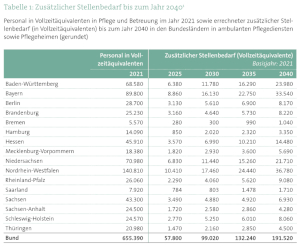
Germany is threatened with a nationwide nursing shortage this decade. This is shown by a current projection from the “Initiative for a Sustainable and Intergenerational Care Reform”. By 2030 alone, an additional 130,000 nursing staff are expected to be needed in nursing homes and outpatient care nationwide. By 2040 there would be up to 250,000 skilled workers. This corresponds to around 99,000 (2030) and 190,000 (2040) full-time positions. Simply hoping for the immigration of nursing staff is not enough. The potential that exists in Germany must be utilized.
The initiative has worked out what Germany can do about the nursing shortage with the technical support of leading experts in nursing and for the nursing profession, including Prof. Dr. Adelheid Kuhlmey from the Charité University Medicine Berlin, Dr. Grit Braeseke from the IGES Institute, Annemarie Fajardo and Prof. Dr. Alexander Karmann from the Technical University of Dresden. The results of the memorandum were presented at the federal press conference on June 26th.
The results at a glance
1. Increase the attractiveness of the job profile: International training standards must finally find their way into local nursing practice. Skilled workers must be given more powers according to their qualifications. Closely linked to this is the improvement of the career advancement opportunities of nursing staff.
2. Relief through resource efficiency: Nursing professionals should be able to concentrate fully on care. All too often their time is taken up by unskilled work and bureaucracy. In order to relieve them, more digitalization and electronic data traffic are urgently needed.
3. More flexibility in staff deployment: More flexible personnel requirements and greater degrees of freedom are urgently needed in order to strengthen optimal cooperation between therapists, social workers, care staff, housekeeping and also volunteer work. Practical personnel measurement systems are required.
4. More prevention in care: The preventive approaches with which the need for care can be avoided or delayed must finally be firmly anchored in nursing practice. It is particularly important to strengthen the skills of older people and enable them to remain in their own homes for longer.
Thomas Eisenreich, managing director of the Federal Association of Care Services, adds: “This also means that outpatient care and nursing not only provides performance-related services, but also preventative services. To do this, these must be reflected in the service catalogue.”
Dr. Timm Genett, policy director at the PKV Association, summarizes the key results of the memorandum: “We need a new strategy for geriatric care, above all an upgrade of the job profile, more resource efficiency and flexibility in the deployment of personnel - and, last but not least, the expansion of nursing care. Prevention.”
To this end, the initiative calls for a new start in nursing policy. In order to effectively curb the shortage of personnel, Germany must orient itself more towards international standards. Pure job financing programs, such as the previous federal government's “13,000 job program,” are not a solution given the acute labor shortage and the unfillability of positions.
“We have to prepare ourselves to organize geriatric care with fewer staff in the future, as around half a million nursing staff will be retiring in the next few years. We can no longer move forward with rigid personnel quotas. They are already making it more difficult to provide care close to home and mean that relatives have to step in or people in need of care remain uncared for,” explains Isabell Halletz, managing director of the Nursing Employers Association.
Thomas Knieling, Federal Managing Director of the Association of German Elderly and Disabled Care, sums up: “It is time to change course in care policy if the nationwide security of supply is not to be further jeopardized. We must use the available resources more efficiently, avoid the need for care as best as possible and give care entrepreneurs more freedom to design. Because they are part of the solution and not the problem.”
The memorandum to Download.
To the background
The initiative for sustainable and generation-appropriate care reform was founded in 2020. She is committed to a fundamental structural reform in order to be able to finance social nursing care insurance (SPV) in a demographic-proof manner without younger people having to bear the increasing costs alone. The Care Employers' Association (AGVP), the Federal Association of Care Services (BBD), the Federal Association of German Employers' Associations (BDA), the Health Think Tank, the Associations of Family Businesses and Young Entrepreneurs as well as the Association of German Elderly and Disabled People's Assistance ( VDAB), the CDU Economic Council and the PKV Association.