


Wound managers and nursing specialists fear that local wound therapy will deteriorate and more hospital stays will occur
20.06.2023 15:41
Wound managers and nursing professionals fear that the new regulations in the area of dressings will lead to a deterioration in local wound therapy, a longer healing time and more complex healing processes in people with chronic wounds, as well as an increase in inpatient care and systemic antibiotic prescriptions.
A BVMed survey in which over 250 wound specialists took part shows that in over 90 percent of treatment cases the initial aim is to reduce clinical signs of infection - complete wound closure is only a criterion in around 20 percent of cases. “According to the new regulations, many wound dressings with antibacterial effects are in danger of being excluded from reimbursement by statutory health insurance (GKV) from December 2023 - with dire consequences for wound care. We cannot allow this to happen by adapting the evidence criteria of the required studies to everyday care,” says BVMed wound expert Juliane Pohl, commenting on the results of the survey.
The background is that in the future an evaluation process will have to be carried out for so-called “other products for wound treatment” before they are reimbursed by the GKV. However, the Federal Joint Committee (G-BA) has not yet defined any evidence criteria adapted to wound care for the proof of benefit relevant to reimbursement. The law also lacks a binding right for manufacturers to receive advice from the G-BA. The new regulation affects a large number of products, such as wound dressings containing silver or PHMB, which were previously eligible for reimbursement. According to BVMed's assessment, around 400 products are affected, for which an assessment procedure is required for inclusion in Appendix V of the amended Medicines Directive.
In order to better understand the care goals, BVMed launched an online survey at the Bremen Wound Congress 2023, in which a total of 256 wound managers, nursing staff, doctors and medical assistants took part. Around half treat patients with acute or chronic, infected or infection-prone wounds in an outpatient facility, a quarter in an inpatient setting and a quarter in other areas. Almost 80 percent of those surveyed have more than five years of experience in the therapy and care of wound patients.
For local wound therapy of infected wounds, 80 percent of those surveyed work with recommendations from wound specialist societies such as DGfW or ICW. 51 percent work according to the DNQP expert standard, 29 percent according to international expert or consensus recommendations, 26 percent according to recommendations from the AWMF guidelines and 25 percent according to recommendations from a wound center or wound network.
In 84 percent of cases, products with antimicrobial silver-containing coatings are used. 69 percent of those surveyed use wound dressings with bacteria-binding properties, 52 percent use products with polihexanide (PHMB). Only 13 percent use wound care products without antimicrobial components for these special treatments.
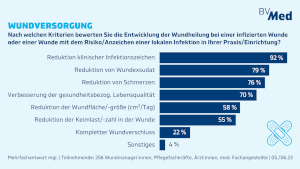
A crucial question in the current health policy discussion about the reimbursement of “other wound treatment products” revolves around the evidence criteria for these products. What criteria do wound experts use to assess the development of wound healing in an infected wound or a wound with the risk or signs of local infection? 92 percent have the primary goal of reducing clinical signs of infection. 79 percent mention the reduction of wound exudate, 76 percent the reduction of pain, and 70 percent the improvement of the health-related quality of life of those affected. Reducing the wound area is the focus of 58 percent, and reducing the germ load in the wound is 55 percent of the focus. Only 22 percent of those surveyed also mentioned complete wound closure as an evidence criterion.
If wound dressings with antimicrobial components and coatings were no longer reimbursed in the GKV system in the future, wound specialists expect dramatic consequences: 85 percent expect a deterioration in local wound therapy, 82 percent a deterioration in the quality of life for the affected patients. 80 percent expect a longer healing time and an increase in systemic antibiotic prescriptions. 78 percent expect an increase in inpatient care, 71 percent an increase in therapy costs and 64 percent expect shorter dressing change intervals or more intensive wound care and observation.
BVMed expert Juliane Pohl: “The transition period for the evidence of other wound treatment products will expire at the beginning of December 2023 if the legislature has not acted by then. From the perspective of wound experts, the criteria for evaluation are still not sufficiently clear. In addition, there is a lack of evidence criteria tailored to wound care. BVMed advocates for companies to have the right to consult on benefit assessment procedures for wound care products and a resulting postponement of the transition period for other wound treatment products. We need legal enshrinement here quickly so that there are no bottlenecks in the care of patients with chronic wounds.”